
The Log of the Mystic Seaport in December, 1948
TOM PAINE IN MYSTIC
Sources: Charles H. Mallory diary and Haley family history, as told by Lucy Haley Chesebro.
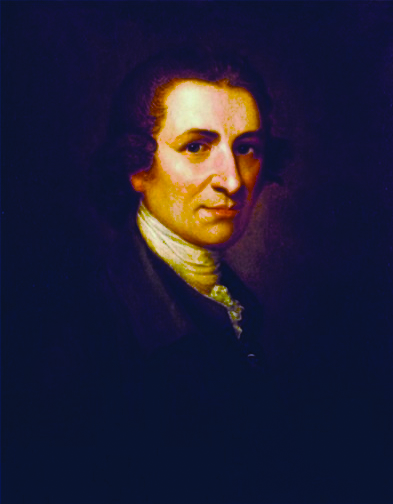
Tom Paine, the man who brought liberty to the new world, who wrote The Age of Reason, The Rights of Man, and Common Sense, once lived in our town.
A little over eighty two years ago, on the 7th of June, there was a funeral in Mystic; Captain Ambrose H. Burrows was buried at the age of eighty-two. In many ways it was an odd sort of funeral. Since the death of his wife three or four years before, the Captain had lived as a recluse in a sequestered place in the woods, a mile from the main road. He had requested that he be buried in his own burial ground beside his wife and his son Ambrose, and that no religious ceremony be performed at his funeral. These requests were strictly complied with. The reason, everyone knew, was that Captain Burrows had been an admirer of Tom Paine and well acquainted with him when he lived in Mystic, and adhered to his religious beliefs, or, as many thought, the lack of them.
While the Captain had died a recluse, in earlier life he had not scorned company, but had endeared himself to all by his charming social qualities. He had entertained his friends with accounts of his service as a privateer and loved to tell how he and his son, Ambrose Jr., had rescued his own ship from pirates in the Pacific, how he had once actually captured and brought to Mystic an English “pirate”. And, of course, he did not have to be urged to talk of his friend and idol, Tom Paine.
To the Haleys of Mystic, the story is family history; for it was Nathan Haley who brought him over in 1802. The Haleys lived on Pistol Point and it was there that Capt. Nathan took him, to the home of his father, Jeremiah. But the house that Tom Paine occupied was a “little” house, it was said, nearby Jeremiah Haley’s. We can only speculate whose house it was but it seems likely it may have been an earlier home of Jeremiah’s, before he built a larger and more pretentious place.
Captain Nathan Haley had been rewarded for his privateering services with the Consulate at Nantes. He married there a French girl and is now buried there beside his wife. While he had no children of his own, his nieces and nephews in America went over to him for long visits and he, himself, came back several times to see his father and mother.
It must have been in 1802 that he brought Paine back to America after an absence of fifteen years, for history tells that Paine arrived in Baltimore October 30th of that year. Carl C. Cutler has dug up the further fact that he came over on the “Neptune”. We have no record that Nathan Haley ever commanded a vessel of that name, but it might have been under the command of some friend of his or at least a passage which had been arranged by Haley. President Jefferson had invited Paine to come over on the U.S. Brig “Maryland” but the public at once set up a howl of protest at the use of the American Navy in this way, and when Paine heard of it he unpacked his bag and refused to come. At any rate, Paine went directly to Washington where he proceeded to get himself in bad grace with almost everybody by writing ungraciously of his benefactor, General Washington; by expressing his unpopular religious views; and by involving himself in political issues, usually on the wrong side. It is easy to imagine the disillusioned hero turning to one place he knew he still had friends–and so he came to Mystic.
The man who had established liberty in the new world, who had been revered by Napoleon, Washington, Franklin and Jefferson, died in 1809 in a cheap lodging house in New York, unhonored, at odds with American respectability. He was buried on the farm which a once grateful government had given him at New Rochelle.
A President of the United States called him a “filthy little atheist” and they said that he was untidy, that he drank heavily and talked religion when he was intoxicated, but no man could question his sincerity or his devotion to his ideals. No man did more to make not only one, but two peoples free and great. Once, when the great Franklin said to him, “Where Liberty is, there is my country”, the fiery Paine replied, “Where Liberty is not, there is mine.”
He it was who first uttered the heart-quickening words “United States of America” and he it was who was finally refused the right to vote in that same United States of America.