
The New York herald (New York [N.Y.]), February 3, 1853, (MORNING EDITION)
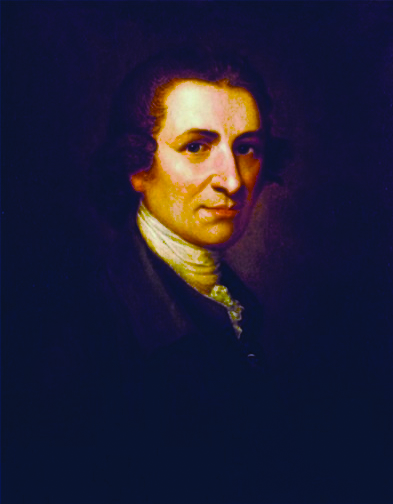
The Celebration of the 116th Anniversary of the Birthday of Thomas Paine.
On Monday evening, the 116th anniversary of the birthday of Thomas Paine was celebrated at the City Assembly Rooms, No. 450 Broadway. At eight o’clock the company, amounting to about 700 persons, assembled in the ball room, and were engaged in dancing until eleven o’clock P. M., after which they proceeded to the supper room, where a sumptuous repast was provided, at which Mrs. Ernestine L. Rose presided. Whitmore’s band was in attendance during the ball and supper, and acquitted themselves most admirably. After the company had done ample justice to the viands, the fair President rose and said :
My Friends—Having had the honor conferred on me to preside on this interesting occasion, and being conscious of the responsibility of my position, I will not repay the confidence you kindly repose in me by the infliction of a long speech. I am happy once more to have met with you to pay a tribute of gratitude to the author hero of the Revolution—Thomas Paine. But in celebrating this anniversary, there is yet a higher object than the respect we wish to manifest to that great patriot and friend of man; it is to encourage each other to go and do likewise—to emulate his noble self-sacrificing spirit in diffusing knowledge, in spreading human freedom, in advocating what to us appears truth, however unpopular. These are the only means worthy of his memory. Opinions and principles are for use in every day life, and not to be kept for show, or to be worn only as a holiday garment. Political doctrines, however good, are utterly worthless, if honored only in profession and ignored in practice. Nor is it when life flows on in an even tenor of tranquillity, but when fiercely struggling with adverse elements, that we perceive the nature and nobleness of virtue. The beauty and majesty of great and exalted convictions are not evinced when assent to them is easy, and the profession in them elicits public approbation, but when deep prejudices, our apparent interest, and even our own feelings, all go violently against it, that the value of a principle, a high-minded conviction, is felt in guiding us, as by a compass or leading star, to truth and to duty. Such was the case with Thomas Paine at “the times that tried men’s souls.” When the tempest of despotism raged the fiercest, and the turbulent waves of political faction ran the highest, he stood like a beacon light amid the dark waters of despair, holding aloft his “Common Sense” to illumine the surrounding darkness, and infusing light and hope into the fear-stricken hearts of the beholders. He saved the tempest-tossed mariners from the royal shipwreck, and aiding them into the bark of universal freedom, with the “Rights of Man” for their chart, and the “Age of Reason” for their compass, they steered safely into the harbor of republicanism. He truly said, “What is right is pure nature; my pen and my soul have ever gone together.” Bribes and threats were alike powerless over him. Exile, the dungeon, and the anathemas of the church, could not make him swerve for one moment from the path of right. He was as true to his convictions as the needle to the pole. He well knew that in mental freedom all others are embraced, for, without it, place man in the most flattering position, and he is but a slave at best. To be free, we must have the right, as well as the inclination, at all times and under all circumstances, to be true to our convictions, for “he only is free whom the truth makes free, and all are slaves besides;” for of all nature’s own noblemen, the honest man is first in rank. And yet it was for that very native title of nobility, his ardent love for truth, united as it was with Herculean strength of mind, that he was persecuted while living, and slandered after his death; for it has ever been the province of error to hate truth as its deadliest foe, and the priests of all denominations but too well know that as darkness is dispelled by the rays of light, so does knowledge and truth dispel ignorance and superstition, the very basis of their calling. Hence the odium and stigma cast upon his name to frighten children of a larger growth. But what matters? As truth is immortal, so will be the name of Thomas Paine; and long after these petty falsehoods will be forgotten, and their reverend authors sunk into oblivion, will grateful hearts revere his memory for his devotion to truth and the cause of liberty. My friends, I have never been so conscious of a marked progress towards the rights of man as tonight, for not until to-night has woman ever been sufficiently recognized as the equal with man, to be honored with the presiding office on a festive occasion; and to friends of human progress it must be a subject of congratulation to have advanced so far as for you to offer it and for me to accept it. And mark the progress. It is but a few years since woman has been admitted to any part of a celebration, except the dance. And I am happy to say that this society, the friends of Thomas Paine, first changed the barbarous custom of exclusiveness to a more rational and consistent practice of combining the physical, intellectual, and social branches of an entertainment for the equal enjoyment of both sexes. And being convinced that we can enjoy happiness only in proportion as we promote happiness in others, I know you must have vastly increased your own enjoyment by having those you love partake in them with you. Nor has your good example been without its effect, for, among many others who followed it, even the sons of the Puritans in this city, who celebrate the landing of the Pilgrim Fathers, have actually found out that they had Pilgrim mothers too, and, in grateful remembrance of them, they ought to admit their daughters to participate in commemorating the event. And it must indeed be gratifying to every liberal and enlightened mind to see that, while others thus wisely followed in your footsteps, you have taken an onward step in the extension of human rights, which my position here to-night proclaims. And thus it should be, for the liberals are the salt of the earth, that keeps the world from entire corruption—the little leaven that enables society to rise higher and higher in the scale of human progression. And no one can truly honor the author of the “Rights of Man” without extending the same rights for woman, for he advocated no rights exclusively for one sex or one nation, but the rights of humanity without distinction of sex, country, or color. And, in his endeavor to free mankind from the trammels of superstition, he labored even more for the benefit of woman than of man, for, as her education and experience, owing to an infringement of her rights, has been more limited than his, superstition has ever had a stronger hold and a more baneful and pernicious effect on the mind of woman than of man. In conclusion, permit me to say, gratifying as it must be to us all, to pay a tribute of respect and gratitude to departed virtue and patriotism, let us remember the millions of our fellow beings who still groan under the heavy burden of oppression—the noble martyrs daily sacrificed on the altar of monarchical despotism and spiritual corruption; that a Kossuth, Mazzini, Louis Blanc and many other noble champions of liberty, are still in exile. The clouds that hang on the horizon of European freedom, are darker than ever; but let us hope that the very intensity of the darkness is an omen of the approaching dawn of the day of freedom. Go on then, my friends, claiming and extending human rights, until liberty shall cover the earth.
“Free in soul, with quenchless zeal must ever glow
To spread the freedom which their own minds know.”
(Loud applause.) The first toast was then read as follows:
Thomas Paine, whose memory we meet to cherish—His intellect and moral courage have stamped their impress upon mankind, leaving a rich legacy for all time, in advocating the cause of liberty, truth, and mental freedom.
Mr. H. S. Smith, in response to this toast, amid much applause, delivered the following eulogy upon Thomas Paine:
Say, was not that, my friends, a glorious day,
When first fair Freedom’s form beamed o’er our way?
What source of joy to freemen more profound
Than that they stand on freedom’s holy ground!
Then let each candid soul join in a strain
Of grateful incense to the illustrious Paine,
The patriot, in his country’s darkest hour,
When every engine of a tyrant’s power
Was raised against it to be hurled
To crush that darling object from the world.
When summer friends proved false, when hope grew cold,
Bought were the venial, faint became the bold,
When Liberty, a child, from Heaven just born,
Seemed doomed to die e’en on its natal morn.
When want and hunger thinned a little band,
Unled, unclad, midst cheerless winter’s snows,
Despairing, struggled ‘gainst as heartless foes,
‘Gainst both the tyrants and the elemental strife,
Was oded ill, one by one, each freeman’s life,
And despotism deemed its reign secure
O’er all mankind, while time should yet endure—
But, no! eternal justice has forbade the lie;
Truth must prevail, and freedom cannot die.
The patriot of the “crisis” rose, and then
The world grew free neath his inspired pen.
What bark is that which breasts the foam
Reluctant, yet so gallantly?
Its sails are spread away from home;
It bears its living freight, and, see,
Fair woman on its deck—Why roam
Such voyagers the untamed sea?
These stern men, and those women fair,
Leave not their homes; for home is not
Where rude oppression taints the air,
With its foul presence. No, that spot
Must bloom with faith and constancy,
Hope’s bright flowers the genial soil
Where soul and body both are free,
And for themselves may think and toil.
Where kings and classes cannot be,
To make a man a constant spoil.
The stigma infidelity
Attached to free thought cannot soil
The present, blast the future fame
Within home’s sacred precincts. No!
Perish the creed that makes man’s name,
His character, his weal or woe,
Depend on its imperious soil,
That makes its votaries mental slaves,
Assumes the attributes of God,
And hunts its victims to their graves.
‘Twas not from home the Mayflower bore
Those champions of humanity,
But to their home on this shore there
Where they might work their destiny;
And, midst the trials which before
Them vanished, all the world may see
A cheerful hope for liberty—
They came to where, in nature’s freedom wild,
Free as her scenes, roamed nature’s savage child;
They spread and flourished, covered all the land,
And wealth rewarded labor’s willing hand.
The wage disappeared. Would there could be
No caste, no class, no savage; but all good,
One universal glorious brotherhood.
Time will produce it. Though the eternal wheels
Long courses yet must roll ere mankind feels
The happy, genial, heartfelt sympathy,
Where every interest blends in perfect harmony,
Where power is not, and where sincerest love
To social justice all the world shall move.
We’ll hope that blessed time! Assembled here
We honor him the prophet of that year,
Its prophet when, by lust of power defiled,
The despot mother warred against her child.
Fair Freedom’s prophet, when her destiny
Seemed darkest, dreariest! When none but he
Could save. His clear, unvarnished “Common Sense”
Spoke with the fervid power of eloquence.
His pen and press, throughout our suffering land
Raised up new hopes, inspired our sinking band,
Almost resolved to yield. In that dread pause
They almost doubt the justice of their cause.
‘Twas indeed a time to try the soul,
When Paine arose and pointed Freedom’s goal,
Solved the great problem of the “Rights of Man,”
And conquered tyranny—back to Europe ran.
Second toast:—
Frances Wright—Her noble devotion in the cause of human liberty, in throwing aside her prejudices of birth, education, and sex, proclaims her a noble and disinterested patriot, while her powerful mind and splendid eloquence demonstrate that genius and worth are not limited to sex, but are universal.
Mr. Webb responded by reading a very able eulogy on Frances Wright. The remaining toasts were then read. Third toast:—
National Public Schools—
To raise the youth from degradation,
Light the lamp of information,
Spread the blaze of education
Around this great misled nation.
Knowledge is mankind’s salvation
Against all priestly domination.
Mr. Walker responded. Fourth toast:—
The Sages and Heroes of the American Revolution—Their names and deeds are emblazoned on history’s page—humanity owes them a debt of gratitude which can never be repaid—may their sons and daughters be animated by the same love of liberty and hatred of oppression.
Mr. Brown responded. Fifth toast:
Kossuth, Mazzini, and the other patriots of Europe—May their day of deliverance be at hand, when, sweeping despots from power, they shall establish in their place the holy democratic trinity of liberty, equality, and fraternity.
Air—”The Marseillaise Hymn.”
Sixth toast:—
The Memory of Departed Liberals—Though proscribed and persecuted, they have fought the good fight, laying the foundation broad and deep of man’s regeneration from ignorance, error, and superstition.
Air—”Hail Columbia.”
Seventh toast:—
The good time coming, when crowns and mitres—emblems of political and moral delusion, will be swept to the tomb of oblivion. Happy will the nation be when kingcraft and priestcraft, like Salem witchcraft, shall be found only in history.
Air—”The Star Spangled Banner.”
Eighth toast:—
The Press—Free and untrammelled.
Let truth and error grapple.
Truth crushed to earth will rise again,
The eternal years of God are hers;
But error wounded writhes in pain,
And dies amid her worshippers.
Ninth toast:—
Woman, the great purifier and elevator of humanity—may she take her proper place in society, not as the dependent, but as the equal of man.
Dr. Hall, in responding to the last toast, said that he could not pay a higher tribute to woman than by quoting the following from Montgomery:—
There woman reigns the mother, daughter, wife,
Strew with fresh flowers the narrow way of life;
Around her knees domestic duties meet,
And fireside pleasures gambol at her feet.
The fair President stated that a subscription would be entered into for the purpose of purchasing a marble slab, with an appropriate inscription, in commemoration of Thomas Paine, to be placed in the Washington Monument. This block of marble, said she, will be a counterbalance to that of Rome. The company then separated in high good humor, evidently much gratified with the festivities of the evening.