
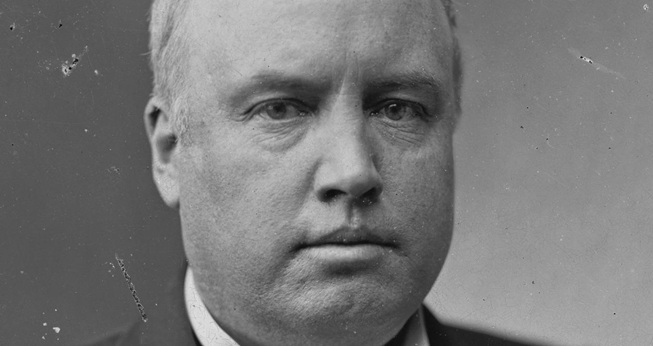

Chicago daily tribune (Chicago, Ill.), January 30, 1880
The article is a report of a lecture by Robert G. Ingersoll in Chicago commemorating Paine’s birthday.
THOMAS PAINE
Celebration of the One Hundred and Thirty-seventh Anniversary
Of the Birthday of the Author of the “Age of Reason” and “Rights of Man.”
Col. Ingersoll’s Vindication of One of the Stanchest of Revolutionary Patriots.
His Early Life and Labors in Behalf of Liberty and Freedom.
The Man Who Hated Monarchs, but Voted to Save the Life of Louis XVI.
Ingersoll Denies that Paine Died the Miserable Death So Often Quoted.
An Eloquent Tribute to the Bravery of the Man of Genius—The Audience, Enthusiasm, Etc.
Had admission to the new Music Hall last evening, or the privilege that went with it of listening to the ever-enjoyable combination of wit and oratory which has made Bob Ingersoll famous, been restricted to those who actually believe there is or ever was any particular reason why Tom Paine should have a monument either in Chicago or anywhere else, it is exceedingly probable that the gifted would have talked “to beggarly account of empty boxes,” and had for his hearers “some quantity of barren spectators.”
With the ability to be interesting on any subject, however, from the nomination of a candidate for President to a lecture on “Moses,” “Skulls,” or anything else, it was no wonder that the brilliant talker met with another of those ovations which always greet his return to the principal city of his State.
The hall began to fill early, and kept on filling at so rapid a rate as to bring out early the placard, “Standing Room Only,” in conspicuous place in the lobby. As each one entered the house he or she was pressed to take a copy of a circular calling attention to a future meeting of the Executive Committee of the Paine Monument Association, and containing a blank form for the benefit of such as might be desirous to aid, in the capacity of subscribers, Robert G. Ingersoll and the P.M.A. in erecting a monument to the man whose portrait, with the motto, “The World Is My Country; To Do Good My Religion,” was placed against the wall at the back of the stage.
The attendance was all that the hall could conveniently hold, and was made up for the larger part of the male sex, though there was a generous sprinkling of ladies. On the platform sat Ernst Prussing, G. A. Shufeldt, George F. Weston, and Perry H. Smith, constituting the prominent and the known, and about twenty others constituting the entirely unknown.
It was a little after 8 o’clock when the audience, already a little impatient, broke into applause as it beheld entering from a side door the lecturer of the evening, fat and jolly-looking as usual, preceded by Gen. I. N. Stiles. After the initial ovation had died down, Gen. Stiles stepped to the front and introduced Col. Ingersoll in the following fitting words:
“This is the 143d anniversary of the birth of Thomas Paine—a patriot, philosopher, the author of ‘Common Sense,’ the defender of the ‘Rights of Man,’ the friend of his kind, philanthropist—a man.”
(Applause.)
“The mists and clouds in which religious bigotry has enshrouded his memory have been dispelled by one who lives with us to-day, who is not unknown to you, who will tell you more of him to-night. He needs no eulogium. I need not address him by any title. I need only mention his name—Robert G. Ingersoll.”
(Loud applause.)
There was another long and welcoming rain of applause as the lecturer made his bow, placed his abundant manuscript on the reading desk, and proceeded to address his audience as follows:
“Ladies and Gentlemen: It so happened to me that in the first speech, the very first public speech I ever made, I took occasion to defend the memory of Thomas Paine. I did it because I had read a little something of the history of my country. I did it because I felt indebted to him for the liberty then enjoyed, and, whatever religion may be termed, ingratitude is the blackest of crimes.”
(Applause.)
“And, whether there is any God or not, in every star that shines gratitude is a virtue. The man who will tell the truth about the dead is a good man, and, for one, about this man I intend to tell just as near the truth as I can.”
The article continues for several more columns. I can also transcribe the next section beginning “Most history consists in giving the details of things that never happened…” if you want the remainder.
Continuing from Ingersoll’s speech:
“Most history consists in giving the details of things that never happened.”
(Laughter.)
“Most biography is either a lie coming from the mouth of flattery or the slander coming from the lips of malice. And whoever attacks the religion of a country will in his turn be attacked. Whoever attacks superstition will find that superstition defended by all the meanness of ingenuity.”
(Applause.)
“Whoever attacks superstition will find that there is still one weapon left in the arsenal of Jehovah—slander.”
(Laughter and applause.)
“I was reading only yesterday a poem called The Light of Asia, and I read in that about the Buddha seeing a tigress perishing of thirst, with her mouth upon the dry stones of a stream, with her two cubs sucking at her dry and empty dugs; and this Buddha took pity upon this wild animal and, furnishing it, and throwing from himself the yellow robe of his order, he stepped naked before this tigress, saying, ‘Here is meat for you and for your cubs.’ In one moment the crooked daggers of her claws ran riot in his flesh, and in another he was devoured.
“Such during nearly all the history of this world has been the history of every man who has stood in front of superstition.”
(Applause.)
“Thomas Paine was, as has been so eloquently said by the gentleman who introduced me, the enemy of hypocrisy at the altar, venality on the bench, tyranny on the throne; and with splendid courage he espoused the cause of the weak against the strong—of the enslaved many against the titled and brutal few.
“In England he was nothing. He belonged to the lower classes—that is to say, useful people.”
(Laughter.)
“The people hugged their chains, and the whole power of the Government was ready to crush any man who endeavored to strike a blow for the right.
“At the age of thirty-seven Thomas Paine left England for America, with the high hope of being instrumental in the establishment of free government. In his own country he could accomplish nothing. Those two vultures—Church and State—were ready to tear with cruel claws in pieces and devour the heart of any one who might deny their divine right to enslave the world.”
(Applause.)
“Upon his arrival in this country he found himself possessed of a letter of introduction signed by another infidel, Benjamin Franklin. Some have said that Franklin was not an infidel. I don’t know whether he was or not. But you can bet one thing—all was not orthodox.”
(Applause and laughter.)
“This and his native genius constituted his entire capital; and he needed no more. He found the colonies clamoring for justice; whining about their grievances; upon their knees at the foot of the throne, imploring that mixture of idiocy and insanity, George III., by the grace of God, for restoration of their ancient privileges.
“They were not endeavoring to become free men, but were trying to soften the heart of their master. They were perfectly willing to make brick if Pharaoh would furnish the straw.
“The colonists wished for, hoped for, and prayed for reconciliation. They did not dream of independence.
“Paine gave the world his Common Sense. It was the first argument for separation, the first assault upon the British form of government, the first blow for a republic, and it aroused our fathers like a trumpet blast.”
(Applause.)
“No other pamphlet ever accomplished such wonderful results. It was filled with argument, reason, persuasion, and unanswerable logic. Everywhere the people responded, and in a few months the Continental Congress declared the colonies free and independent States. A new nation was born.”
“It is simple justice to say that Paine did more to cause the Declaration of Independence than any other man. Neither should it be forgotten that his attacks upon Great Britain were also attacks upon monarchy, and while he convinced the people that the colonies ought to separate from the mother-country, he also proved to them that free government is the best that can be instituted among men.
“Paine was not content with having aroused the spirit of independence, but he gave every energy of his soul to keep that spirit alive. He was with the army. He shared its defeats, its dangers, and its glory.
“When the situation became desperate, when gloom settled upon all, he gave them The Crisis. It was a cloud by day and a pillar of fire by night, leading the way to freedom, honor, and glory.
“He shouted to them:
‘These are the times that try men’s souls. The summer soldier and the sunshine patriot will, in this crisis, shrink from the service of his country; but he that stands it now deserves the love and thanks of man and woman.’
“Some said it was not to the interest of the colonies to be free. Paine answered this by saying:
‘To know whether it be the interest of the Continent to be independent, we need ask only this simple, easy question: Is it the interest of a man to be a boy all his life?’
“He found many who would listen to nothing, and to them he said:
‘That to argue with a man who has renounced his reason is like giving medicine to the dead.’
“This sentiment ought to adorn the walls of every orthodox church in this world.”
(Laughter.)
“Day and night he labored for America; month after month, year after year, he gave himself to the great cause, until there was a government of the people and for the people, and until the banner of the stars floated over a continent redeemed and consecrated to the happiness of mankind.
“At the close of the Revolution no one stood higher in America than Thomas Paine. The best, the wisest, the most patriotic, were his friends and admirers; and had he been thinking only of his own good he might have rested from his toils and spent the remainder of his life in comfort and in ease.
“He could have been what the world is pleased to call ‘respectable.’ He could have died surrounded by clergymen, warriors, and statesmen. At his death there would have been an imposing funeral, miles of carriages, civic societies, salvos of artillery, a nation in mourning, and, above his dust, a splendid monument covered with lies.”
(Applause.)
“He chose rather to benefit mankind.
“At that time the seeds sown by the great infidels were beginning to bear fruit in France. The people were beginning to think. On every hand science was bearing testimony against the Church. Voltaire had filled Europe with light; D’Holbach was giving to the elite of Paris the principles contained in his System of Nature.
“A few had the courage to keep their shoes on and let the bush burn.”
(Laughter.)
“Miracles began to get scarce.”
(Laughter.)
“Everywhere the people began to inquire. America had set an example to the world. The word Liberty was in the mouths of men, and they began to wipe the dust from their superstitious knees.
“Thomas Paine went to France. Into the new movement he threw all his energies. His fame had gone before him, and he was welcomed as a friend of the human race and as a champion of free government.”
Continuing Ingersoll’s address:
“His fame had gone before him, and he was welcomed as a friend of the human race, and as a champion of free government. He had never relinquished his intention of pointing out to his countrymen the defects, absurdities, and abuses of the English Government.
“For this purpose he composed and published his greatest political work, The Rights of Man.
“This work should be read by every man and woman, and especially by every minister.”
(Laughter.)
“And let me say right here, there are not ten ministers in the United States who ever read the works of Thomas Paine.”
(Applause.)
“If they had read them, they couldn’t answer him.”
(Laughter.)
“Since they never read what he said, they can answer him.”
(Laughter.)
“That’s why they answer me.”
(Renewed laughter.)
“It is concise, accurate, natural, convincing, and unanswerable. It shows great thought and intimate knowledge of the various forms of government; deep insight into the varied springs of human action, and courage that compels respect and admiration.
“The difficult political problems are solved in a few sentences. The venerable arguments in favor of wrong are refuted with a question, answered with a word. For forcible illustration, apt comparison, accuracy and clearness of statement, and absolute thoroughness it has never been excelled.
“In 1792, Paine was elected by the Department of Calais as their representative in the National Assembly. So great was his popularity in France that he was selected about the same time by the people of no less than four Departments.
“Upon taking his place in the Assembly he was appointed as one of a committee to draft a Constitution for France.
“Had the French people taken the advice of Thomas Paine there would have been no Reign of Terror. The streets of Paris would not have been filled with blood.
“And let me say right here that in all that Reign of Terror there were killed in the City of Paris less, I think, than 17,000 people; and on one night in the massacre of St. Bartholomew there fell in France by assassination over 60,000 souls—men, women, and children.”
“Paine was filled with real love for mankind. His philanthropy was boundless. He wished to destroy monarchy—not the monarch.
“He voted for the destruction of tyranny, and against the death of the tyrant. He wished to establish government on a new basis; one that would forget the past; one that would give privileges to none, and protection to all.
“In the Assembly, where nearly all were demanding the execution of the King—where to differ from the majority was to be suspected, and where to be suspected was almost certain death—Thomas Paine had the courage, the goodness, and the justice to vote against death.
“To vote against the execution of the King was to vote against his own life, and there isn’t a theologian who has ever maligned Thomas Paine that had the courage to do that thing.
“This was the sublimity of devotion to principle.
“For this he was arrested, imprisoned, and doomed to death.
“Search the records of the world and you will find but few sublimer acts than that of Thomas Paine voting against the King’s death. He, the hater of despotism, the abhorrer of monarchy, the champion of the rights of man, the Republican, accepting death to save the life of a dethroned King.
“This was Paine the man; and whoever is a friend of man is also a friend of God—if there is one.”
(Laughter.)
“But God has had many friends who were the enemies of their fellow-men.”
(Applause.)
“There is but one test by which to measure any man who has lived. Did he leave this world better than he found it? Did he leave in this world more liberty? Did he leave in this world more goodness, more humanity, than when he was born? That is the test.
“And whatever may have been the faults of Thomas Paine, no American who appreciates liberty, no American who believes in true Democracy and in pure Republicanism, should ever breathe one word against his name.”
Continuing:
“He was a common man; he did not belong to the aristocracy. Upon the head of his father God had never injured the divine petroleum of authority.”
(Laughter and cheers.)
“He had not the misfortune to belong to the upper classes.”
(Laughter.)
“He had the fortune to be born among the poor, and to feel against his great heart the throb of the toiling and suffering masses.”
(Applause.)
“Neither was it his misfortune to have been educated at Oxford.”
(Laughter.)
“What little sense he had was not squeezed out at Westminster.”
(Applause.)
“He got his education from books; he got his education from contact with his fellow-men; and he thought; and a man is worth just what Nature impresses upon him.
“A man standing by the sea, or in a forest, or looking at a flower, or hearing a poem, or looking into the eyes of the woman he loves, receives all that he is capable of receiving.
“If he is a great man, the impression is great, and he uses it for the purpose of benefiting his fellow-man.”
(Loud cheers.)
“But the last grand act of his political life—the sublime conclusion of his political career.
“All his life he had been the disinterested friend of man. He had labored—not for money, not for fame, but for the general good. He aspired to no office, had asked no recognition of his services, but had ever been content to labor as a common soldier in the army of progress.
“Confined in his efforts to no country, looking upon the world as his field of action, filled with genuine love for the right, he found himself imprisoned by the very people he had striven to save.
“Let me tell you how he escaped.
“His cell had two doors, one at each end. It was a dark passage, and when they concluded to get a man cut up the next day, a gentleman went along and made a long mark on the door where the poor prisoner was found.
“Barlow, the American Minister, happened to be with Paine one day, talking with him, and the outer door was open against the wall and the inner door was shut; and when the man came along he marked this door that Thomas Paine had pushed against the wall, so that when it was shut the mark was inside, and the messenger of death passed by on the next day.
“If that had been done in favor of some Methodist preacher, they would not simply have seen the hand of God, but both of them.”
(Great laughter.)
“Thomas Paine had not finished his career. He had spent his life thus far in destroying the power of kings, and now he turned his attention to the priests.
“He knew that every abuse had been embalmed in Scripture—that every outrage was in partnership with some holy text.
“He knew that the throne skulked behind the altar, and both behind pretended revelation from God.
“By this time he had found that it was of little use to free the body and leave the mind in chains.
“He had explored the foundations of despotism and had found them entirely rotten.
“He had dug under the throne, and it occurred to him that he would take a look behind the altar.
“The result of his investigations was given to the world in the Age of Reason.”
Continuing:
“You will find in the publications of the American Tract Society—and I suppose that association has published more well-attested lies than any other association on the earth—”
(Laughter.)
“—that Thomas Paine submitted to Benjamin Franklin the manuscript of the Age of Reason, and that Franklin told him not to unchain the tiger; if people were so bad with religion, what would they be without it?
“I hate to spoil so good a story, but the fact is that Franklin had been dead three years before Paine wrote a word of the Age of Reason.”
(Laughter.)
“From the moment of its publication he became infamous. He was calumniated beyond measure. To slander him was to secure the thanks of the Church.
“All his services were instantly forgotten, disparaged, or denied. He was shunned as though he had been a pestilence. Most of his old friends forsook him. He was regarded as a moral plague, and at the bare mention of his name the bloody hands of the Church were raised in horror.
“Not content with following him to his grave, they pursued him after death with redoubled fury, and recounted with infinite gusto and satisfaction the supposed horrors of his death-bed; gloried in the fact that he was forlorn and friendless, and gloated like fiends over what they supposed to be the remorse of his lonely death.
“Nothing has been considered so pleasing to the Deity as total denial of the authority of your own mind. Self-reliance has been thought a deadly sin; and the idea of living and dying without the aid and consolation of some ancient falsehood has always horrified the Church.
“By some unaccountable infatuation, belief has been, and still is, considered of immense importance.
“All religions have been based upon the idea that God will forever reward the true believer, and eternally damn the man who doubts or denies.
“Credulity goes to Heaven; investigation goes to Hell.
“The more you believe, the more happiness; the more you doubt, the more fire.
“Nobody will be in Heaven if he had doubts. Doubts don’t go there, and doubts are the smartest things about you.
“And if you want to be really good, be really stupid.”
(Laughter.)
“If you want to have a sure thing on Heaven, say ‘yes,’ and keep saying it, and let your head, in front of every priest, go like one of those Chinese tea-signs.”
(Laughter and applause.)
“You will then be a musician.”
(Laughter.)
“When Paine was born the world was religious, the pulpit was the real throne, and the churches were making every effort to crush out of the brain the idea that it had the right to think.
“The splendid saying of Lord Bacon that ‘The inquiry of truth, which is the love-making or wooing of it; the knowledge of truth, which is the presence of it; and the belief of truth, which is the enjoying of it, is the sovereign good of human nature,’ has been, and ever will be, rejected by religionists.
“Intellectual liberty as a matter of necessity forever destroys the idea that belief is either praise- or blame-worthy, and is wholly inconsistent with every creed in Christendom.”
“Paine recognized this truth.”
“He also saw that, so long as the Bible was considered inspired, this infamous doctrine of the virtue of belief would be believed and preached.
“He examined the Scriptures for himself, and found them filled with cruelty, absurdity, and immorality.
“He again made up his mind to sacrifice himself for the good of his fellow-man.
“He commenced with the assertion that any system of religion that has anything in it that shocks the mind of a child cannot be a true system.
“What a beautiful, what a tender sentiment! No wonder the Church began to hate him.
“He believed in one God, and no more. Isn’t that enough?”
(Laughter.)
“What does an infinite God need of help for? If He is infinitely strong, infinitely wise, and everywhere, why does He need a partner?”
(Laughter.)
“One God is enough, though I hope there is more. One always seems so lonesome to me.”
(Laughter and applause.)
“I hope He has got a wife, to say the least of it.”
(Laughter.)
“After this life he hoped for happiness.
“Do you know that man was so wicked that he denied that God, the Maker of all worlds, had ever ordered His soldiers to butcher babes and to violate maidens, and for that reason God is tormenting him in hell to-night?
“That’s what you get for defending the character of God.”
(Laughter and applause.)
“In his day to doubt was to secure the damnation of your soul.
“Paine believed that true religion consisted in doing justice, loving mercy, in endeavoring to make our fellow-creatures happy, and in offering to God the perfume of the heart.
“He denied the inspiration of the Bible. That was his crime.
“He didn’t believe the Bible was inspired, and there is not an intelligent man in the United States who did.”
(Tremendous applause.)
“This was his crime.
“He contended that it is a contradiction in terms to call anything a revelation that comes to us second-hand, either verbally or in writing.
“He asserted that revelation is necessarily limited to the first communication, and that after that it is only an account of something which another person says was a revelation to him.
“We have only his word for it, as it was never made to us.
“This argument never has been and probably never will be answered.
“He denied the divine origin of Christ, and showed conclusively that the pretended prophecies of the Old Testament had no reference to Him whatever; and yet he believed that Christ was a virtuous and amiable man; that the morality He taught and practiced was of the most benevolent and elevated character, and that it had not been exceeded by any.
“Upon this point he entertained the same sentiments now held by the Unitarians, and in fact by all the most enlightened Christians.
“Paine thought the barbarities of the Old Testament inconsistent with what he deemed the real character of God.
“He believed that murder, massacre, and indiscriminate slaughter had never been commanded by the Deity.
“He regarded much of the Bible as childish, unimportant, and foolish.
“The scientific world entertain the same opinion.”
“Paine attacked the Bible precisely in the same spirit in which he had attacked the pretensions of kings. He used the same weapons.
“All the pomp of the world could not make him cower. His reason knew no ‘Holy of Holies’ except the abode of Truth.
“The sciences were then in their infancy. The attention of the really learned had not been directed to an impartial examination of our pretended revelation. It was accepted by most as a matter of course.
“The clergy were all-powerful, rather than self-supporting, and no one, unless thoroughly imbued with the spirit of self-sacrifice, thought for a moment of disputing the fundamental doctrines of Christianity.
“The infamous doctrine that salvation depends upon belief—upon mere intellectual conviction—was then believed and preached.
“To doubt was to secure the damnation of your soul.
“This absurd and devilish doctrine shocked the common sense of Thomas Paine, and he denounced it with the fervor of honest indignation.
“This doctrine, although infinitely ridiculous, has been nearly universal, and has been as hurtful as senseless.
“For the overthrow of this infamous tenet, Paine exerted all his strength.
“He left few arguments to be used by those who should come after him, and he used none that have been refuted.
“The combined wisdom and genius of all mankind cannot possibly conceive of an argument against liberty of thought.
“Neither can they show why any one should be punished, either in this world or another, for acting honestly in accordance with reason; and yet this doctrine, with every possible argument against it, has been, and still is, believed and defended by the entire orthodox world.
“Can it be possible that we have been endowed with reason simply that our souls may be caught in its toils and snares; that we may be led by its false and delusive glare out of the narrow path that leads to joy into the broad way of everlasting death?
“Is it possible that we have been given reason simply that we may through faith ignore its deductions and avoid its conclusions?
“Ought the sailor to throw away his compass and depend entirely upon the fog?”
“If reason is not to be depended upon in matters of religion—that is to say, in respect of our duties to the Deity—why should it be relied upon in matters respecting the rights of our fellows?
“Why should we throw away the laws given to Moses by God Himself, and have the audacity to make some of our own?
“How dare we drown the thunders of Sinai by calling the ayes and noes in a petty legislature?
“If reason can determine what is merciful, what is just, the duties of man to man, what more do we want either in time or eternity?
“Down, forever down, with any religion that requires upon its ignorant altar the sacrifice of the goddess Reason; that compels her to abdicate forever the shining throne of the soul, strips from her form the imperial purple, snatches from her hand the sceptre of thought, and makes her the hand-maiden of senseless faith!”
(Applause.)
“I admit that most Christians are honest—always have admitted it.
“I admit that most ministers are honest, and that they are doing the best they can in their way for the good of mankind; but their doctrines are hurtful; they do harm in the world; and I am going to do what I can against their doctrines.”
(Loud applause.)
“They preach this infamy:
‘He that believeth shall be saved, and he that believeth not shall be damned.’
“Every word of that text has been an instrument of torture; every letter in that text has been a sword thrust into the bleeding and quivering heart of man; every letter has been a dungeon; every line has been a chain; and that infamous sentence has covered this world with blood.”
(Applause.)
“I deny that ‘whoso believes shall be saved, and he that believeth not shall be damned.’
“No man can control his belief; you might as well say, ‘All that have red hair shall be damned.’”
(Laughter and applause.)
“The maligners of Paine say that he had no right to attack this doctrine because he was unacquainted with the dead languages.
“People have said that about me.
‘You have no right to say anything against the Bible because you don’t understand Hebrew.’
“If your Bible is not translated right, then it is not wrong for me to attack it.
“If it is not translated right, it is your business to see that it is translated right.
“And why would God give an inspired book to the world and not see to it that it was translated right?
“And call upon some of the angels who have nothing else to do to get that book right.”
(Laughter.)
“I suppose there are some angels who understand Hebrew.”
(Laughter.)
“It is not necessary to understand Hebrew in order to know that cruelty is not virtue, that murder is inconsistent with infinite goodness, and that eternal punishment can be inflicted upon man only by an eternal fiend.
“Is it really essential to conjugate the Greek verbs before you can make up your mind as to the probability of dead people getting out of their graves?
“Must one be versed in Latin before he is entitled to express his opinion as to the genuineness of a pretended revelation from God?
“Common sense belongs exclusively to no tongue.
“Logic is not confined to, nor has it been buried with, the dead languages.
“Paine attacked the Bible as it is translated.
“If the translation is wrong, let its defenders correct it.”
“The Christianity of Paine’s day was not the Christianity of our day.
“It is better now, because there is less of it.”
(Laughter.)
“One hundred and fifty years ago the foremost preachers of our time—that genial gentleman who preaches in this magnificent hall—would have burned me at the stake.”
(Cheers.)
“Lord, Lord, how John Calvin would have liked to have roasted this man!”
(Roars of laughter and applause.)
“And the perfume of his burning flesh would have filled Heaven with joy.
“In that day the Universalist would have been torn in pieces, and in England, in Scotland, in America, Unitarians would have found themselves followed by the rabble with bricks and dead cats, after which their ears would have been cut off and their tongues bored, and they would have been branded upon the forehead.
“They only branded those foreheads that were unfortunate enough to have within them brains.”
(Loud applause.)
“Less than one hundred years ago the following law was in force in Maryland:
‘That if any person shall hereafter, within this province, wittingly, maliciously, and advisedly, by writing or speaking, blaspheme or curse God, or deny our Saviour Jesus Christ to be the Son of God, or shall deny the Holy Trinity, the Father, Son, and Holy Ghost, or the Godhead of any of the three persons, or the unity of the Godhead, or shall utter any profane words concerning the Holy Trinity, or any of the persons thereof, and shall thereof be convicted by verdict, shall, for the first offense, be bored through the tongue, and fined £20 to be levied of his body.
‘And for the second offense, the offender shall be stigmatized by branding in the forehead with the letter B, and fined £40.
‘And for the third offense, the offender shall suffer death without benefit of clergy.’”
(Laughter.)
“That is what they called religious liberty.”
“The strange thing about this law is that it has never been repealed, and was in force in the District of Columbia until 1876.”
“Laws like this were in force in most of the colonies, and in all countries where the Church had power.
“In the Old Testament the death penalty was attached to hundreds of offenses.
“It has been the same in all Christian countries.
“To-day, in civilized governments, the death penalty is attached only to murder and treason, and in some it has been entirely abolished.
“What a commentary upon the divine systems of the world!”
“In the day of Thomas Paine the Church was ignorant, bloody, and relentless.
“In Scotland the Kirk was at the summit of its power. It was a full sister of the Spanish Inquisition.
“It waged war upon human nature.
“It was the enemy of happiness, the hater of joy, and the despiser of religious liberty.
“It taught parents to murder their children rather than allow them to propagate error.
“If the mother held opinions of which the infamous Kirk disapproved, her children were taken from her arms, her babe from her very bosom, and she was not allowed to see them or to write them a word.
“It would not allow shipwrecked sailors to be rescued from drowning on Sunday.
“You have no idea what a mess it kicks up in Heaven to have anybody swim on Sunday.”
(Laughter.)
“It fills all the whirling worlds with sadness to see a boy in a boat, and the attention of the Recording Secretary is called to it, and, in a voice of thunder, they exclaim, ‘Upset him!’”
(Laughter.)
“It sought to annihilate pleasure, to pollute the heart by filling it with religious cruelty and gloom, and to change mankind into a vast horde of pious, heartless fiends.
“One of the most famous Scotch divines said:
‘The Kirk holds that religious toleration is not far from blasphemy.’
“And this same Scotch Kirk denounced, beyond measure, the man who had the moral grandeur to say:
‘The world is my country, and to do good my religion.’
“And this same Kirk abhorred the man who said:
‘Any system of religion that shocks the mind of a child cannot be a true system.’
“At that time nothing so delighted the Church as the beauties of endless torment and listening to the weak wailings of damned infants struggling in the slimy coils and poison folds of the worm that never dies.”
“About the beginning of the nineteenth century a boy by the name of Thomas Aikenhead was indicted and tried at Edinburgh for having denied the inspiration of the Bible, and for having, on several occasions, when cold, wished himself in hell that he might get warm.”
(Laughter.)
“Notwithstanding the poor boy recanted and begged for mercy, he was found guilty and hanged.
“His body was thrown in a hole at the foot of the scaffold and covered with stones; and his mother came with her face covered with tears begging for the corpse, but was driven away in the name of charity—that is, religion.
“And in the velvet of their politeness lurked the cruel claws of a tiger.
“Give them the power and see how quick they would leave this earth.”
(Applause and laughter.)
“They know I am going to be burned forever; they know I am going to hell; but that doesn’t satisfy them.
“They want to give me a little foretaste here.”
(Laughter.)
“No wonder the Church hated and traduced the author of the Age of Reason.
“England was filled with Puritan gloom and Episcopal ceremony.
“All religious conceptions were of the grossest nature.
“The ideas of crazy fanatics and extravagant poets were taken as sober facts.
“Milton had clothed Christianity in the soiled and faded finery of the gods and added to the story of Christ the fables of mythology.
“He gave to the Protestant Church the most outrageously material ideas of the Deity.
“He turned all the angels into soldiers, made Heaven a battlefield, put Christ in uniform, and described God as a militia general.”
(Laughter.)
“Heaven and Hell were realities, and no one, unless thoroughly imbued with the spirit of self-sacrifice, thought for a moment of disputing the fundamental doctrines of Christianity.”
“The infamous doctrine that salvation depends upon belief—upon mere intellectual conviction—was then believed and preached.
“To doubt was to secure the damnation of your soul.
“The Age of Reason did more to undermine the power of the Protestant Church than all other books then known.
“It furnished an immense amount of food for thought.
“It was written for the average mind, and is a straightforward, honest investigation of the Bible and of the Christian system.
“Paine did not falter from the first page to the last.
“He gives you his candid thought, and candid thoughts are always valuable.
“The Age of Reason has liberalized us all.
“It put arguments in the mouths of the people.
“It put the Church on the defensive.
“It enabled somebody in the village to corner the parson.
“It made the world wiser, and the Church better.
“It took power from the pulpit and divided it among the pews.
“Just in proportion that the human race has advanced, the Church has lost power.
“There is no exception to this rule.
“No nation ever materially advanced that held strictly to the religion of its founders.
“No nation ever gave itself wholly to the control of the Church without losing its power, its honor, and its existence.
“Every Church pretends to have found the exact truth.
“This is the end of progress.
“‘Why pursue that which you have? Why investigate when you know?’
“Every creed is a rock in running water; humanity sweeps by it.
“Every creed cries to the universe, ‘Halt!’
“A creed is the ignorant Past bullying the enlightened Present.
“The ignorant are not satisfied with what can be demonstrated.
“Science is too slow for them, and so they invent creeds.
“They demand completeness.
“A sublime segment, a grand fragment, are of no value to them.
“They demand the complete circle—the entire structure.
“Paine denied the authority of Bibles and creeds.
“This was his crime.
“And for this the world shut the door in his face and emptied its slops upon him.”
(Laughter.)
“I challenge the world to show that Thomas Paine ever wrote one line, one word in favor of tyranny—in favor of immorality; one line, one word against what he believed to be for the highest and best interests of mankind; one line, one word against justice, charity, and liberty.
“And yet he has been pursued as though he had been a fiend from hell.
“His memory has been execrated as though he had murdered some Uriah for his wife; driven some Hagar into the desert to starve with her child upon her bosom; defiled his own daughters; ripped open with the sword the sweet bodies of loving and innocent women; advised one brother to assassinate another; kept a harem with seven hundred wives and three hundred concubines; or had persecuted Christians even unto strange cities.”
(Applause.)
“The doubter, the investigator, the infidel, have been the saviors of liberty.
“But the Church is as unforgiving as ever, and still wonders why any infidel should be wicked enough to endeavor to destroy her power.
“I will tell the Church why.
“You have imprisoned the human mind.
“You have been the enemy of liberty.
“You have burned us at the stake—wasted us upon slow fires—torn our flesh with iron.
“You have covered us with chains—treated us as outcasts.
“You have filled the world with fear.
“You have taken our wives and children from our arms.
“You have confiscated our property.
“You have denied us the right to testify in courts of justice.
“You have branded us with infamy.
“You have torn out our tongues.
“You have refused us burial.
“In the name of your religion, you have robbed us of every right; and after having inflicted upon us every evil that can be inflicted in this world, you have fallen upon your knees, and with clasped hands implored your God to finish the holy work in hell.”
(Applause.)
“Can you wonder that we are proud to know that we have always been disciples of Reason, and soldiers of Freedom; that we have denounced tyranny and superstition, and have kept our hands unstained with human blood?
“I deny that the worship of God is the end and object of this life.
“I deny it.
“The Infinite needs nothing from me.
“I can neither hurt Him nor help Him.
“I will turn my attention to somebody I can help.”
(Applause.)
“When religion is so considered it becomes destructive of happiness—the real end of life.
“It becomes a hydra-headed monster, reaching its terrible coils from the heavens, and thrusting its thousand fangs into the bleeding, quivering hearts of men.
“It devours their substance, builds palaces for God (who dwells not in temples made with hands), and allows His children to die in huts and hovels.
“It fills the earth with mourning, Heaven with hatred, the present with fear, and all the future with fire and despair.
“Virtue is the subordination of the passions to the intellect.
“It is to act in accordance with the highest convictions.
“Happiness does not consist in having, but in doing.
“This is the religion that the Infidels in all ages have uttered.
“The deity in liberty; all religion is slavery.
“In every creed man is the slave of God, woman is the slave of man, and the sweet children are the slaves of all.
“We do not want creeds; we want knowledge—we want happiness.
“And then we are told by the Church that we have accomplished nothing; that we are simply seeking nothing to free the mind—nothing to civilize mankind.
“Is it nothing to fill the world with light, with discovery, with science?
“Is it nothing to dignify man and exalt the intellect?
“Is it nothing to grope your way into the prisons, the damp and dropping dungeons, the dark and silent cells of superstition, where the souls of men are chained to floors of stone?
“Is it nothing to conduct those souls gradually to the blessed light of day—to let them see again the happy fields, the sweet green earth, hear the everlasting music of the waves?
“Is it nothing to make men wipe the dust from their swollen knees, the tears from their blanched and furrowed cheeks?
“Is it nothing to erase from the heavens the image of an insatiate monster, and write upon the eternal dome, glittering with stars, the grand word—LIBERTY?”
(Enthusiastic applause.)
“It does seem to me as though the most earnest Christian must at times entertain some doubts as to the divine origin of his religion.
“For eighteen hundred years the doctrine has been preached.
“For more than a thousand years the Church had the control of the civilized world, and what has been the result?
“Are the Christian nations patterns of charity and forbearance?
“On the contrary, their principal business is to destroy each other.
“More than five million Christians are trained, educated, and drilled to murder their fellow-Christians.
“Every nation is groaning under vast debts incurred in carrying on war against other Christians, or defending itself from Christians.
“Industry is crippled, honest toil is robbed, and even beggary is taxed to defray the expenses of Christian warfare.”