
Corvallis daily gazette (Corvallis, Benton County, Oregon), June 2, 1909
Centenary of Thomas Paine
Illustrious Political Agitator Whose Admirers Will Soon Meet at His Tomb In New Rochelle to Celebrate the One Hundredth Anniversary of His Birth.
The Apostle of Liberty In Three Lands Who Originated Many Humanitarian Movements — Deemed “True Author of the Declaration of Independence.”
BY JAMES A. EDGERTON
This is centenary year. It is the hundredth anniversary of the birth of Lincoln, Darwin, Gladstone, Tennyson, Poe, Holmes, Chopin, Fitzgerald and many more almost as illustrious; it likewise measures the completed century following one notable death, that of Thomas Paine, who breathed his last in the city of New York on June 8, 1809. On Saturday afternoon, June 5, many societies and individuals from New York and other cities will journey to the Paine monument at New Rochelle, N. Y., to celebrate the event. There will also be services by the Brooklyn Philosophical association and many other bodies both in the United States and in Europe.
The misunderstanding of Paine is rapidly passing away. It is now recognized that his religious views were no more radical than those of modern Unitarianism and that his unquestioned services for political and intellectual liberty, his conspicuous works for human rights in three lands, and especially in the United States, the country of his adoption, deserve generous recognition. The changed attitude toward him has been shown in many ways, notably by the acceptance of his statue in Independence hall and generally by the more kindly treatment of him throughout the world. The case of New Rochelle is typical. That city has not only accepted his monument, placing it in the center of the old road that led up to his house, which it calls Paine avenue, but the Huguenot Association of New Rochelle has moved his house to its park near his grave and will convert it into a museum of historical relics.
Forecasted Modern Reforms
Thomas Paine first suggested American independence; by his writings and otherwise he powerfully aided the Revolution.
He first suggested the federal union of the states.
He first proposed the abolition of negro slavery.
He first suggested protection for dumb animals.
He first proposed arbitration and international peace.
He first suggested equal rights for women.
He pointed out the reality of human brotherhood.
He first proposed old age pensions.
He first suggested international copyright.
He first suggested the education of poor children at public expense.
He suggested a great republic of all the nations of the world.
In addition to these, several of his notable achievements occur to my mind.
He wrote for liberty in three lands and never took a cent for any of his writings, putting them out for the most part anonymously. All are agreed that the “Common Sense” converted the colonies to independence. When he was secretary of the Pennsylvania assembly and there was no money to buy food for Washington’s army, Paine started a subscription list by heading it with his whole year’s salary, raising a million and a half and starting a bank. Yet he was a poor man. At another crisis he planned a trip to France to procure a loan, accompanied Colonel Laurens, who was sent on the mission, and brought back the money.
In the French Revolution
When the king fled from Paris at the beginning of the French Revolution, Paine with others issued a circular, placarded Paris and aroused the French capital as he had before aroused America.
His “Rights of Man” had a phenomenal sale throughout England, and the younger Pitt said that if it had not been suppressed it would have resulted in a revolution there. The peaceful reforms that came later to England were from the seeds then sown. With Condorcet he wrote the first French constitution.
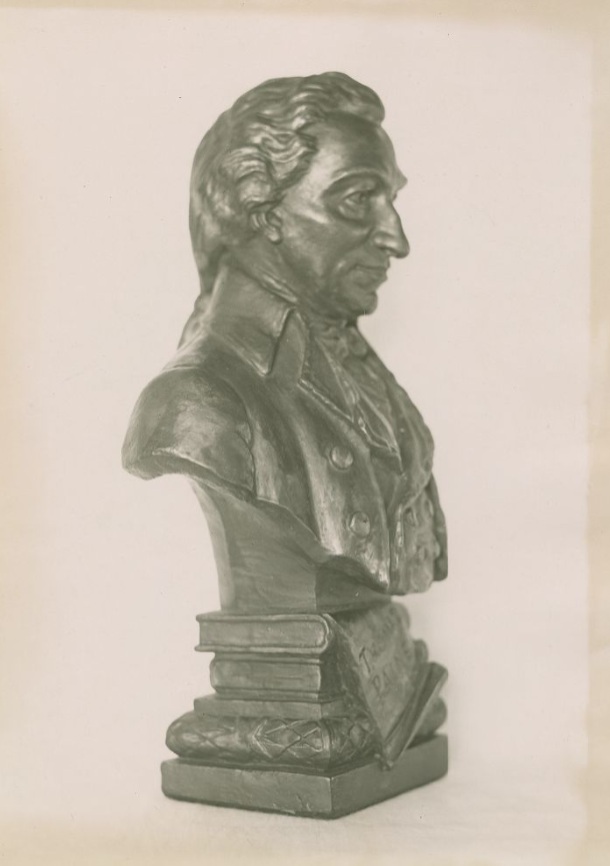
Perhaps the most sublime act of his life was in opposing the sending of King Louis to the scaffold. “Kill the monarchy, but spare the man,” was his cry. Yet he knew that by this act he would endanger his own life. As a matter of fact, Paine was thrown into prison for eleven months and escaped the guillotine only through a chalk mark on the wrong side of his door. For this arch democrat to risk his own life to save that of a friendless and dethroned king strikes me as the finest piece of heroism seen in modern times.
These are but the beginning of Thomas Paine’s services to humanity. Throughout most of the adult period of his seventy-two years of life he was working for the advancement of man in some quarter of the world.
Perhaps the greatest service of all, the credit of which he unselfishly gave to another, was in writing the Declaration of Independence. After careful study of the subject I have absolutely no doubt that Paine was the actual author of this document.
Several years ago, writing under a nom de plume, I gave my reasons for believing this. For the most part they were arguments that had already been advanced by William Henry Burr and Van Buren Denslow, and there is not space to give them in detail here. One was that a paper in Newark, N. J., in 1802 practically said that Tom wrote the Declaration. Jefferson never claimed to be the author until just before his death, years after Paine was dead.
The style is unquestionably that of Paine, the sentiments—meaning of writing views on slavery, on taxation, on deity, on government, on liberty, on the Scotch and on many other subjects being those of Paine rather than Jefferson. There are several stock phrases of Paine’s in the Declaration. In addition to all these marks, there is one that I discovered myself, the use of the word hath in the Declaration. Jefferson never used that word in his life. Paine used it.
He wrote spirited numbers of The Crisis that are read at the heads of the regiments and have been described as worth an army.
Since writing that article I have read a convincing post-sentiment of Paine’s authorship in a book issued anonymously but which I have recently learned was written by Joel Moody of Kansas. I had few doubts on the subject before. After reading that book I have none at all. I have space to refer to but one of Moody’s telling points. It consists in proving both Paine’s and Jefferson’s ideas of a proper pronounciation—ideas that the Declaration was unique in style, in thought, in argument and in every possible way. Jefferson’s statement is utterly different from the Declaration of Independence. On the other hand Paine six months before the Declaration was adopted said that such a document should be given out. Not only so, but he set forth the four grand divisions that should be included in the instrument and gave them in the exact order afterward found in the Declaration itself.
The tradition of the authorship of this charter of American liberty follows: Paine’s “Common Sense” appeared about six months before the adoption of the Declaration of Independence. During this time it is known that he worked incessantly for independence. He was so ardent that he drafted a tentative paper that might be used by the congress as a reason for the step. Of this his friend Jefferson knew and used it as the basis of the Declaration when he came to draw it up. Not being a member of congress, Paine never claimed the authorship.
Expert Opinions on Authorship
That Paine assisted Jefferson in writing the Declaration or actually penned a tentative draft for him is now accepted by most students. The New York Herald in a recent half page review of a new twelve volume edition of Paine’s works and life says:
“Then when Paine was editor of the Pennsylvania Magazine he wrote a paper called ‘A Serious Thought’ which was the Declaration of Independence in embryo. Indeed, Paine is said to have assisted Jefferson in drawing up the first draft of the Declaration itself. It has been epigrammatically said of him that even if he did not write it he was its author.”
Albert Payson Terhune in the New York World, using as a basis an article written by myself, gives a review of the argument that is strongly in favor of Paine. He does not absolutely commit himself, but says: “Though the evidence may or may not be conclusive, it is at least interesting and has found many supporters.”
William Cobbett, the famous English member of parliament and reformer, puts the case thus:
“Jefferson and some others have had the credit of being the authors of the Declaration of Independence of America. Either of them may have written it, but Paine was the author of it.”
Thaddeus Burr Wakeman, who is perhaps the most thorough student of Paine now living, states:
“The claim of some that Paine made a first draft of a declaration for the of Union and part of the balance for the use of Jefferson is not improbable, for he was certainly an active and inspiring man in Philadelphia during these fateful six months.”
For a World Republic
Mr. Wakeman, who regards Paine’s ideas as still very factors in the progress of democracy and of liberalism throughout the world, gives the five great objects of Paine’s life as follows: (1) American independence, (2) the modern democratic republic, (3) the American federal union and “nations of humanity” (4) the religion of humanity (5) the republic of man and of the world.
In an adequate consideration of the work of Thomas Paine several further facts should be considered.
He was introduced to the United States by a letter from Benjamin Franklin.
Thomas Jefferson was admittedly a disciple of Paine and sent a war vessel to France to bring him back to America.
Washington avowed, in effect, that Paine had converted him to the cause of independence.
Paine’s services were considered so valuable to the United States that he was voted large sums of money and two farms.
Among the other reforms he favored was the abolition of dueling.
He was so popular in France that, although a foreigner, he was simultaneously elected to several different constituencies to represent them in the national convention.
He advised with Napoleon about the invasion of England and had the invasion been made was to have written a new constitution for England.
He was born a Quaker and was in reality a most religious man. The “Age of Reason,” which raised the theological storm against him, was written to combat French atheism and at a time when Paine momentarily expected death from the guillotine.
Thomas Paine has been frequently called the greatest political writer that ever lived. Some of his sentences have passed into the common speech of the world—for example, “These are the times that try men’s souls,” and “The world is my country, to do good is my religion.”
It is known that Abraham Lincoln was an admirer of Paine and read him with avidity in his early years. Lincoln’s ideas of democracy and their views of religion were not dissimilar, as would be universally acknowledged if the popular misacceptations of Paine’s notions were swept aside.
It requires a century or more for the world to come to just estimate of its benefactors, but at last the scale is balanced, as it now is being balanced for Thomas Paine, the true author of the Declaration of Independence and the apostle of liberty in three lands.