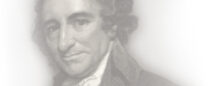
The San Francisco call (San Francisco [Calif.]), January 31, 1896
HONORING THOMAS PAINE
Interesting Exercises in Celebration of the Author Hero’s Birth
Some Rather Radical Speeches—The Orthodox Churches Arraigned for Illiberalism
The fourth annual celebration of the birthday of Thomas Paine by the San Francisco Liberal Union was held at Scottish Hall last evening—celebrating the one hundred and fifty-ninth anniversary.
The hall was crowded, a large part of the audience being women. The red, white and blue was everywhere in evidence, and a large picture of the author-hero of the American Revolution occupied one side of the stage framed with electric lamps of the three colors.

The programme was diversified and entertaining, including fancy dancing, songs and recitations, given by Mrs. Sully, Miss Childs, Miss Coleman, Mrs. Tenney, E. A. Kerr, Miss O’Brien and Miss Stone. Addresses were made by President Bean, C. Fannie Allyn, Professor C. Wright and Dr. J. L. York touching the life and character of Thomas Paine. Some of them were very radical. Professor Wright said that “in the face of an audience like this Dr. Brown’s church was not in it.”
He said liberalism was growing rapidly, but it would take 200 years to wash from the name of Thomas Paine the mud and slush that had been cast at it by priests and parsons.
Dr. York, father of the union, who presides at its Sunday night sessions in Scottish Hall, made the address of the evening. He paid a beautiful tribute to the memory of Paine, who he declared had done more for human liberty, political and religious, than any other since the creation of the world. It was he who first cried out against human slavery. “Man,” he said, “had no right of property in man.”
That was the first stroke of the ax at the root of the tree of slavery. Moses had spoken face to face with God and brought to the people of earth his written commandments, but nowhere did he utter a word against slavery. Jesus, the Son of God, came and said many very good things—but why did he not tell the people that traffic in human beings, God’s alleged greatest work, was wrong? Then came Paul—but the doctrine of all of them was, ‘Servants, be faithful to your masters.’ Surely this was an inspired doctrine—inspired by the devil. ‘Where liberty is there is my country,’ said Thomas Paine—the expression of a heart and brain in consonance, that spoke 100 years too early for their own comfort, but not for the listening generations.”
The speaker said he had heard that a monument was to be erected to the memory of Thomas Paine in Golden Gate Park. “Let it be raised,” he said, “a little higher than the hymn-book cross planted there in honor of Drake, the pirate.”
Speaking of the orthodoxy of the churches, he said that the Church of Rome was years in advance of Presbyterianism so far as liberalism was concerned, for if a human soul went wrong under the auspices of the Catholic Church that church had influence to bring it out of torment. But if a soul slipped through the fingers of Presbyterianism, it was good-by, John.