
Blue-grass blade (Lexington, Ky.), January 24, 1909
By C. Amory Stevens
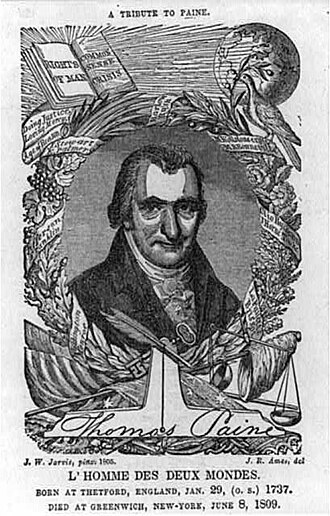
THOMAS PAINE, born at Thetford, England, 1737, first visited America in 1774. In 1776 he published “Common Sense,” which won the friendship of Washington, Jefferson, Franklin, Lafayette and good citizens generally. Congress appointed him Secretary of Foreign Affairs. In 1787 he visited France, where he took an active part in the nation’s politics also. In 1791 he published the “Rights of Man”, the most famous of all replies to Burke’s “Reflections on the French Revolution.” In 1792 he was admitted to the National Convention of France, having been invited to represent no less than four different districts of that country. In that convention he supported the Republican Girondists. At the trial of Louis XVI., Thomas Paine generously proposed what would have done honor to France, had it been accepted, the offering to the King of an asylum in America. That proposition, however, gave offense, and in 1793 Robespierre caused him to be ejected from the convention and thrown into prison, professedly because he was a foreigner. During his imprisonment, he wrote most of his “Age of Reason,” a rational argument against Atheism and Church superstition, but strongly supporting deism. After fourteen months of imprisonment he was released through the intercession of the American government and reinstated to his seat in the convention. In 1802 he returned to the United States, where, in New York, in 1809, he closed his useful life.
Such is a brief record of the life of Thomas Paine. He stands on the page of history as the one individual who more than any other has helped to free the world from superstition and mental slavery. He will also be recollected as among the foremost who opposed the counterfeit divinity of kings, and who inspired and started the first great republics of the earth. In our nation his efforts were specially helpful and opportune. Among the important reforms and established principles of better government that now mark its merit and pride, are those that Thomas Paine was prominently among the first to introduce and advocate. Among such are the abolition of slavery, free and general education, the abolition of primo-geniture, the right of women to their wages, to own their clothes, and hold property in their own name: also the abolition of dueling. He was a strong advocate of international arbitration, humanely and wisely seeking to lessen the horrors of war and waste of treasure.
During the American Revolution, when freedom and advancing civilization were hanging in the balance, at its very darkest hour his was the strongest individual pen that encouraged and by the light of reason led to success. Paine’s published pamphlet of “Common Sense” was the first and strongest plea to unite and lead the American people to independence. They sought originally only to defend and procure their rights as Colonists against Royal oppression. Even Washington had previously declared strongly against the idea of American Independence.
In 1775 Paine wrote and published in one of his articles, thus: “I hesitate not for a moment to believe that the Almighty will finally separate America from Britain. Call it independence or what you will, if it is the cause of God and Humanity it will go on.”
So strong was the merit and influence of that article that Washington, in January, 1776, wrote, to-wit: “A few more of such flaming arguments as were exhibited at Falmouth and Norfolk, aided by the sound doctrines and unanswerable reasoning contained in the pamphlet, Common Sense, will not leave numbers at a loss to decide upon the propriety of separation.” In April of the same year, Washington again wrote, “By private letters, which I have lately received from Virginia, I find ‘Common Sense’ is working a wonderful change there in the minds of many men.” But three months later, American Independence was declared. In the same year, and but a few months subsequently, Paine, a soldier in the ranks at Fort Lee, and after the retreat of the Continental Army across New Jersey, wrote his first article known as the “Crisis”, with the introductory, “These are the times which try men’s souls. The summer soldier and the sunshine patriot will in this crisis shrink from the service of his country; but he that stands by it now deserves the love and thanks of man and woman.” At that despondent time, generally circulated as that article was, and also by the command of Washington read to the American soldiers before they crossed the Delaware and attacked the Hessians, who can measure what inspiring influence that noble plea of Thomas Paine had on American destiny and all the other Republics and growing civilization of the world that have been educated by American success.
Not only was Paine’s pen, from the start to the finish, in the active service of that great cause, but his limited purse was also open to it. When after many discouraging reverses, Washington was obliged to inform the Pennsylvania Assembly that he was destitute of supplies and that his troops threatened mutiny, Thomas Paine, clerk of the Assembly, called Philadelphians together, suggested the Relief Subscription, and from his scanty means started it with five hundred dollars. The appreciation of Paine’s service in the struggling cause of American freedom was well expressed by our first Attorney General, Edmund Randolph. He declared that American Independence was due first to the misrule of George III., and second to the rational and inspiring words of Thomas Paine. When in our gratitude we recollect the brave sword of Washington let us never forget the mighty pen of Thomas Paine.
Thomas Paine being so far ahead of the general intelligence of his day, suffered from the ignorance and superstition of that age. As time advances and civilization advances, his memory is more and more revered by intelligently reflecting minds. That growing change is shown by the fact that so many and increasing numbers are anxious to commemorate the natal day of him who described his life object and made it his life work: “The world is my country to do good is my religion.” That humanity, philosophy and religion in the judgment of the intelligence of our day marks the highest plane of civilized man.
The ignorant and the scheming always have been and will be with us. The name of Thomas Paine, as others who have actively aided civilization, is even still the enduring target of the petty marksmen. Who but a scheming and egotistical politician and he a church idolator, would stoop so low to gather church votes or believe that he could enlarge his reputation by falsely and even absurdly in our day defaming so honored a hero in the cause of humanity and so intellectual giant among men. Teddy Roosevelt, an exceptional, half-civilized Twentieth Century product, won that unenviable distinction when he described in print Thomas Paine as “a filthy little Atheist.” Those who realize how ungrateful, how untruthful and cowardly that uncorrected defamation, seeking to belittle so noble a character, dead and yet so strongly living, are not surprised to note that the personal veracity of that author is occasionally in his life affairs challenged. Roosevelt might have, with as much truth, declared that Washington, Lincoln, Jefferson, Franklin, Emerson or Whittier and other of the best representatives of civilization, past and present, were but “filthy little Atheists.” What a refreshing and manly contrast to that slander is the declaration of Roosevelt’s superior and senior, Andrew Jackson, who, in his day, said: “Thomas Paine needs no monument made by hands; he has erected a monument in the hearts of all lovers of liberty.” It is a sad case of politics and church when either statecraft or priestcraft seek to change honest truth in history. But the schemers of both Church and State have ever sought close alliance.
No really intelligent mind was ever an Atheist: “Who made those stars?” was Napoleon’s reply to the doubter. The wonders of both firmament and earth prove overwhelmingly a Master Creator and answer forever the absurdity of atheism.
Nature and Science both prove a supremely wise first Cause. Call it God or Nature or what you will. It is our greatest teacher. With human reason and observation to guide, it unmistakably exposes Church errors and craft. Thomas Paine was not even a modest Agnostic. He was plainly and unmistakably a Deist, a believer in God, and his God a higher ideal than the Roosevelt standard. Although giving the Church credit for its dues, he being in advance of his day, saw the future more clearly. Fortified with the courage that strong reason and the spirit of justice inspire, his duty appeared plain and its execution vigorously commanding. He challenged the Church, State and all to show error in his reasoning or wrong in his humanity. They all tried by fair means and by foul, but entirely failed. Through his victory, the world finally won and is still winning. How could such a mind, following the highest God ideals known to man—justice and humanity—credit or endorse the Adam and Eve myth borrowed from previous dark age, or the blasphemy of the Immaculate Conception, or the alleged resurrection of a mortal Christ, or an imaginary Heaven as a future monopoly for the scheming elect and alert, well knowing as he did that such were but the work of Priest and Kingcraft in combination for power.
Thomas Paine was humanely wise. He taught us to acquire knowledge, to grow mentally free and strong and to live as good citizens making the most of the living present and not wasting time or vitality dreaming or worrying over the wisely veiled Unknowable.