
Where, and why, did a loyalist doctor bring Paine back from the brink of death?
As his London Packet approached the colonies in November 1774, Thomas Paine was not scanning for land. After turning northwards towards Philadelphia in Delaware Bay, he was not visualizing where, during the Seven Years War, French privateer ships awaited English prey within the folds of the eastern shore. Stricken with typhus fever that had ravaged his ship, the delirious and barely conscious Paine was confined to his cabin.
In a March 1775 letter to Franklin, Paine said he had “suffered dreadfully” during the voyage, “had very little hopes” he “would live to see America,” and that six weeks in the care of Dr. John Kearsley, Jr.—who “attended the ship on her Arrival, ”took Paine on as a patient, had him brought “on Shore,”and “provided a Lodging”— resulted in full recovery.
Why Kearsley? Many doctors then practiced in Philadelphia. Some Paine biographers assert that Kearsley had Paine brought to him because he heard about someone with a letter of introduction from Franklin. Kearsley did not hear it through the grapevine.
He “attended the Ship on her Arrival. ”Presumably appointed under Pennsylvania law to inspect the infected ship, he learned of Paine and the letter during that inspection.
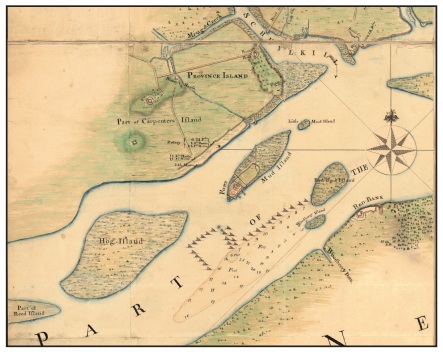
Where did Kearsley inspect the ship and where did Paine recover? Paine biographers, who specify where the ship docked and Paine’s care occurred, assume Philadelphia locations. Instead, Pennsylvania law expressly prohibited ships “disordered with any infectious disease” from coming closer than Little Mud Island, seven nautical miles downriver, and required that infected persons be quarantined at a “hospital or pest house” on adjacent Province Island.
Unless the captain risked severe penalties by flouting Pennsylvania law and obtained Kearsley’s cooperation, Paine sailed no closer than Little Mud Island and was brought “on Shore” on Province Island.
Kearsley would not have defied a law requiring that infected ships be cleansed with vinegar. Kearsley derived significant income from operating a vinegar factory and vigorously advocated vinegar’s health benefits, recommending “bathing the body” of patients “with very strong warm vinegar ”as“ an auxiliary to stop the progress of putridity,” and drawing “hot steams of vinegar” and other ingredients “through a funnel into the lungs.”
The mortality rate for “highly intellectual” people who contracted typhus fever, like Paine, was “very high.” Paine’s delirium upon arriving suggested untreated severe typhus and heightened the prospect of death.
Available evidence indicates that Paine’sship docked downriver, and that, quarantined on Province Island, he was rescued from likely death by Kearsley’s care. Cabin “passengers” like Paine had to pay for care. The hospital’s “Keeper” could charge for a passenger’s stay. Since Paine lacked financial resources, Kearsley having “provided a Lodging” during recovery may mean that he absorbed those charges.
Caring for Paine distant from Philadelphia was a considerable economic hit. Why did Kearsley decide to care for Paine without charge, perhaps pay the Keeper, and travel far downriver on multiple occasions?
Charity was an unlikely motivator. Kearsley prioritized his financial pursuits over needs of the poor. His uncle, dying in 1772, intended to create and fund an infirmary for poor women. Kearsley substantially delayed and nearly thwarted that bequest. Suing to obtain more from his uncle’s estate, his claim prevailed before a jury though legally groundless, and his uncle’sintent was realized only through additional donations by others.
Franklin’s letter of introduction was also an unlikely motivator. Kearsley detested Franklin, who he sarcastically called “The Electrician,” Kearsley accused Franklin of misusing public revenues for his private benefit and cynically predicted he would succeed because “he is wicked enough to Blind the people.”
The most likely rationale for Kearsley taking on Paine’s care isironic. A Loyalist who forcefully opposed American resistance to England, Kearsley was, as friends and foes perceived, “violent” in his Loyalist views and actions. Before and after Paine arrived, Kearsley headed “The Association” that was designed to assure all “Englishmen” actively support British forces, drink to their success against the Americans, and “combine together to join the British Forces when they should arrive.”
Did Kearsley view the Englishman Paine as a potential Association member and fodder for his Loyalist plans? During his inspection, did Kearsley read notes in Paine’s cabin and recognize his extraordinary written communication skills? This explanation gainstraction by considering Kearsley’s actions in October 1775 that were, to Pennsylvanians supporting the American cause, stunningly treasonous.
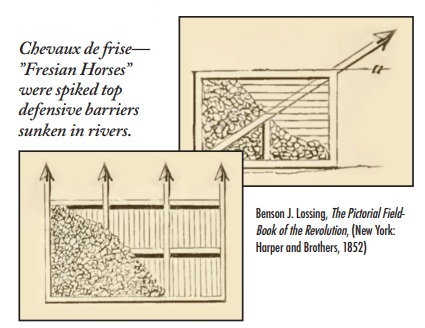
Kearsley tried to send a map to London that disclosed precisely where British ships could maneuver around carefully constructed and critically important sharpened log structures sunk into the Delaware River – chevaux defrise – to reach and attack Philadelphia. The map was accompanied by a letter proposing that, if Britain sent troops, Kearsley would lead those troops and an equivalent number of Loyalists who, he promised, would come forward. Those papers were intercepted and Kearsley and his co-conspirators were arrested. Kearsley remained imprisoned until, 53 years old, he died in November 1777.
Locations of those chevaux defrise—the prime defense protecting Philadelphia from British ships—were deeply held secrets. Other Loyalists were hanged for far less egregious activities.
Kearsley presumably read Paine’s Common Sense and his first four Crisis essays, published before November 1777. Imagine Kearsley’s rage while consuming Paine’s proclamation that “every Tory is a coward” and, “though he may be cruel, never can be brave.” Or Paine’s claims that “the instant that” a Tory “endeavors to bring his toryism A TRAITOR” and that a “traitor is the foulest fiend on earth.”
Did Kearsley realize that, had he not cared for Paine, independence may never have transpired? Dwelling on that irony, would execution shortly after arrest have seemed an attractive alternative? Rather than being hanged in October 1775, Kearsley watched helplessly for two years —perhaps going insane—as his world turned upside down and the decision to bring Paine back from the brink gave birth to his nightmare.