
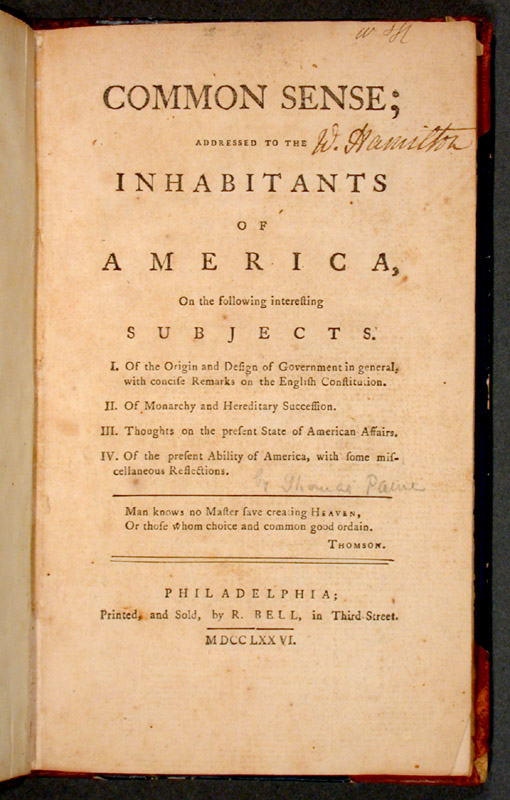
Common Sense, published in January 1776, is well known for its strong advocacy of independence from Britain. Less known, but of vital importance, is Paine’s insistence that it is essential to create republics in which the people as a whole—not any one person— are sovereign. Ridiculing the unwritten English “Constitution” that all American factions then cherished as a repository of their rights, Paine asserted that democratic government is properly created only through written constitutions based on the equality of all people and framed by and for the people themselves and for their happiness and freedom. He affirmed in Common Sense that “in free countries the law ought to be King.”
Paine envisioned a single legislative chamber, subject to frequent direct elections by the people, that controlled any executive and judiciary departments. He stressed the urgency of establishing a “Charter” immediately, for a “continental form of government…while we have it in our power.”
Beyond prescribing in detail the elements of a future democratic America governed by a written Constitution, Paine made the case in Common Sense for immediate and unified action by the colonists to fight for their independence from Britain, including these eight key messages.
- Not only should every American care about the assault on their natural rights, but the cause of America is “the cause of all mankind.” Paine stressed that the choices made by Americans in 1776 would affect all who come after them, repeatedly emphasizing the urgency of action. He appealed to their idealism, offering a thought exercise in which people could meet sequestered in a “state of natural liberty” and shape a society starting from fresh principles in which all would remain “perfectly just toeach other.”
- Government is necessary because people are not always good. To be free, they therefore need security, especially protection from others. But, Paine pointed out, government can cause intolerable suffering as evidenced by the excesses of monarchy and all systems of hereditary succession. All people are equal, and no one has the right to set himself up as a monarch and presume that his descendants will be worthy of leadership. Monarchs are isolated from, and don’t really know the interests of the people. If they are minors, or aged, they can easily be manipulated by those around them. Paine drew on the lessons of history to support his argument and cited the Bible’s rejection of monarchy.
- Paine asserted that Britain’s claim ofproviding protection for America served only Britain’s interests. Paine believed America was most interested in trade and that, as long as America remained a colony of Britain, it would be drawn into European wars. Those born in America were not enemies of France and Spain and an independent America would beat peace with France and Spain.
- Reconciliation with Britain was not possible; there must be a final separation. It was absurd for an island to govern a continent that was three or four thousand miles distant.
- As an independent nation, Paine believed, the American continent could be “the glory of the earth.” He saw it as the“asylum for the persecuted lovers of civil and religious liberty from every part of Europe. ”Significantly, Paine called for religious tolerance and diversity of religious opinions.
- For Paine, the events of April 1775 (the battles in Lexington and Concord) and other “barbarous” actions of Britain further demonstrated the impossibility of reconciliation. Reconciliation would only lead to more revolt later and to dissension among the colonies that were beginning to unite behind a continental government—colonies that were strong in numbers and natural resources. The challenge of fighting for America’s independence should not be left to future generations.
- In Common Sense, Paine explicitly called for a “declaration of independence.” He asserted that assistance to the American cause from other countries such as France and Spain would come only if America pursued independence rather than reconciliation.
- Paine saw the potential for America to reopen trade and reconciliation with Britain on different terms, once independence was achieved. He ended Common Sense with an inspiringcall for all to join together as good citizens and friends.