
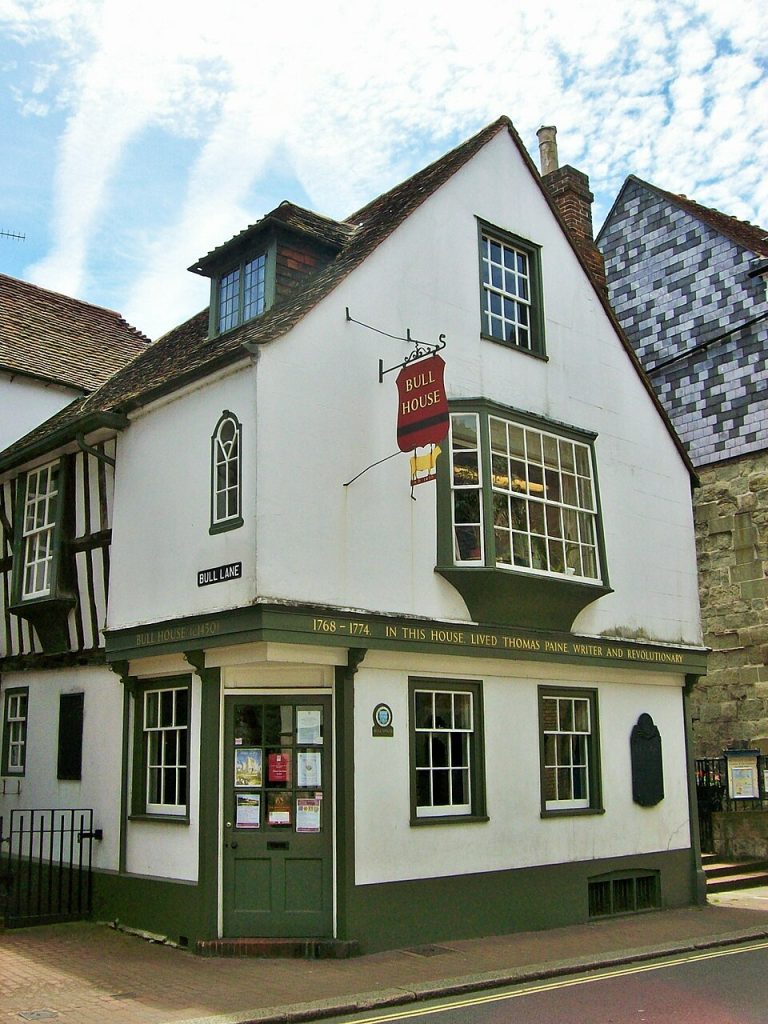
From 1768 to 1774, when Thomas Paine sailed to America, he lived in the town of Lewes, England. In his honor, a conference was organized in Sussex, January 9- 10, 2026, by Thomas Paine: Legacy; the University of Sussex; and the Iona University Institute for Thomas Paine Studies. About 40 scholars and Paine admirers met to share research findings and explore Paine’s life, work, and global influence,with a special focus on the 250th anniversary of Paine’s seminal work, Common Sense. They were also treated to tours of the charming medieval town of Lewes, and enjoyed experiencing part of the conference inside Bull House, Paine’s residence while in Lewes, now open regularly as a historic site and an aspiring “center for democracy.”
This article seeks to capture the major themes and only partially summarizes the wealth of information and wide range of perspectives exchanged during two full days of formal sessions and informal discussions. A number of presentations drew attention to the mutual influences between Paine and radical thinkers supporting working-class and suffrage reform movements in England, Scotland and Ireland in the late 18th and early 19th centuries.
Presentations also addressed the widespread influence of Paine’s ideas not only in England and America, but in France, Spanish America, and beyond. Starting with the German translation of Common Sense for the German community in Philadelphia, other Paine writings were thereafter translated into many languages. Participants often alluded to Common Sense as a living document, one that encourages people to think for themselves, evokes emotional responses, and deservesto be heard orally, as it often was when it was first published.
Presenters recognized Paine’s writing as a call to action against tyranny and dogma not only in 1776, but throughout the 19th century and one still relevant for our time.Paine was praised as a political philosopher who was practical in his approach to institutions and the work of good government, which he regarded as essential to protecting freedom and achieving equality.
Gregory Claeys, Professor Emeritus of History at Royal Holloway, University of London, and general editor of Paine’s new Collected Writings, delivered a keynote presentation entitled “Thomas Paine and Three Revolutions That Weren’t.” The presentation highlighted Paine’s roles in reform efforts in America, Britain, and France. Paine’s ideal was a universal democratic republic with limits on concentration of power and executive authority. He envisioned a forerunner to the modern welfare state, governed by a popularly elected legislature. As Claeys concluded, Paine’s ideal was unfulfilled in all three cases. In America, he was particularly disappointed by the Federalist constitution adopted in 1787.
PAINE AND THE JUNIUS LETTERS
A second keynote presentation was made by the respected political scientist and historian Danielle Allen, James Bryant Conant University Professor at Harvard. Like Claeys, Allen affirmed that Thomas Paine was forming his ideas and beginning to write eloquently long before he arrived in America. She described her discovery of a close relationship between Paine and Charles Lennox, the reformminded Duke of Richmond who lived near Lewes. Her research on Lennox will be published later in 2026 under the title Radical Duke: How One Aristocrat-and the American Revolution-Transformed Britain. Among other things, she looked closely at the Junius letters: seditious attacks on the British monarchy that called for universal male suffrage, published during the period from 1768-1772. The actual authors were kept secret, constituting a mystery for centuries. Allen has concluded that the Junius letters were underwritten by the Duke and that Paine was a key author of many of the letters, recruited by the Duke to advance his agenda. Allen reached her conclusions on the roles of the Duke and Paine in the Junius letters independently of the editorial team assembling Paine’s new Collected Writings, which also recognizes Paine’s hand in the Junius letters based on computer-assisted text analysis.
Paul Myles, member of the TPHA Board,reported on his continuing research into Paine’s early writing while in Lewes. Various presentations also examined Paine as a man with many gifts and a social being with varied friendships and influential networks throughout his career. His writings tell uslittle about his views on gender relationships. As one presenter described, he married a local Lewes woman and schoolteacher, Elizabeth Ollive, in 1771. Although their marriage dissolved in 1774, both the content of the separation agreement and the evident mutual respect between the two may provide an indication of Paine’s relatively enlightened perspective on women.
The enthusiasm and engagement of younger scholars in Lewes suggests that scholarship about Thomas Paine and exploration of the context and impact of his work will continue to yield new insights well into the future.