
The New York herald (New York [N.Y.]), February 1, 1848
Singular Celebration of the Birthday of Thomas Paine. — Smearing. — Eating. — Drinking. — Dancing.
On Sunday evening last, at the Minerva Room, the birth-day of the celebrated Thomas Paine was solemnized by the delivery of a speech from the lips of Mr. Allen, of this city, before a respectable congregation of old fashioned people, both English and American.
The celebration was continued on Monday evening at the Minerva Rooms, and carried on by dancing, eating, and drinking, and all the festivities of the ball. A report of this speech will be found in another column of this paper.
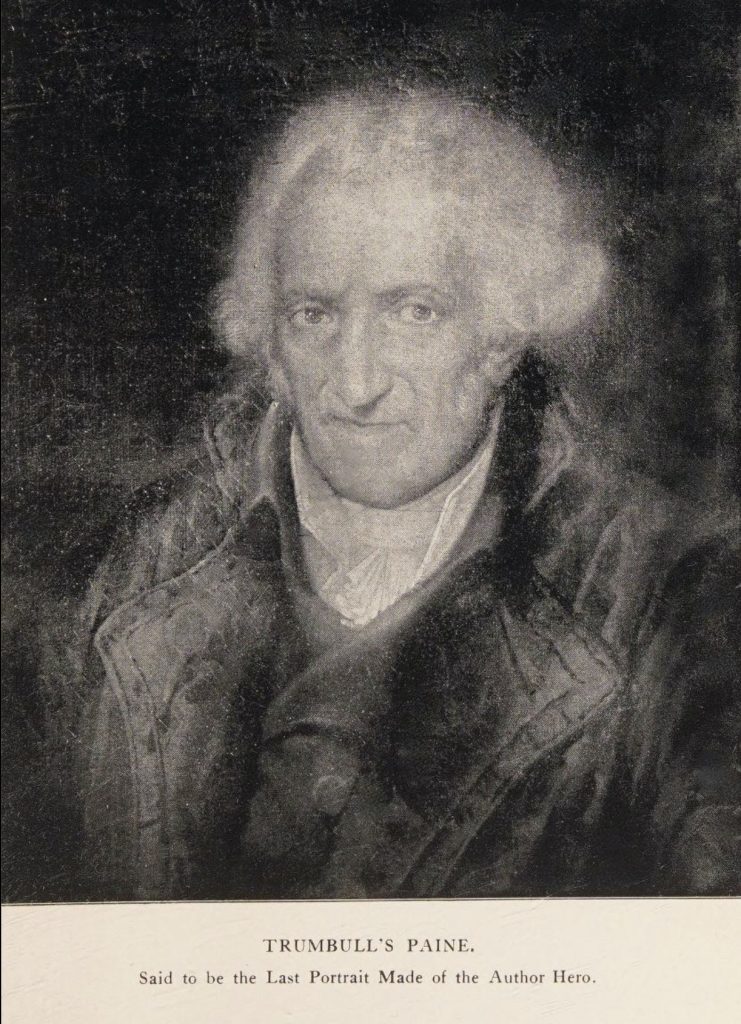
This celebration of the birth-day of Thomas Paine has been kept up in this city for many years past, and is not a greater departure from good taste and good sense than the celebration which have been had of the birth or death of Fourier, or even if the French should get up a celebration for Voltaire or Rousseau.
Thomas Paine belonged to the same school of moralists and thinkers as Fourier, Rousseau and Voltaire; but in his latter days he made a greater departure from sobriety in his demeanor, and propriety in his daily habits. The character and history of Tom. Paine, or Thomas Paine, Esq., if it is desired we should be more respectful—a study in themselves. Possessed of a remarkable genius for literature and politics, he was, in the early part of his career, an admirer and supporter of liberty, in opposition to kings and lords. This spirit brought him over to this country, and during the revolution, he did more service to the cause of liberty, by his writings, than any other man—even more than Jefferson himself. His subsequent career, however, in England and in France, rather turned over the steadiness of his mind, and led him into a way of life such as his last days miserably exhibited.
The violent, gross and outrageous attacks he made upon religion, were not only to mere opinions, but were carried beyond, and lighted upon those who cherished the Christian faith, who were shocked by the violence with which it was assailed. But even this would not have extinguished the brilliancy of Paine’s career if it had not, with an utter prostration of his mental and moral powers, given himself up in his latter days to the brandy bottle. There is no doubt that for several years before his death, Tom Paine, or the great Thomas Paine, Esq., was nothing but a miserable loafer, as bad as any of the vagabonds who frequent the worst grog-shop upon the Five Points.
This unhappy and unfortunate period of his life destroyed all that respect and veneration which the earlier part of his career produced, and might have fixed upon all future generations. Yet, with all these elements of intelligence and power, of weakness, immorality and drunkenness, commixed together in his career, he probably left behind him more of a better spirit, as a legacy to the present age, than any other philosopher, of similar hue, who enjoy more fame.
Fourier, the French philosopher, of whom so much has been said, was equally demoralized, more foolish and silly, less efficient in his day, and yet men calling themselves distinguished and moral, get up celebrations to his memory.
Voltaire is also vaunted at this day, and he was a great genius; but his whole life was passed in the violation of the rules of morality, and at his famous chateau of Ferney, near Geneva, he lived in open violation of all moral ties, with Madame Chapelet. Yet that place is still exhibited and looked upon as a place to be revered, venerated and admired. Voltaire was a man of a different genius with Paine, more refined in taste and manners; but with this exception, his works perhaps have produced a higher degree of demoralization among his countrymen than the more beastly appetites of Paine could ever create among his followers.
The constant repetition of these celebrations every year, by a certain set in New York, may be looked upon as one of the freaks remaining from the last century. They are gradually dying away; and in a few years, the birthday of Tom Paine will pass by unheeded, like that of other equivocal reformers whose principles and practice in early life are in open hostility to the principles both of thought and action of their latter days.