
The New York herald (New York [N.Y.]), February 1, 1848
The Celebration of the Birth-Day of Thomas Paine.
At a meeting held at the Minerva House, on Sunday evening, January 30, 1848, for the purpose of celebrating the birthday of Thomas Paine, Mr. Allen, of this city, addressed the company present as follows:
It has been the practice, ever since the commencement of civilization, to keep in grateful remembrance the persons of the great and good, either by inscribing their names upon lasting monuments, or by returning annually, in some public manner, to testify respect for the departed. This is right. This is as it should be; for there is a glowing desire in the mind of every man to live in history, song, or in the hearts of their countrymen, after the breath shall have left their nostrils and their bodies covered with the cold clods of the valley and they sleeping with the silent dead. And what is better calculated to inspire laudable ambition in youth, what is better conceived to encourage and foster the hopes of enterprise, than to see respect paid to the memory of departed worth? Who would seek a reputation in the cannon’s mouth, or who consent to stem the torrent of public opinion, or who consent to face the pitiless peltings of an ungrateful world, if their name, their memory, and their body, are to sink into the grave together? True it is, that no splendid monument has been erected to the memory of the man for whom we have met here to show our regard; but equally true it is, that in the heart of every generous American lives the name of Thomas Paine. Saying nothing about his religious opinions, or his theological writings, his political opinions and the bold and manly stand he took against monarchy, and the divine right of kings, in the “days that tried men’s souls,” entitle him not only to a people’s gratitude, but to a nation’s glory. It may well be said of him, that he achieved that with the pen that could not have been achieved with the sword. In the gloomy times of the Revolution, when the strongest hearts began to sink, when fear had seized upon all, when a foreboding of despair appeared to shroud the hopes, and the heavens of liberty were hung with blackness—it was that the services of Thomas Paine were needed, and then it was that Thomas Paine undertook the mighty task of restraining the fears, raising the hopes, and sweeping away the clouds of gloom, restoring health, life and hope to the land. Then it was that his “Crisis,” in which he talked like a man, but reasoned like a philosopher, with a child-like simplicity, but with gigantic strength, made such pathetic appeals as could not be resisted; and from Maine to Georgia the shout went up, “To arms,” and echo replied, “To arms, to arms;” and the people, inspired with ardor not their own, rushed to battle, and the most brilliant victories followed, and a nation freed from foreign thraldom was the glorious result.
Mr. Erskine, in speaking upon the subject of the American Revolution, says:
“In that great and calamitous conflict, Edmund Burke and Thomas Paine fought in the same field of reason together; but with very different success. Mr. Burke spoke to a Parliament in England, such as Sir George Saville describes it, having no ears but for sounds that flattered its corruptions. Mr. Paine, on the other hand, spoke to a people, reasoned with them, told them that they were bound by no subjection farther than their own benefit connected them; sovereignty, by these powerful arguments, prepared the minds of the American people for that glorious, just and happy Revolution.”
Thomas Paine was most emphatically a self-made man; and, as a general rule, every great man of the world is self-made, for he that cannot make himself, cannot stand after he is made by others. Perhaps there never was a more wicked, unscrupulous, untiring, organized opposition, composed of the most despicable qualities that ever entered into a soul, to destroy the reputation of any man, than that which was formed to detract from the character of Thomas Paine. These vile traducers, not being able to meet and answer his arguments, make an attack upon his style of writing; they say “he was an ignorant man, and his style coarse and rude.” This is vulgar. But, presuming to show their own consciousness of the falsehood, and the despicable resort for the purpose of covering their iniquity, I will state a circumstance that is not generally known. In all our colleges the professors of rhetoric have selected from the best writers in the world, sentences and paragraphs that are the best specimens of composition, in chasteness of diction, purity of style, or sublimity of thought, for examples for their pupils, and as a general rule the name of the author is appended to each sentence. Among these are many that were taken from the writings of Thomas Paine, and instead of the author’s name, the word “anonymous” is placed.
Mr. Paine begins his political writings by declaring his political creed, and it is in these words:
“Society is produced by our wants, and government by our wickedness; the former promotes our happiness positively, by uniting our affections; the latter negatively, by restraining our vices. The one encourages intercourse, the other creates distinctions. The first is a patron, the last a punisher. Society in every state is a blessing, but government, even in its best state, is but a necessary evil; in its worst state, an intolerable one; for when we suffer, or are exposed to the same miseries by a government, which we might expect in a country without government, our calamity is heightened by reflecting that we furnish the means by which we suffer. Government, like dress, is the badge of lost innocence; the palaces of kings are built upon the ruins of the bowers of Paradise. Security being the true design and end of government, it unanswerably follows that whatever form thereof appears most likely to ensure it to us, with the least expense and greatest benefit, is preferable to all others. This is my creed of politics. If I have anywhere expressed myself over warmly, ’tis from a fixed, immovable hatred I have, and ever had, to cruel men and cruel measures. I have likewise an aversion to monarchy, as being too debasing to the dignity of man; but I never troubled others with my notions till very lately, nor ever published a syllable in England in my life. What I write is pure nature, and my pen and my soul have ever gone together. My writings I have always given away, reserving only the expense of printing and paper, and sometimes not even that. I never courted either fame or interest, and my manner of life, to those who know it, will justify what I say. My study is to be useful. If there is a sin superior to every other, it is that of wilful and offensive war. Most other sins are circumscribed within narrow limits; that is, the power of one man cannot give them a very general extension, and many kinds of sins have only a mental existence, from which no infection arises; but he who is the author of a war lets loose the whole contagion of hell, and opens a vein that bleeds a nation to death.”
It has been truly said of him, “that he labored for the greatness of the nation of which he was a member, and sought its happiness; and in the pursuit of which, he built up his own greatness and promoted his own happiness.”
To go a little more into his history, he was born at Thetford, in the county of Norfolk, England, on the 29th day of January, 1737. At the age of thirteen he was taken from school, and employed by his father as an assistant in the business of stay-making, where he continued till he was seventeen; he then went to London and Dover; but not meeting with encouragement, he went on board the Terrible privateer, Capt. Death, on board of which he continued but a short time. Shortly after, he entered on board the King of Prussia privateer, Capt. Mendez; but he did not continue long there. In 1759 he settled at Sandwich as a master stay-maker, where he became acquainted with Mary Lambert, to whom he was married. From there he moved to Margate, where his wife died in 1760; from Margate he went to London, and from London he returned to Thetford, where he obtained a place in the excise. He left that situation and went to London, where he became a teacher in an academy kept by Mr. Noble, of Goodman’s Fields, where he applied himself to the study of astronomy and natural philosophy, where he continued about two years, when he was reappointed to the excise. He then left London, and returned to Thetford; and in the spring of 1764, he was removed to Lewes, in Sussex, where he resided in the house of Mr. Ollive, tobacconist, to whose daughter he was married in 1771. He then commenced the business of tobacconist and grocer, and continued the same till 1774, at which time he was dismissed from the excise; and his other business proving unsuccessful, he closed that, and, for some unknown cause, he and his wife separated.
Mr. Paine was, by this, and prior events, relieved from every tie which might be supposed to bind him to his country. Deprived of his home, and destitute of friends and employment, he had to commence life anew, and hence was not embarrassed in years; the industry was no more than to procure sustenance for themselves, and therefore he could not have derived, even if he had desired, any assistance from their kindness. The cheerless prospect which lay expanded before him; the misfortunes that had already befallen him, and the situation in which he was then placed, must have impressed upon his mind the idea that, to whatever country he went, it was impossible for his condition to become worse. In England there was no hope. Every change only brought a succession of fresh misfortunes. Some days accumulation of poverty, and surrounded by difficulties of every description, his condition appears to have been that of a ruined man. In this situation, many would have sat down discouraged, without a struggle. But despair and dismay appeared to form no part of Thomas Paine’s character. His mind appeared never to have been crushed by defeat, or elated by success. The unshaken fortitude which could smile on disappointment and danger, and look serenely amidst the tumults of triumph, seems to have been the most prominent feature in his character.
After the sale of his effects, he went to London, where, soon after his arrival, he obtained an introduction to Dr. Franklin, who advised him to go to America. This advice was accepted, and he sailed from England towards the end of the year 1774, and arrived in Philadelphia about two months afterwards.
Very shortly after his arrival in Philadelphia, he became acquainted with Mr. Aitkin, a respectable bookseller of that town. In January, 1775, Mr. Aitkin commenced the publication of the Pennsylvania Magazine, of which Mr. Paine became the editor. Many of the pieces in this publication are truly elegant. The well known song on the Death of General Wolfe appeared in an early number of this magazine, and it is unquestionably one of the most beautiful productions of the sort in the English language. In one of his lucubrations, adverting to the riches of the earth, the diligence which is necessary to discover, and the labor to possess them, he is most singularly happy in his elegant invitation to us to inquiry and research.
In 1776, he published his “Common Sense,” in which he boldly proposed Independence as the best means to get out of the difficulties into which the colonies were now plunged, and as an object worth fighting for. When “Common Sense” arrived in Albany, the Convention of New York was in session. General Scott, a leading member, alarmed at its boldness and novelty of its arguments, mentioned his fears to several of his distinguished colleagues, and suggested a private meeting in the evening for the purpose of writing an answer. They accordingly met, and Mr. McKesson read the pamphlet through. At first it was deemed both necessary and expedient to answer it immediately; but casting about for the necessary arguments, they concluded to adjourn and meet again in a few evenings. They assembled, but so rapid was the change of opinion in the colonies at large, in favor of Independence, that they ultimately agreed not to oppose it; and on the fourth day of July that year, Independence was declared.
The time was now arrived when Thomas Paine was to take as active as well as a decisive part in public affairs. Many individuals of respectability volunteered their services in support of their country’s freedom, and among the foremost of them was Mr. Paine. He now accompanied the army of Independence as a sort of itinerant writer, of which his pen was an appendage almost as necessary and formidable as its cannon.
When the colonists drooped, he revived them with a “Crisis.” The first of these numbers he published early in December, 1776. The object of it was good, the method excellent, and the language suited to the depressed spirits of the army, of public bodies, and of private citizens, cheering Washington, defeated on Long Island, had retreated to New York, and been driven with great loss from Forts Washington and Lee; the gallant little army, overwhelmed with a rapid succession of misfortunes, was dwindling away, and all seemed to be over with the cause when scarcely a blow had been struck.
“These,” said the Crisis, “are the times that try men’s souls. The summer soldier and the sunshine patriot will, in this crisis, shrink from the service of his country; but he that stands it now, deserves the love and thanks of man and woman. Tyranny, like hell, is not easily conquered; yet we have this consolation with us, that the harder the conflict, the more glorious the triumph; what we obtain too cheap we esteem too lightly.”
This number was read in the camp, to every corporal’s guard, and in the army and out of it, had more than the intended effect. The Convention of New York, reduced by dispersion occasioned by alarm, to nine members, was rallied and reanimated. Militiamen, who, already tired of the war, were straggling from the army, returned. Hope succeeded to despair, cheerfulness to gloom, and firmness to irresolution. To the confidence which it inspired may be attributed much of the brilliant little affair which, in the same month, followed at Trenton.
In April, 1777, Mr. Paine was elected by Congress secretary to the Committee for Foreign Affairs. The fifth number of his “Crisis” was published at Lancaster, in Pennsylvania, March, 1778. It contained, among other things, a letter addressed to General Sir William Howe, in the latter part of which is this paragraph:
“There is something in meanness which excites a species of resentment that never subsides; and something in cruelty which stirs up the heart to the highest agony of human hatred. Britain has filled up both these characters till no addition can be made, and hath not reputation left with it to obtain credit for the slightest promise. The will of God hath parted us; and the deed is registered for eternity. When she shall be a spot scarcely visible among nations, America shall flourish, the favorite of Heaven, and the friend of man.”
In February, 1781, he sailed with Colonel Laurens for France, where they negotiated a loan of two millions of livres, and obtained large supplies, forming the lading of a brig and a ship, with which they returned just before the capture of Cornwallis at Yorktown. He continued to publish numbers of the “Crisis,” as occasion appeared to call for them, thirteen in all.
In 1782, he published a letter to the Abbé Raynal. The object of this letter was to clear up the mistake, and to expose the errors into which the Abbé had fallen in his history of the American Revolution. This letter was a masterly production, as the following paragraph, which is an extract from it, will show. He says:
“There is something exceedingly curious in the constitution and operation of prejudice. It has the singular ability of accommodating itself to all the possible varieties of the human mind. Some passions and vices are but thinly scattered among mankind, and find only here and there a fitness of reception. But prejudice, of all others, is never at a loss. It has neither taste nor choice of place, and all that it requires is room. There is scarcely a situation, except fire and water, in which the spider will not live. So let the mind be as naked as the walls of an empty and forsaken tenement, gloomy as a dungeon, or ornamented with the richest abilities of thinking; let it be hot, cold, dark or light, lonely or inhabited, still prejudice, if undisturbed, will fill it with cobwebs, and live, like the spider, where there seems nothing to live on. If the one prepares her food by poisoning it to her palate and her use, the other does the same; and as several of our passions are strongly characterized by the animal world, prejudice may be denominated the spider of the mind.”
In 1785 Congress granted to Thomas Paine the thanks of the United States; Pennsylvania granted to him £500, and the State of New York granted to him the confiscated estate of a Mr. Frederick Davoe, a royalist. This estate, situated at New Rochelle, consisting of more than three hundred acres of land, in a high state of cultivation, with a spacious and elegant stone house, besides extensive outbuildings, was a valuable acquisition; and the readiness with which it was granted is a proof of the high estimation in which his services were held by one of the most opulent and powerful States in the Union.
He retired to this farm, where he lived, enjoying the society of a large circle of acquaintances, and the friendship of the best men in the nation, till April, 1787, when he set sail from the United States for France, and arrived in Paris after a short passage. In September after, he went to London, and from thence to Thetford, to see his mother, who was still living; his father was then dead. Here he spent some time in relieving the wants of his surviving parent, and writing a pamphlet on the state of the nation.
During the year 1788 he spent his time in building his bridge. The year 1789 he spent in France. In 1790 Mr. Burke published his “Reflections upon the Principles of the French Revolution.” In November of that year Mr. Paine returned to England, and lost no time in preparing his answer to Mr. Burke. In less than three months he produced the first part of the “Rights of Man,” in which he combatted and confuted the greater portion of Mr. Burke’s doctrines.
About the middle of May he again went to France. On the 1st July, 1791, he returned to London, and prepared the second part of the “Rights of Man.” He continued in England, quarrelling with the ministry upon the principles contained in his “Rights of Man,” till about the middle of September, 1792, when a French deputation announced to him in London, that the department of Calais had elected him as their representative in the National Convention.
He immediately proceeded to Dover, where he embarked for France, and in about three hours arrived at Calais. From thence he went to Paris, and took his seat as a member of the National Assembly; and shortly after, he was appointed a member of the committee for framing the new constitution.
The question of the trial of the King was then agitated, for which Mr. Paine voted; but after the conviction, he strenuously opposed sentence of death upon the King. Here again he made a powerful effort to have the execution postponed. Here again he was defeated, and the King was beheaded on the 21st day of January, 1793.
The National Assembly became divided into two parties. Mr. Paine, from his love of liberty and humanity, was induced to join the weaker party, and thereby incurred the displeasure of Danton, Marat and Robespierre, and in December, 1793, he was arrested and imprisoned, where he continued eleven months.
On the 4th of November, 1794, he was released. Mr. Monroe, who was afterwards President of the United States, was then Minister to France, kindly invited Mr. Paine to his house, where he remained for about eighteen months. Shortly after his release from prison he was invited by the National Assembly to resume his seat in that body, which he did, and continued in France until the 1st of September, 1802, when he embarked from Havre for America, and arrived at Baltimore on the 30th of October. He remained there awhile, and visited the different departments at Washington, and then came to New York and put up at the City Hotel, where he continued for a time, receiving visits from friends, and on one occasion a public dinner was given him as a token of respect.
He returned to his farm at New Rochelle, and afterwards divided his time between that place and New York until his death, which took place on the 8th day of June, 1809, at which time he was seventy-two years and five months old. He was buried on his farm at New Rochelle, where since a beautiful monument has been erected by his friends, with no other inscription upon it than “Thomas Paine, Author of Common Sense.”
Thus ended the days of one of the most remarkable men that ever lived; of the most perfect moral principle, and true to the cause of humanity as the needle to the pole. Neither powers nor principalities could make him swerve from the line of rectitude. His reflections upon the virtue and integrity of America were glowing, and his description of what America may hereafter become is most eloquent, and yet melancholy. He says:
“A thousand years hence (for I must indulge a few thoughts perhaps in less)—America may be what England now is. The innocence of her character, that won the hearts of all nations in her favor, may sound like a romance, and her inimitable virtue as if it had never been. The ruins of that liberty, which thousands bled to obtain, may just furnish materials for a village tale, or extort a sigh from rustic sensibility; while the fashionable of that day, enveloped in dissipation, shall deride the principle and deny the fact. When we contemplate the fall of empires, and the extinction of the nations of the ancient world, we see but little more to excite our regret than the mouldering ruins of pompous palaces, magnificent monuments, lofty pyramids, and walls and towers of the most costly workmanship; but when the empire of America shall fall, the subject for contemplative sorrow will be infinitely greater than crumbling brass or crumbling marble can inspire. It will not then be said, ‘Here stood a temple of vast antiquity—here rose a Babel of invisible height, or there a palace of sumptuous extravagance;’ but, ‘Here, ah painful to relate, the noblest work of human wisdom, the grandest scene of human glory, the fair cause of freedom, rose and fell.’“
And thus it will be seen, from a review of his life and writings, that he was a correct thinker, a ready writer, with a heart free from guile, but overflowing with benevolence. Firm in purpose and untiring in pursuits, he warmly espoused the cause of liberty and human rights, and he defended his cause with such force of argument and eloquence that he bore down all opposition. With a mind as capacious as the universe, and a perception as quick as thought, he could grasp the most extensive subjects, and discover their most abstruse bearings; he could discover truth, and always espoused her cause, which was one reason why, in debate, he always put his adversary to flight. He erected a monument that will be more durable than brass, and more precious than rubies. When conquering heroes shall be forgotten; when the rich and noble of the earth shall be low in the dust; when the proud obelisk and triumphal arch shall moulder and decay; then shall live, with grateful remembrance in the hearts of his countrymen, the name of Thomas Paine.
THE BALL AND SUPPER.
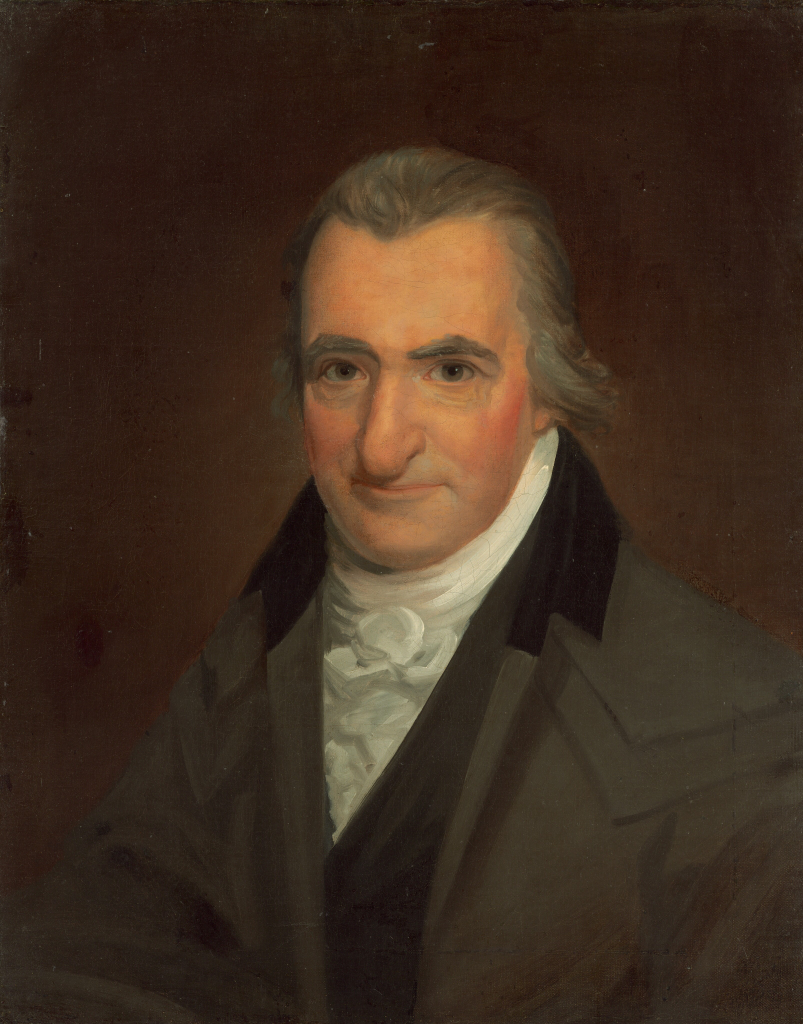
The ball and supper on the occasion of this anniversary came off last night at the Minerva Rooms. The ballroom presented a pleasing and interesting sight. Opposite the entrance was a portrait of Thomas Paine, by one of the first masters, evidently; and at one end of the hall was a portrait of Robert Owen, Esq. Landscapes bearing the names of Voltaire, Volney, Hampden, Hume, Gibbon, Shaftesbury, Bolingbroke, Scott, &c., were hung round the room.
After some time spent in the cheerful and enlivening dance, in which it is delightful to see the elegant forms of young women, and even little children, tastefully dressed, with their long and pendant hair plaited in ringlets moving on the fantastic toe, in the merry dance, the company adjourned to the supper room.
Here several long rows of tables, tastefully decorated, and groaning under a load of savory viands and seasonable luxuries, awaited the company. It would be doing great injustice to the company, and to our own feelings, if we failed to notice the kindness, amiability, cheerful ease and friendliness of every one present, and how, though quite strangers, we were received.
After the cloth was removed, the company having partaken, with social hilarity and mutual good will towards each other, of the abundant luxuries laid out before them, the Chairman, Dr. Hull, called the attention of the company to the regular toasts of the evening.
Dr. Hull began with expressing the pleasure he felt in again meeting the company on the present anniversary. He said:
“Though persons of liberal opinions are generally philosophers, yet I see no reason why they should not enjoy these occasions. Indeed, I think they should enjoy them highly, for, beyond doubt, happiness is the object of philosophy. It follows, then, by the simplest logic in the world, that fun and philosophy mutually promote each other. Often have liberals been accused of being ‘sore given to laughter and ungodly glee,’ while their bigot accusers were quite unaware that philosophy, by removing the fear of that burning pit which the priests tell us of, from before their eyes, had restored them to that mirthfulness which nature intended for them.
Pleasantry, good nature and kindness will always be found among those who are redeemed from the terrors and delusions of bigotry. The liberal principles taught us by the great philosophers who have enlightened the world, and especially by him whose birthday we have met to celebrate, are of the most enlarged philanthropy. Their principles are most favorable to liberty and happiness. In every age of the world they have been the great defenders of liberty against the tyranny of the church and the state.
If their principles had prevailed in the world, would the fires of Smithfield have been lighted, or the daggers of St. Bartholomew’s day been unsheathed? Would the generous heart and open hand of Thomas Paine ever have lighted the faggot around the learned Servetus? Was there anything in his nature or his principles which would have induced him to imprison or persecute another for a difference of religious opinions? Would liberals have hanged the Quakers of Boston, or crushed the witches to death at Salem?
The great crimes which have astonished the world, and crushed humanity to the dust, have arisen from principles directly opposed to those of such men as Thomas Paine; and I feel persuaded that the world will be free and happy in exact proportion to the prevalence of their doctrines.
Look at unhappy Ireland; at the manufacturing and laboring population of England; at the serfs of Russia; look anywhere, where bigotry and tyranny prevail, and the same spectacle is presented of suffering humanity. Would not the principles of Thomas Paine furnish a perfect antidote to oppression? Never have such men contributed to oppress mankind. It is, on the contrary, the terrible incubus of kings and priests which has destroyed them; which has rendered them bigoted and helpless; which takes away the product of their industry, and leaves them destitute, ignorant and wretched.
It makes one’s blood boil with indignation when we think of this oppression, this robbery of the people to squander on the rich and to waste by a profligate government. Who are the great robbers of the world? I answer, kings, priests, and the aristocratic and privileged classes. They absorb, by taxation, the products of industry into their own coffers, to squander on themselves, and a host of idle retainers, whom they corrupt by their favors and their vices. In their hands government becomes a great and well organized system of plunder, and the producing classes are their victims.
‘If, from the more wretched parts of the old world,’ says Mr. Paine, ‘we look at those which are in an advanced state of improvement, we still find the greedy hand of government thrusting itself into every corner and crevice of industry, and grasping the spoil of the multitude. Invention is continually exercised to furnish new pretences for revenue and taxation. It watches prosperity as its prey, and permits none to escape without a tribute.’
In another place he says:
‘I presume that no man, in his sober senses, will compare the character of any of the kings of Europe with that of General Washington. Yet, in France, and also in England, the expense of the civil list only for the support of one man is eight times greater than the whole expense of the federal government of America.’
It is by thus withdrawing immense sums from industry that the producing classes are rendered wretchedly poor, and the poor are crushed down to the point of starvation. It is this which forces them from their homes and sends them forth to find some more favorable spot, where the grasping hand of tyranny shall not be able to reach them.
Here, in this happy country, thanks to Thomas Paine and the other patriots of the Revolution, is an asylum prepared for the oppressed, from whatever quarter of the world they may come. Here they may sit down in safety under their own vine and fig tree, and enjoy the fruits of their labor, without fearing the harpy fingers of oppressors.
But, ladies and gentlemen, I will endeavor to avoid so serious a subject. We have met here to-night on a festive occasion, to celebrate the birthday of one whose happy fortune it was to revolutionize the world. I speak in sober earnest when I say that the energetic pen of Thomas Paine, more than that of any other man, revolutionized the world. Consult his Common Sense, that bold pamphlet which successfully advocated Independence in this country. Compare its tone and sentiments with the Declaration of Independence by Thomas Jefferson, and you will readily trace the analogy, showing that Paine was the bold suggester of those ideas so nobly expressed by Jefferson, and so bravely carried out by the Congress and army of 1776.”
“And has not the example of America—her success, her liberty, her prosperity, her happiness, her plenty, her strength, her republican simplicity, her real glory, the equality and friendship of all her people, whether born here or emigrated from other countries—has not all this furnished an example to oppressed nations, which shall make all thrones and mitres totter to their fall?
The good work is going on. The battles of liberty have been and will be fought, and fought successfully too. The world is making, at the present time, the most wonderful efforts in that Herculean, but delightful labor, expressed by the word progression.
Our own country is still progressing in the application of the great principles of liberty and equality; and shall not the people of other countries gather strength from our own example? We hear with delight that other nations, looking to us as the patterns of liberty and plenty, are copying our institutions, and imitating our liberality. Even the Pope himself appears to have caught the enthusiasm of humanity, and we shall yet hear from the Eternal City Te Deums and hosannas to liberty.
May the day speedily arrive, when the voice of freedom shall be heard from every quarter of the world. When mankind shall escape from the oppression which has crushed them for ages, and shall walk forth, disenthralled, rejoicing in that liberty which is their right—a right derived from Nature and from God.”
Dr. Hull then concluded with giving the following toast:
“Thomas Paine.—Whose bold genius and common sense has set on foot the revolution of the world.”
The following regular toasts were then successively given by the Chair, aided by E. J. Webb and Thomas Thompson, Esqs., as Vice Presidents:
“The day we celebrate.—The memory of Thomas Paine; gifted by talent, honored by integrity. The world was his country; mankind his brethren.”
“The Ladies present.—We are honored by their countenance; free from the thraldom of superstition, they are the crowning glory to this assembly.”
“The Trinity of Thomases.—Thomas Paine, Thomas Jefferson, and Thomas Herttell; kingcraft reviewers, priestcraft expositors; acknowledged by their enemies as honest men.”
“A Scientific Education.—The sovereign antidote to every lingering superstition; good for the head, but inimical to the drone.”
“The Union of the United States.—May it, and the public good, like twins, be ever inseparable.”
“The departed Liberals.—Who, with the strong hand of inquiry, opened the furrows of knowledge, and planted the vines of information; may succeeding generations profit by their labor.”
“The Clergy.—May public opinion compel preachers to eat the bread of industry; may the time come when, instead of twenty thousand priests in our country, every State may exclaim, ‘the locusts have fled.'”
“Philosophic Information.—The master key to open the portals of Science; to unfold the volume of Nature; to equalize opinion; to expose the crafts of law, physic and divinity.”
“Woman.—Man’s most sincere friend; his most cheering companion; his guardian in affliction; his consolation in the hour of trouble. Let us pity the unfortunate bachelor, who knows not the felicity of him blessed with an amiable wife.”
On the last toast being given, Mrs. Rose, a colored lady, as we were informed, arose and addressed the company in a strain of pleasing eloquence, and with great ability, in ardent support of those principles which characterize the votaries of the philosophy of reason.
We regret that time will not allow us to give the remarks of Mrs. Rose in substance. She said what we took to be undeniably true, that truth, justice, kindness, love, and all that is really good, is divine. That these humanity principles were their principles, and therefore their principles were divine.
Mrs. Rose having concluded, gave as a volunteer toast:
“Robert Owen.”
Which was drank with three times three.
Numerous other volunteer toasts were then given, and some songs were sung by several amateurs, to the best style. Mr. Webb gave as a recitation a translation of one of Béranger’s most effective poems. We were struck with its force and beauty of expression, even in a translation.
After an evening spent in a manner which may be called rational and intellectual, far more intellectual and more friendly, kindly, sociable and unaffected than is in general to be met with at public dinners or suppers, the company, at a late hour, or rather an early hour of the morning, gradually scattered towards their several homes, and we wended our way in a heavy rain to prepare our notes for the printer.