
The North-Carolinian (Fayetteville [N.C.]), March 25, 1848
Written for the Charleston News
By T. Thorburn
Thomas Paine was born in the town of Lewis, County of Sussex, in Old England. He held a situation in the office of Excise, he married a daughter of the supervisor in said office; she obtained a divorce from him in three years after marriage, for cruel treatment; from this we may infer, that the author of the Rights of Man paid no respect to the rights of women. He became a defaulter in the Excise office, and came to America in the time of the Revolution; he published the Crisis and Common Sense, two pamphlets, containing a fund of common sense.
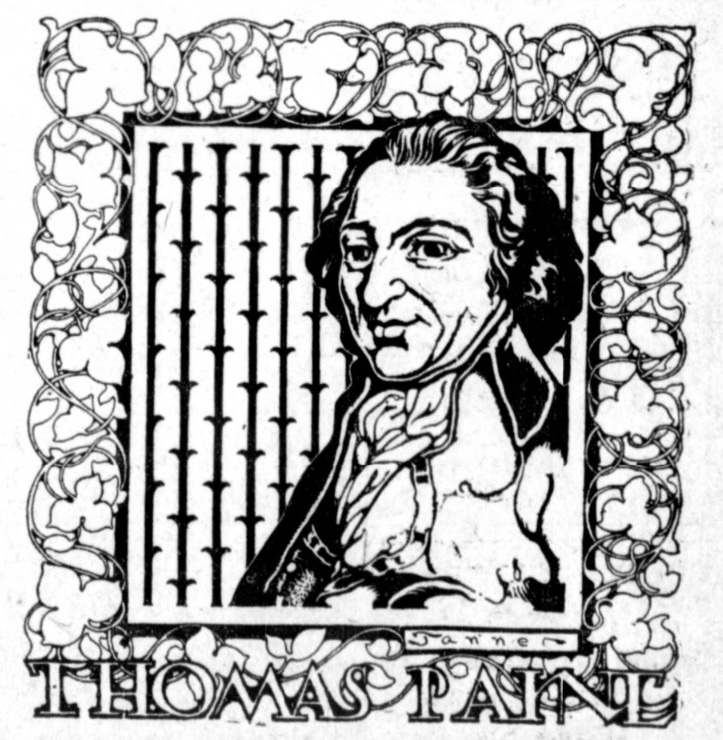
In 1793 he became a citizen of the French Republic, and was a member of the Convention who sat on the trial and condemnation of Louis XVI; he now declared war against all kings—the King of Heaven not excepted. In 1794 he narrowly escaped the guillotine, during the bloody reign of Robespierre; after his liberation he resided seven years in France, where he published several political tracts of little moment; but one of them was a scandalous attack on Washington, which, even the Bucktails of Tammany Hall, New York, were ashamed of.
As a reward for writing Common Sense, the Legislature of Pennsylvania gave him £500; he also obtained a grant of land in New York. These friends of man—Paine, Cobbett, Hunt and O’Connell—never served the sovereign people for naught. In the Fall of 1801, the powers that then were at Washington despatched a National vessel, wherein to convey to our happy shores the profound head and venerated person of Thomas Paine, a citizen of France and member of its National Assembly. I think it was in March, 1802, he arrived in New York; at that time I kept a Seed store in Nassau-Street, near the City Hotel, a neighbor entered my store and said to me, “there goes the profound head.”
“At your service and very learned servant, sir,” replied I. He was dressed in common brown clothes. He had broad, long sleeves with the smallest metal buttons; trousers at the ankles buckled with shoe strings. Near the Hotel stood Samuel Loudon the New York printer. He was a stout old fashioned New Englander. Samuel followed the fortunes of Washington, and carrying with him his black balls and printing devils, printed proclamations, while Washington wrote them.
Knowing that Paine and Loudon had been contemporaries, I thought that Samuel was going to see his old friend. I proposed to my companions to step in, as through Loudon we would get an introduction to Paine; they declined, so I went myself; a servant was sweeping the passage.
“Is Mr Paine at home?”
“Yes!”
“Alone?”
“Yes! Here I was put out. If he was alone, I had no introduction. These obstacles only increased my curiosity, I was determined now to see him, and being alone, a man and woman entered into a few civil words. “I will introduce myself. I can see him,” without ceremony.
“Can I see him?”
“Follow me!”
I was ushered into a spacious room, where the table was set for breakfast. A gentleman sat at the table writing, another reading the newspaper, and at the farther end of the room stood a long coarse-looking man, his back to the fire, and his arms behind his back. From the resemblance the latter person bore to portraits I had seen in his books, I knew it was Paine. While I followed the waiter, I was preparing an exordium to introduce myself to a plain republican alone; but when I found a company I was taken aback, brought up standing, as we say at sea (all at once).
“Is Mr Paine in this room?” said I.
“Mr Paine, sir,” said the waiter, stepping towards him and answering for him. Paine then turned. He appeared upwards of six feet in height, broad shouldered; stout in frame. Says Paine, and you gentlemen, (turning to the table,) “will you excuse my abruptness; I have been anxious to see the man whose writings have made so much noise in the world.” Paine answered, “Very kind, sir; I had a desire to see your country.” I being about to reply, a quick and genial laugh set the company roaring, and one after another burst out. They all turned and said the same. They all went off with a loud laugh, the sound of which followed me to my front steps.
I am very much obliged, sir, but no thanks. I am not the man you take me for. The little gentleman,” said the waiter and pointing to the person at the table, “is Mr. Thorburn, the seedsman.”
I retired from the room with all imaginable speed. A gentleman entered, and said, “if you step into Broadway, you may see Mr. Paine, he’s on the steps of the City Hotel.” In company with two others, I sallied forth; before we reached the Hotel, he had returned inside; at this moment I observed Samuel Loudon enter the Hotel. Knowing that Paine and Loudon had been contemporaries, I thought that Samuel was going to see his old friend. I proposed to my companions to step in, as through Loudon we would get an introduction to Paine; they declined, so I went myself.
The whole church and congregation was moved, some crying one thing and some another, and the greater part knew not for what they were come together. An extra meeting of the Kirk Session was convened, and I was suspended (not by the neck, however,) but from psalm singing in the Scotch Presbyterian Kirk, under the pastoral care of the venerable Dr. John Mason, for shaking hands with Thomas Paine.
Mr. Paine died at Greenwich, near New York, 8th June, 1809, in the seventy-second year of his age.
N. B. William Cobbett carried his bones to England. This is a fact; and if fame speaks true they were seized by the Custom House and sunk in the deep green sea.