
Springfield weekly Republican (Springfield, Mass.), June 14, 1923
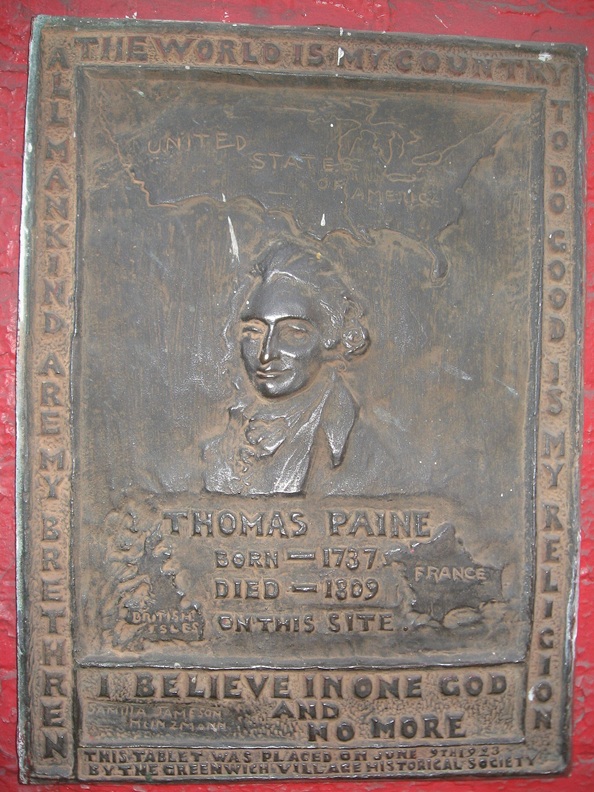
The bronze tablet erected Saturday by the Greenwich Village Historical society on the site formerly occupied by the house where Thomas Paine died, on June 8, 1809, is said to be the first memorial in New York city to the revolutionary philosopher and pamphleteer. The fact is eloquent of the neglect which his fame has suffered; and eloquent of the strong hold which stern religious orthodoxy had upon the Americans of Paine’s time and upon their descendants.
The liberal views on Christian dogma which are now spoken from many evangelical pulpits and seminary chairs make it impossible to believe that if Paine were living today the stigma which has been attached to his name because of his authorship of The Age of Reason would exist in more than the faintest trace, if at all. As it is, whether the tradition that Paine was an unholy man to be dismissed from consideration, in charitable regard for his public services, will ever entirely disappear is perhaps doubtful. The fate of Paine is an impressive commentary upon the psychological danger of being ahead of the time, especially in a manner in discord with the time.
On the tablet that has just been put up at 59 Grove street, just west of the Seventh avenue extension—the work of Mrs. Samilla Jameson Heinzmann of the Greenwich Village Historical society—are these inscriptions taken from Paine’s writings: “The World Is My Country, To Do Good Is My Religion,” “All Mankind Are My Brethren,” and “I Believe In One God And No More.” In the chief address at the unveiling, Dean Joseph French Johnson of New York university said:
Were he alive today, it is possible he might be a college president, and if so his commencement addresses would put the fear of God into his hearers. There are today many religious leaders who are honest enough not to cast a stone at Paine and I am sure there are many others who, although they may condemn Paine publicly, would not honestly throw a stone at him if they thought God were looking at them.
It is pertinent to mention that two clergymen—Rev. Alonzo R. Petty of the Judson Memorial church and Rev. Edward H. Schlueter of old St. Luke’s chapel—took part in the dedicatory exercises.
But while Paine’s religious heresy has undoubtedly been an important factor in the failure of posterity to recognize the merits which his famous contemporaries appreciated and made full use of, it has probably not been the only one. As the inscriptions on the tablet suggest, his genius was not easily confined within national boundaries. Born an Englishman, he came to America at the suggestion of Franklin and after distinguished service in the revolutionary cause returned to England to continue, in uncongenial soil, to sow the seeds of republicanism. Then to France to become a hero of the French revolution and to incur the hostility of the mountain because of his moderation.
It was in a French prison that he completed The Age of Reason and when he returned to America, to a life of inactivity, his place with the fathers of the country was not as secure as perhaps it might have been if his temperament and his tastes had been different. Yet history has never faltered in recognition of his great part in the accomplishment of American independence and in the establishment of the philosophy upon which the structure of the republic was to be built. And Americans will come more and more to recognize that part.