
By Adrian Tawfik
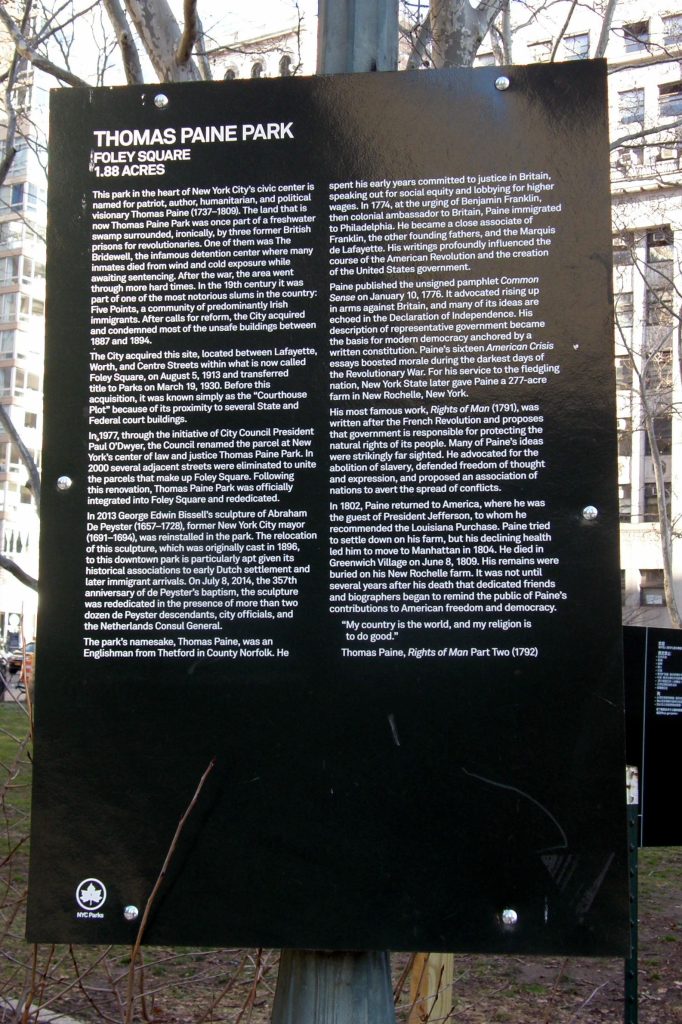
Quite appropriately, Thomas Paine Park sits next to the seat of government for the largest city in America, at Civic Center in New York City, the site of many political protests. Consisting mostly of a wide stone-paved walkway flanked by benches, Thomas Paine Park is just a small part of Foley Square, a triangle bound by Lafayette, Worth and Centre Streets in the Civic Center portion of Lower Manhattan.
Thomas Paine Park is surrounded by New York City Hall, the Manhattan Municipal Building, the New York County Courthouse, the Thurgood Marshall U.S, Courthouse (U.S. Court of Appeals, Second Circuit), the Daniel Patrick Moynihan U.S. Courthouse, the Court of International Trade, and several massive federal office buildings.
Thomas Paine Park is a small sideshow in Foley Square that should be the main event. After all, in contrast to Paine’s amazing life, Foley Square is named for a man of distinctly different moral quality.
Historically, the site centuries ago was home to a thriving fishing village on Collect Pond (at Chinatown) named Werpoes by the Munsee, a Lenape-speaking people, said Kenneth Jackson in his 1995 Encyclopedia of New York City.
By the War of Independence, reports the NYC Parks website, it was a “swamp surrounded, ironically, by three former British prisons for revolutionaries.” A medallion marks the spot of an African-American burial ground from the 1700s.
The swamp later was drained, and tenements were built there. By the 1800s, Irish gangs fought turf wars here over the impoverished Five Points slum.
Five Points was the initial base of Tammany Hall. Starting in the 1850s for 100 years, Tammany Hall had almost total control of New York politics, most famously led by “Boss” Tweed.
A prominent Tammany Hall figure was Thomas “Big Tom” Foley, a saloon keeper and corrupt politician featured in Herbert Asbury’s 1928 book, The Gangs of New York, which inspired Martin Scorsese’s 2002 movie.
Foley’s claim to fame in New York history was being the political godfather of Al Smith, the New York Governor and Democratic presidential candidate. The triangle was named for Foley in 1925.
Foley also is known for his nefarious ties to Russian-Jewish gangster Mike Salter, owner of The Pelham Café at 12 Pell Street, called “the birthplace of Irving Berlin” by gangland history website Infamous New York, which wrote that Salter “was rumored to have killed ten men on the road to becoming Big Tom Foley’s chief election captain.” Foley used Salter for false voter registrations, ballot box stuffing, repeat voting, and especially “getting out the vote.”
Foley further used Monk Eastman and his gang to conduct election fraud. When a turf war broke out between the Eastman Gang and Paul Kelly’s Five Points Gang, said Asbury, Foley served as a mediator.
Foley Square at the Civic Center now wears the name of a corrupt politician while Thomas Paine Park has a lightpost marker with no statue of the great man. Paine lived a substantial part of his life in New York and died in Greenwich Village. New York should recognize Paine’s achievements and give him the place of honor at Civic Center, even at the risk of insulting “Big Tom.”