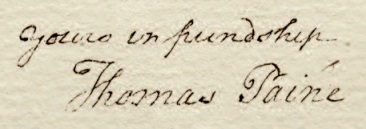
Like many other writers in 18th-century England, Thomas Paine used the familiar valediction “Your humble and obedientservant,” or some variation thereof, throughout the 1770s and much of the 1780s. To Richard Lee, for instance, he would close with “Your affectionate humble servant”—and to Benjamin Franklin, “yr Obliged and Affectionate Hblservant.” There are some exceptions such as in a letter to Timothy Matlack on October 30, 1777, which is signed with just Thomas Paine—probably because it was an explanatory message enclosing other letters.
However, Paine’s valedictions changed over the course of the late 1780s. In a letter to Kitty Nicholson Few, he simply signed off with “Thomas Paine”—but only after writing “God bless you all! and send me safe back to my much loved America!” A letter to Jefferson closed with “I remain yours affectionately.” In 1790, Paine continued to sign his letters to friends with variations on “I am my dear friend yours very affectionately.” For more formal occasions, or addressing those in more elevated positions whom he respected, he would still use some variant of “your humble servant” such as in a letter to George Washington of October 26, 1789, where he signed it “your most affectiona. obedient Hblservant.”
For those to whom he bore some resentment or hostility, he omitted any valediction, adding only his signature. We see this in a letter to John King (1793), Gouverneur Morris(1794), and Daniel Isaacs Eaton (1795). But Paine’s most famously assertive valediction can be seen in his letter to Home Secretary Henry Dundas (of Britain), reproaching the latter for issuing a proclamation that sought to suppress “seditious” writings. Here, Paine signs his letter with great aplomb, writing “Not your obedient humble Servant, But the contrary, THOMAS PAINE.” A far cry indeed from his earlier valedictions!
Later in life, a new signature appeared: “Yours in friendship.” Less courtly, but so much more heartfelt!