
By Gary Berton
Diego Rivera was a famous Mexican artist in the first half of the 20th century. He excelled in large public murals, and also did hundreds of paintings on a smaller scale. He died in 1957 in Mexico City.
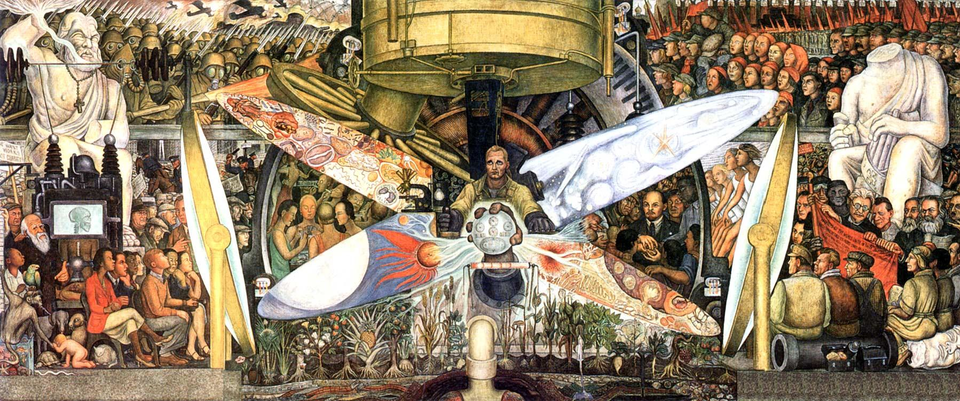
His most controversial project was the mural he created for the Rockefeller Center in New York City. His politics were overlooked by the Rockefeller family (Rivera was a member of the Communist Party in the 1930s), because of his celebrity, but Rivera refused to compromise his politics, and eventually the mural was destroyed rather than be exhibited. The title of the work was Man at the Crossroads, and it depicted workers, with social and political choices visibly represented. When he inserted figures like Lenin and Trotsky, it put an end to the project.
Rivera anticipated that his mural would be destroyed before it could be displayed, which it was. So Rivera had pictures taken, in black and white, of the panels, and the whole mural. He then returned to Mexico and re-created the mural for the Palacio de Bellas Artes in Mexico City. He renamed it Man, Controller of the Universe. See below:

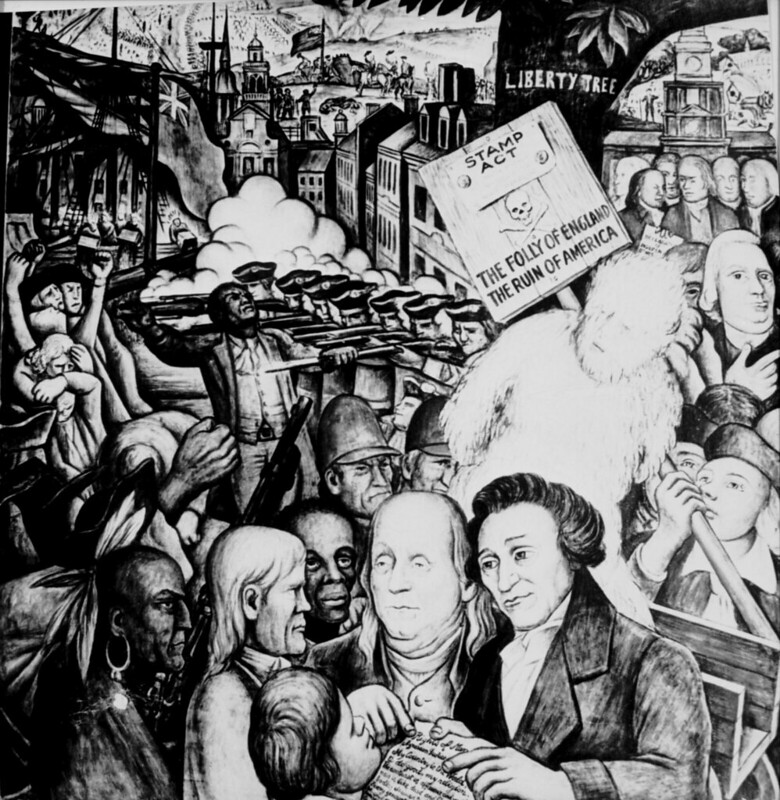
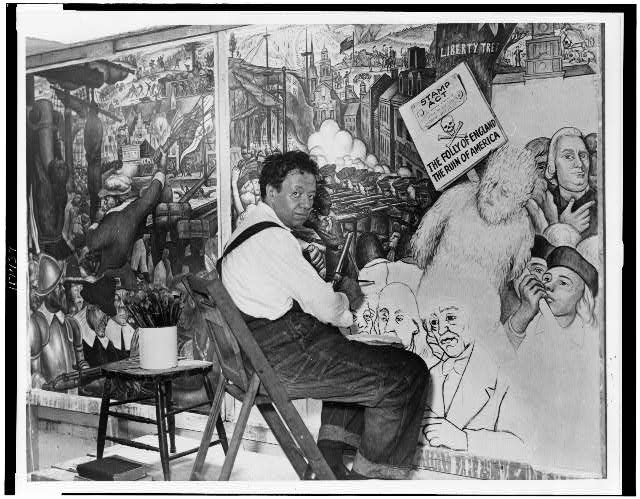
As part of the exhibit at the Thomas Paine Memorial Building, we included the panel that depicts the American Revolution. This panel did not become part of Rivera’s final production for Mexico City, as it pertained to the U.S. The only thing that remains of it is the black and white photo. Here is Rivera working on this panel in 1933:
The panel can be seen at top of this article.
The knowledge that Rivera displays here is impressive. He must have studied Paine to grasp his significance, his close relationship to Franklin (standing next to him), his foundational principle of equality as the basis of his thought (with all the races standing together pointing to Rights of Man), the significance of Crispus Attucks being martyred, and the militant attitude toward a foreign power invading a supposedly weaker country.