
The liberator (Boston, Mass.), January 28, 1859
NEW PUBLICATIONS.
The Life of Thomas Paine, Author of “Common Sense,” “Rights of Man,” “Age of Reason,” &c. With Critical and Explanatory Observations on his Writings. By G. Vale, Editor of “The Citizen of the World.” Boston: Printed and published at the Boston Investigator Office, by J. P. Mendum. 1859.
No writer has been more venomously assailed, or more unrelentingly aspersed, than Thomas Paine. Of the tens of thousands of individuals who have been led to attribute every thing of evil to him, and who never mention his name except in derision or abhorrence, probably not fifty have ever had either the courage or the fairness, even if they have had the opportunity, to read his writings, or learn the facts of his personal history. With them it has sufficed that he stands branded as an “infidel” by chief priest, scribe and pharisee, and the nominal church. Unlike those who said of him of old, “We have heard his blasphemy, what need have we of further witnesses?” they have only heard of the blasphemy of Thomas Paine, through the most prejudiced sources, and dare not or will not investigate for themselves the truth or precise meaning of the allegation. Such conduct is as cowardly as it is unjust. It is the spirit of modern, not of primitive Christianity.
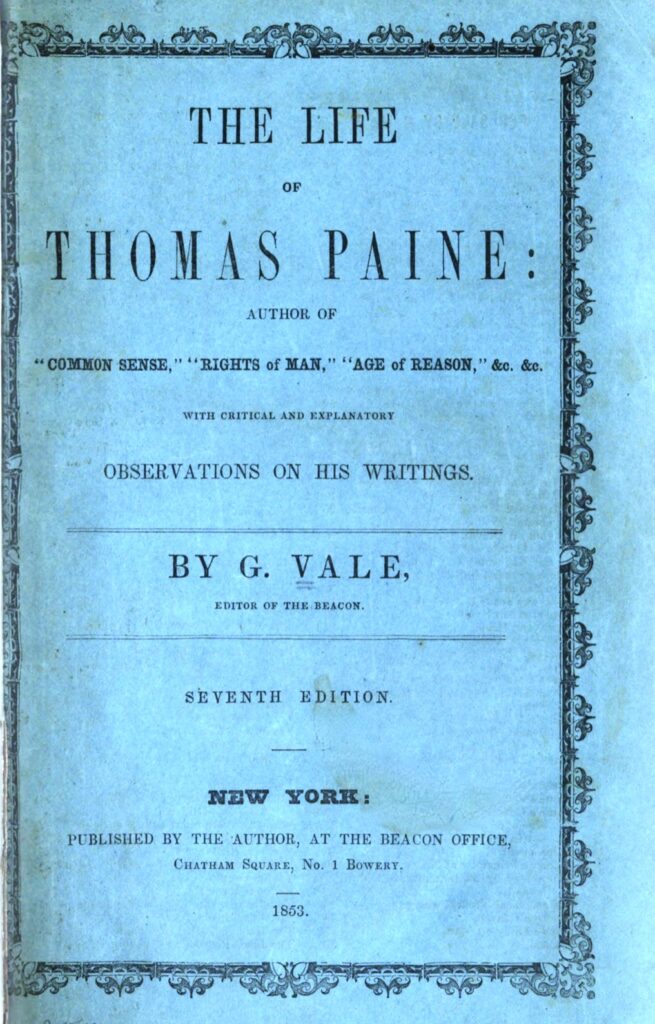
Of four lives that have been published of Paine, not one is now extant in the United States. The first was by “Francis Oldys,” alias George Chalmers, written in London in 1792 for political purposes, in a slanderous spirit, at the instigation of Lord Hawksbury. This soon passed into oblivion. The second was by a political renegade appropriately named Cheetham, (cheat ’em,) whom Paine scorchingly rebuked for the desertion of his principles, and thereby incurred his deadly enmity. It abounded, of course, in false allegations and bitter calumnies, which have been the “stock in trade” of all who have sought to blast the character of Paine. The third life was written by “an excellent and amiable Quaker,” named Rickman, “who was to Paine what Boswell was to Johnson.” With the best intentions, he was not the man to do the subject of his narrative justice. The fourth, written by T. W. Sherman, of London, though incorrect on some points, was the most reliable, but too exclusively adapted to English readers. The present life of Paine, by G. Vale, is unquestionably the most authentic of the whole series, written as it is in a calm and sober spirit, with evident care and candor, “nothing extenuating, and setting down naught in malice.” In his introductory remarks he says:—
“We are not about to write a eulogy; to enhance his virtues, or to suppress his faults or vices. Paine was a part of human nature, and partook of its imperfections; and our purpose is fairly to represent him as he was; but the greater part of Mr. Paine’s life was public, and as such we know of no man who had greater virtues or less vices.”
His natural life is distinctly marked into four periods: his history in England before he embarked for North America; his residence and exertions in this country during the revolutionary war; his return to Europe, and his exertions in France and England during the great French revolution and revolutionary war; and his final return and residence in the United States till his death. He came to this country in 1774, by the advice of Dr. Franklin, who was at that time in England, and who had the sagacity to perceive his talents as a writer, and to appreciate his zeal in the cause of liberty and equal rights. As soon as he landed, he became the bold and eloquent advocate of American independence; though, (says Mr. Vale,) as late as January, 1776—
“None talked of independence, but a few of no weight in society; as none of the leaders would risk their popularity in supporting what appeared hopeless: yet Jefferson, Franklin, Patrick Henry, and others, evidently wished independence: but this could only be supported by the unanimity of the body of the people; and these did not dare to dream of it. At this period of excitement, anger, and fear, Paine published his ‘Common Sense’ and boldly proposed independence, as the best means to get out of the difficulties into which they had now plunged; and as an object alone worth fighting for. This pamphlet effected wonders: it overcame difficulties apparently insurmountable, for it removed prejudices, generally a hopeless task: it convinced the people that the British constitution was not the best that could be, and that a government of kings, lords, and commons, might not be the essence of all that is excellent in each; but that the union might retain much that was bad in each: he satisfied the people of the disadvantages of carrying on war with a government whose authority was acknowledged: and he opened to them the resources within their power, and hinted at the possibility of getting foreign help as an independent nation. He produced, what his writings generally did produce, a change of opinion. The pamphlet was read from North to South; everybody talked about it; and each seemed surprised that he had not had the same thoughts, so clear did the propositions appear as explained in ‘Common Sense.’ The boldness of the language, indeed, alarmed those who are in the habit of understanding for other people: they had no objection to it themselves, but they thought the people not yet prepared for such opinions; and some ludicrous scenes occurred. The people, indeed, were not prepared: they read first from curiosity, and then became convinced. Paine absolutely produced the events he sought. He wanted a declaration of independence, and he produced the wish for it.”
Mr. Vale pertinently adds:—
“The impression which the first number of the ‘Crisis’ made on the public mind is evident by the very first sentence being handed down already to two generations, as a sort of watchword: ‘These are the times that try men’s souls;’ yet the dastardly enmity to Paine has suppressed the author. Thousands use this expression, while individuals only know the origin of it. Yet the fact of this expression being thus handed down, even in spite of the personal prejudices against the man, clearly shows the impression this well-timed pamphlet must have made on the nation.”
Historical truth demands the acknowledgment, that to no writer, at that eventful period, was this country so indebted for its independence as to Thomas Paine; nay, on such isolated events are mightiest consequences often dependant, it is very doubtful whether that independence would then have been attempted, had it not been for his patriotic appeals and the inspiration that pervaded his writings; yet who ever sees or hears his name honorably connected with that memorable struggle, in any celebration thereof? And why this injustice? It is because he was the consistent and courageous advocate of religious liberty, of mental as well as political independence, of the supremacy of reason as against theological dogmatism and priestly imposture. It is because he dared to read and judge the Bible as he read and judged any other book, and to reject the popular Protestant idea of its infallibility and plenary inspiration. Had he been silent on those matters, and submissively conformed to the prevalent religious opinions of the age, he never would have been held up as a monster of iniquity, nor been forgotten as among the foremost in and throughout the revolutionary struggle. But he could not stifle his own convictions, nor play the part of a dissembler. To quote his own words:
“It is necessary to the happiness of man, that he be mentally faithful to himself. Infidelity does not consist in believing or disbelieving; it consists in professing to believe what he does not believe. … When a man has so far corrupted and prostituted the chastity of his mind as to subscribe his professional belief to things he does not believe, he has prepared himself for the commission of every other crime. … I have always strenuously supported the right of every man to his opinion, however different that opinion might be to mine. He who denies to another this right, makes a slave of himself to his present opinion, because he precludes himself from the right of changing it. The most formidable weapon against errors of every kind, is Reason. I have never used any other, and I trust I never shall. … I believe in one God, and no more; and I hope for happiness beyond this life. I believe in the equality of man; and I believe that religious duties consist in doing justice, loving mercy, and endeavoring to make our fellow-creatures happy.”
These are noble sentiments, worthy to be recorded in letters of gold, and perfectly in accordance with the interrogation of Jesus, “Why judge ye not of yourselves what is right?”—with the apostolic injunction, “Prove all things”—and with the Golden Rule, “Whatsoever ye would that men should do to you, do ye even so to them.”
We are by no means endorsing all the views expressed by him in his writings, but only maintaining that he has been cruelly maligned and most unjustly treated,—we believe mainly, if not exclusively, on account of his theological non-conformity. Whatever may have been his error in this particular, he was no dissembler or time-server, but ever set an example of manly courage and conscientious integrity.
The common charge, that he was a man of grossly intemperate habits, has very little of truth in it; and if it were wholly true, it would only show that he was at last overcome by the universal custom of the times, in company with many eminent statesmen, politicians, and divines, and not as a legitimate consequence of theological opinions on one side or another. Let justice be done to his memory.