
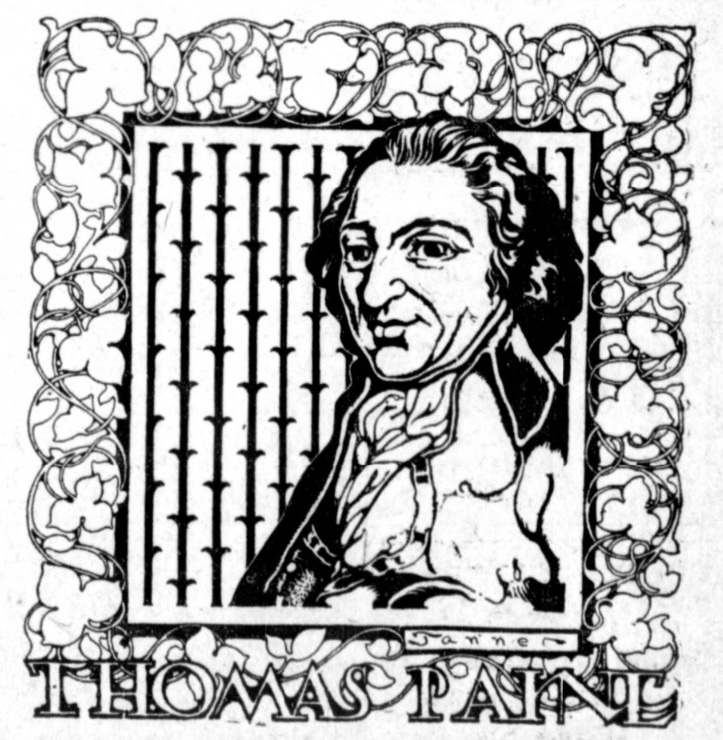
Blue-grass blade (Lexington, Ky.), June 2, 1901
Col. Breckinridge, “The Silver-Tongued Orator,” Eulogizes Thomas Paine.
TWO REMARKABLE LETTERS WHICH BREATHE EXPANSION.
Lexington Democrat
In a search for other material we stumbled on a correspondence between Thomas Jefferson, James Monroe, Thomas Paine and John Breckinridge, the elder, concerning the Louisiana Purchase.
On August 2, 1803, nearly a century ago, Thomas Paine, the author of Common Sense, then living at Bordentown on the Delaware, writes a letter to John Breckinridge, whom he addresses “My Dear Friend,” and, not knowing his address, whether in Washington or at his home on North Elkhorn, sends it under cover to Mr. Jefferson with the request that he read it and forward it. Mr. Jefferson does read it and forward it with a long letter of his own and encloses in his letter the celebrated draft of a proposed amendment to the Constitution concerning Louisiana as ceded by France to the United States, which was made part of the Constitution. These two letters are remarkable from every standpoint.
The respective authors, Thomas Paine and Thomas Jefferson, were able and learned men. Paine, a jurist learned in the civil and Roman law, had been of immeasurable service to the Colonies during the struggle for independence. After the Revolution his peculiar views concerning the inspiration of the Scriptures and the divinity of Christ estranged from him the vast mass of the people he had served. But Mr. Jefferson and John Breckinridge never withdrew their friendship nor abated their gratitude.
This correspondence cannot well be understood without one being somewhat familiar with the relation these four persons bore to each other and to the subject matter of the correspondence. But we do not refer to these letters today except for a reference in the letter of Thomas Paine. In speaking of the government to be formed for this newly acquired territory, he goes into a full discussion of the treaty and its peculiar nature and of the peculiarities of the population, and after pointing out that our purpose is not to govern the territory as provinces but incorporate it as States, he says:
“As to political condition the idea proper to be held out is that we have neither conquered them nor bought them and they become in consequence of that Union a part of the National Sovereignty. The present inhabitants and their descendants will be a majority for some time, but new emigrations from the old States and from Europe and intermarriages will soon change the first face of things and it is necessary to have this in mind in the first measures that shall be taken.”
In consultation with Mr. Jefferson and Albert Gallatin, John Breckinridge, then a Senator from Kentucky, drew the original governmental bills concerning Louisiana. Thomas Jefferson knew that John Breckinridge would have to defend, if not draft, them, and this accounts in part for his letter and that he sent it open to Mr. Jefferson.
But we call the attention of our readers to the remarkable prophecy contained in the single sentence quoted, its fulfillment and its precise description of the present condition of affairs in the Philippines and the certainty of a similar experience.
Thomas Paine! By that acquisition we had neither conquered nor bought those people but had formed a union with them and they became in consequence of that union part of the national sovereignty—not merely they who were then in possession of that wide and splendid territory but they who were hereafter to populate its noble and fertile stretches, and these of the future will be like unto us; they will be the descendants of Americans and Europeans just as we are. And is it not so today?
Comment: The above is about the first half of the editorial, the latter half of it basing the argument upon the position of Thomas Jefferson and ranking these two distinguished Infidels in the very van of American statesmen exactly as we Infidel apologists are wont to do.
The trouble with the political parallelism that Col. Breckinridge attempts to establish is that it is not parallel. The purchase of Louisiana was in perfect accord with the whole genius and spirit of the American Republic and was in absolute harmony with the Monroe Doctrine. The country was contiguous, cost $3,000,000 less than the Philippines did, we bought it from the people who owned it and wanted to sell it, its possession by our government was necessary for our defense in case of war by a foreign enemy, the people who lived on the territory wanted to be annexed to our government and there was not a single possible reason why the purchase should not be made.
With the Philippines, however, all of these conditions are reversed. We bought it from a people who did not own it. It was not merely the purchase of a white elephant but of an unjustifiable war, was opposed to the spirit of the Monroe Doctrine and in subjugating the people of that country we disavowed the principles for which Washington and Paine had fought and which Jefferson endorsed.
While all Infidels everywhere will appreciate this tribute alike to Paine and Jefferson from the silver-tongued orator of Kentucky, we will all decry any attempt on the part of anybody to put our Infidel patriot exemplars on the same level with the mercenary politicians of this day.
Our war against the Philippines, as against China, has simply been an outrage fomented by the priests, Catholic and Protestant, such as Paine and Jefferson would have held in profoundest contempt and disgust.
But this tribute to Paine from a man like Col. Breckinridge, a Presbyterian preacher and the son of a Presbyterian preacher, and the most effective defender of the Christian religion that Kentucky has ever had, is one of the most marked among the many marked evidences of the cyclonic sweep and seismic upheaval of Infidelity in Kentucky, and that is the leader in the American movement toward intellectual emancipation.
A thousand times as much as it has been the purpose of American Christianity to teach to the youth of this land the jewels of morals that Christianity borrowed from Buddhism, as the exodistic Jewish women borrowed the golden rings and bracelets of the Egyptian women, has it been the purpose of American Christians to teach our youth to hate the very name of Tom Paine, the most self-sacrificing of all American patriots in the days that tried men’s souls; and yet at last, in the dawn of the twentieth century, in Lexington, where religion and murder and race horses and tobacco and whiskey have all been but links of the same chain, the old dark and bloody ground picks out her most distinguished citizen, present company always excepted, to pay the very tribute to Paine that every intelligent Infidel has always claimed was due.
I was expelled from the Lexington Daily Press, then the most prominent paper in Lexington, simply because I wrote a little editorial ridiculing Talmage, and one of my neighbors, a wealthy and influential man, came to me and warned me that such writing would ruin me. Now Col. Breckinridge, a headlight in Episcopacy, a born politician who supposedly sets his sails for the popular breeze as the editor of a Lexington paper, the orthodoxy of which nobody doubts, says of Paine, the target for a century of Christian hate, all that I or any other radical Infidel would say.