
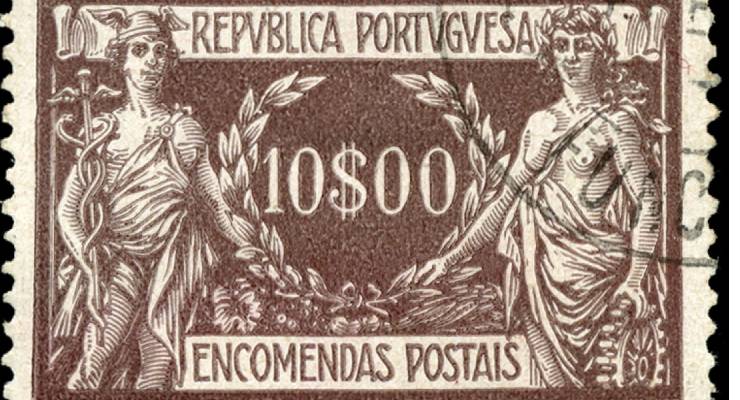
Rock Island Argus (Rock Island, Ill.), October 24, 1910
Final Fruit of American Declaration of Independence Now Being Plucked on Iberian Peninsula of Europe
By JAMES A. EDGERTON
The republic of Portugal is the latest recruit to the democratic army of nations. In a sense it is a child of the American Declaration of Independence and as such should be enthusiastically welcomed by all Americans.
Portugal in area is not much larger than the state of Maine and in population is but little bigger than New York city, yet the size of a world event cannot always be measured by a footrule or counted by the head. Portugal may start a fire in Europe that will burn far and consume several other thrones before the flames are quenched.
Poor little Manuel lost his crown overnight. The revolution was won almost as soon as started. Hardly had the world heard that there was fighting in Lisbon until it was met with the proclamation of the new republic. There was talk that Great Britain might interfere, but Great Britain had no time to interfere. Before Downing Street had awakened to the fact that something was happening it was all over.
News Broken Hastily
The first England knew of Manuel, looking apprehensively behind him and all out of breath, arrived suddenly at Gibraltar, just in advance of the Portuguese boat. As soon as he could collect his nerves enough to write he sent back a letter telling his countrymen that his hurried exit had been involuntary, which they already knew, and that his leaving was in no sense an abdication. That was also superfluous, as it was not necessary for him to abdicate.
Portugal had attended to all the little details in that line. When a king’s loving subjects chase him across the border, with the warning never to come back, it is not a matter of supreme importance whether he abdicates or not. Charles I and Louis XVI did not abdicate, but their heads did, which served the same purpose. Manuel’s letter was something like a fired employee writing back to his boss that he had not resigned.
The stage has had many high kickers who kicked off a Johnnie’s hat, but Gaby Deslys is the first that kicked off a king’s. You know about Gaby? She is the French danseuse with whom Manuel was so smitten that he had her down in Lisbon and danced attendance on her before the shocked eyes of the nation. In Paris they called her the uncrowned queen of Portugal.
Well, Gaby Deslys (pronounce it De-leel) had little to do with bringing on the revolution. The Portuguese are not a nation of prudes, though they do object to exalted rulers making love to dance-hall girls in public. It gets on their nerves.
Blow at Eight
Not only did the Portuguese tire of Manuel’s attentions to Gaby, but they grew weary of Manuel himself. They saw no permanent effect in the incongruity of a boy king. They concluded that a lad still in his teens was hardly fitted to govern an ancient nation merely because he happened to be somebody’s son.
Hereditary kingship might not look absurd were it not for the fact that the history of royalty abundantly testifies otherwise.
Portugal is something over a thousand years old, and she concluded she had grown up and was entitled to a grown-up ruler. So she dismissed her boy king with his ballroom affairs and elected as her president the most distinguished man of letters in the realm.
Theophile Braga is a poet, author, and idealist, who in his cottage has suffered for his principles. The revolutionists chose such a man to head the new republic. This shows not only that their hearts are in the right place, but also that some poets are honored before they receive their crowns.
America Republican Progenitor
Since our Declaration of Independence there has arisen a group of republics throughout the world. The first link in that chain was the United States. In 1776 Switzerland was under a cantonal government corresponding somewhat to our Articles of Confederation.
The so-called Dutch Republic was aristocratic, and the Stadtholder was virtually a hereditary king. Not only so, but there had never been a republic according to the new ideals. The republics of Greece and Rome and later those of Italy were only so in name.
The birthday of the American Republic was really the dawn of the republican age in all the world, the glory of which we have not yet begun to see.
Herein is the chief honor of America. Compared with it our material splendor is but cheap and vulgar. We hold the hope of the world. Our torch of liberty has shed a light into all lands, and it will be well for us if we feed the flame. The grafter, the mammonist, the reactionary, who does aught to subvert or retard popular government here in the land of its birth are not only enemies of their country, but foes to the best hopes of all mankind.
France First Follower
The French Revolution was the first fruit of the American Revolution. Then came Napoleon, who almost quenched the torch of liberty in Europe that we had started—almost, but not quite.
Napoleon was really the arch-enemy of popular government. No man perhaps ever had a greater opportunity for good, and none ever more miserably failed to live up to his high possibilities. On the ruins of the French Republic he erected his own empire. Over the budding or possible republics of the rest of Europe he placed as kings the incapable members of his own family.
Compare the career of the overrated Napoleon with that of the underrated and misunderstood Thomas Paine.
Paine sought no position for himself, but gave the work of a life for the liberation of mankind. He was the apostle of freedom in three lands. He was the real author of the American Declaration of Independence, but unselfishly permitted the credit to go to another. He donated a year’s salary to head a subscription when Washington’s army needed money and later went to France to appeal for funds from the French king.
He wrote on brown wrapping paper by the light of the campfire, using a drumhead as a desk, those immortal essays that were read at the heads of the regiments and that were described as “half battles.”
Paine was at the birth of the French Revolution and placarded Paris when the king took flight, helped to write the Declaration of Rights, and was the consistent friend of France throughout the struggle, going to prison and braving death for his convictions.
He penned the Rights of Man, which set England on fire for liberty and which later helped the peaceful revolution that swept over that country. He even arranged with Napoleon to write a new republican constitution for England when the Corsican should make his projected invasion. But Napoleon failed him, as he failed in almost everything else of real worth to mankind.
Paine a True Forecaster
Under the very shadow of the guillotine Paine risked his reputation by writing for religious liberty. He proposed the republic of Europe. He forecast most of the reforms that have occurred since his day, among them the emancipation of the slaves, the end of dueling, the age of peace, the single land tax, and the rights of women.
He wrote:
“The world is my country, to do good my religion.”
If Washington was the Father of His Country, to Thomas Paine will be reserved a yet higher title. When at last real history is written by men who can look above the fogs of prejudice, Paine will be recognized as the father of the republican era in the whole world.
When poor Paine died he was followed to his grave by only a woman and her two sons whom he had befriended, by a Quaker preacher, and a negro. Yet every new republic erected is his monument.
Such a man can afford to wait for the recognition of the ages.
Forever the right comes uppermost,
And ever is justice done.
If that is true, the world at last will put the name of Thomas Paine as high as before it has dragged it low.
Paine kindled the fire of independence and republicanism in America, and America in turn kindled it in other nations.
Long Battle in France
After Waterloo France went through the Restoration, the reign of Louis Philippe, the presidency and empire of the second Napoleon, and finally emerged through the Commune into a permanent republic forty years ago.
It required eighty years for her to reach the goal, but it was worth more than eighty years of struggle.
Fired by the revolution in France, the Helvetic Republic was established in Switzerland in 1798 and has grown in freedom from that day to the present.
Following the example of the United States, the Latin American colonies threw off the yoke of Spain and adopted constitutions modeled after our own. At our direct intervention Mexico was enabled to free herself from Maximilian. The last king left American shores when Brazil requested Dom Pedro to abdicate, a trifle more than a score of years ago.
The glorious chapter of American republics was completed when the United States took up arms to free Cuba.
The Influence of the American Idea
The influence of the American idea has accomplished more than the mere founding of republics. Directly or indirectly, it has aided in the fight to establish every constitutional government.
The reformation of Japan came directly from our friendship and example. The establishment of parliaments throughout Europe and Asia proceeded indirectly from the same source.
Today there is not a monarchy in Europe without some sort of parliament. Even Russia has her Duma, the Young Turks have triumphed in the Ottoman Empire, Persia has a constitution, and China recently convoked a senate with the declared purpose of calling together a parliament in a certain fixed period.
Colonies Show Effect
The same force has been at work in the colonial field. It was the loss of America which showed England the futility of her old colonial policy. She changed it for the better.
The result is that most of the dependencies of the British Empire are self-governing. Australasia, for example, has adopted some of the most advanced governmental ideas now in force on earth.
In all lands steady progress has been made, and the trend has been toward democracy. This movement for political freedom has had no small part in bringing about the marvelous material and scientific progress of the century.
Democracy throws men on their own resources and thus calls out their inherent powers and individual initiative. Likewise it removes shackles from their minds. The result is an era of invention, research, and advancement.
The American Declaration of Independence was the starting point of all this new development. The book of liberty of which it was the opening chapter has only begun to be written.
The Republic of Portugal is the latest paragraph, and Spain is preparing to write another. Already she has broken the shackles of church and state, and her full emergence from the night of monarchy is but a question of time.
Spain had a republic once under Emilio Castelar. True, it lasted only for a year and a day; but, having once heard the music of democracy, she will never be satisfied until she again evokes the harmony.