
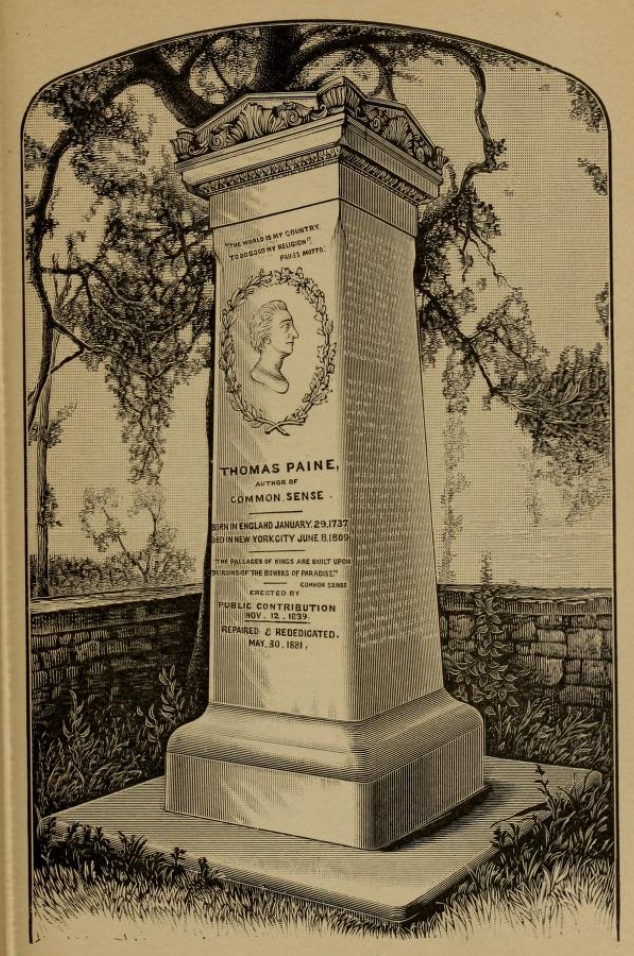
Blue-grass blade (Lexington, Ky.), June 19, 1910
PAINE’S VINDICATION
Address at the One Hundred and First Anniversary of the Death of Thomas Paine
BY T. C. Jefferies
Dennison, Ohio
June 1910
Mr. Chairman, Ladies and Gentlemen:
Foremost among the Revolutionary patriots stands the name of Thomas Paine. His name is linked inseparably with the noble men who “brought forth upon this continent a new nation, conceived in liberty, and dedicated to the proposition that all men are created free and equal.”
As an American patriot, Paine stands with Jefferson and Washington in point of service to the country, and in unselfishness he stands in the unprejudiced mind higher then they, for we must remember that America was to Paine an adopted country and not his native land.
When Thomas Paine was born there came into being a man who was destined to shape the affairs of nations. His influence was to be felt everywhere, and especially in three of the future great powers. His birth was practically in obscurity, but the man was not to long remain in that obscurity.
In America he fought with sword and pen. To him belongs the credit for a continuation of the hostilities with the mother country until the war was brought to a successful termination.
In France, his grandest act, and the act most characteristic of the man, was his plea against the death of the king, and for this he nearly lost his life.
It is seldom in the history of the world that we run across a man whose field of activity is so wide and extensive as was that of Thomas Paine. His field was unlimited, either as to place of subject. Anything that had to do with the welfare of humanity interested him personally and vitally. He had no particular sphere, he was universal. He concerned himself with all that had to do with the happiness of mankind and he went cheerfully wherever that great, broad, unselfish concern led.
My subject today is the vindication of Thomas Paine. In this age it seems a shame, a thing sad and fully unnecessary to vindicate a man who, in his life, did so much, and in a way so unselfish and so generously for the human race. They say that this man was not good; that he was not a drunkard, that he was not beastly, that he was not filthy. And if it were not for the love of God that some folks feel, it is for the love of their heavenly father which some folks have, it WOULD NOT be necessary to vindicate him, either. As a rule, whisky plays a leading part in the life of all infidels, it is said. If it were not for the infatuation of some folks for their God, for their Bible, for their religion, we would not need to say, and keep on saying, that Thomas Paine was not a bad man. Paine expounded a new gospel, a gospel of reason and love, of humanity and equality, he would make the world a better place in which to live and would banish sorrow from the world. And, of course, the clergy joined with those tyrants, even the clergy joined in singing his praises then. That was before he wrote the “Age of Reason,” and he was a good man in the eyes of all. He had not yet attacked the tyrants of heaven, but had confined his efforts to the destruction of cruelty and oppression on earth. He had not yet knocked at the clergy’s support, not yet shown them up in their real light and so he was acceptable and satisfactory to them at that time.
Before he wrote the “Age of Reason,” Thomas Paine was universally acknowledged as a benefactor of mankind, excepting in the castles of kings and czars. So long as he limited his activity and gave his attention only to the destruction of tyrants on earth, Paine was a hero in the eyes of all. But the moment he carried his work to the clouds, the moment he transferred his scene of action, and levelled his attack at the throne of God, the moment he carried his work where it logically led him, and destroyed the tyrants of heaven, that moment he drew down upon himself the everlasting wrath of those pious people who tell us to love our enemies and say that it is better to give than to receive. Those of the emotional preachers recognized in Thomas Paine a man who would make the people think, and this they resented as they always do. If there is anything a devout Christian dislikes to do it is to think. He prefers to pay men to do that for him.
Paine denied the god of the Bible. Paine would have nothing to do with such a god. This cruel deity conflicted too much with his idea of a happy state was Freedom, and not Slavery; Liberty, and not Oppression. And so when in the face of death he wrote his honest thoughts about religion in general he drew down upon himself the everlasting wrath of those pious people. They immediately arrayed themselves against him. With their usual keen perception they at once proceeded to get on the wrong side, as they always do and always have, but let us hope, not as they always will. They were immediately against this man. They could not answer his arguments nor deny his logic. And so, with customary skill in such matters, they abused him, slandered him, villified him. And they have not yet ceased lying about him. And so, while it should not be necessary for Thomas Paine to be vindicated, we must brand as contemptible lies these shameful tales which have had their origin in the pulpit.
Standing at the head of those priestly lies is the charge—most important to the clergy—that Tom Paine recanted on his death bed, and expressed great regret at ever having written the “Age of Reason.” Why the long-faced worshippers find such a death comforting is because they have been taught that all of those who die infidels die in agony and terror. And thus comes the necessity for truth loving citizens to arise and deny the falsehoods wrung from the pulpit and heaps of godless, unable to answer our logic. The clergy seem to think it wholly impossible for a man to die as he has lived, guided by reason and the laws of nature. They don’t seem to think it is possible for a man to balance the accounts of this life, and close his books and bid farewell, without grasping at an extenuation or a wafer or something of that sort, some manufactured article put out by the theology factory. They don’t seem to possibly conceive, that will close his eyes, and take his departure, and bid the life and world adieu, unless his room is filled with holy candles and his pillow is wet with looking priest or preacher comes and praises god, prays to god, asks god and thanks god in the customary way. Prayer in the sick room, flickering candles and a psalm singing doctor might be very idealistic, but we have to go back to the vindication of Thomas Paine. In this he showed that a man who had lived such a life, did so much, and in a face of death he went his honest way.
That Thomas Paine did not change the opinions he held about religion during his life-time, is proven to the fair minded mind by the works of the man, if in no other way. It has been claimed that while writing the “Age of Reason”, Paine was generally drunk, but all that is necessary to refute this lie is to submit the “Age of Reason” to any fair minded man or woman in the world and will say that that work is a masterpiece of a sane and sober mind. Those accusations have been made against Paine and both have been proven false. I cannot, will not believe this man was bad, that he was an objectionable character, excepting perhaps to the theologians and tyrants, of whom he was objectionable to them.
Letters of good men and good women, to the effect that Thomas Paine did not recant, and that he did not die a drunken death, did not die disgraced. Were there no such statements and letters showing that Thomas Paine died as he had lived, a Man, I would still refuse to believe that the man who wrote the “Rights of Man,” and “Common Sense,” who cheered and inspired men at the front with “The Crisis” and who in the face of Death wrote the “Age of Reason,” died a hypocrite and a slave to vice. I would still deny that he who said, “The World is my Country, to do Good is my Religion,” died so bad and worthless, when he had lived so good and so useful.