
Rock Island Argus (Rock Island, Ill.), June 17, 1910
For Tom Paine, a New Rochelle Home
New Rochelle Home to Be Dedicated as Museum Under His Name.
TO CONTAIN MANY RELICS
Life Sized Wax Figure of American Patriot to Be Given Prominent Place.
A century after the death of Thomas Paine, the Revolutionary patriot, the honors so long denied him are being paid. The process is somewhat slow, but four or five years ago an organization was perfected of those who wish to bring Paine into his true place among the founders of American liberty, and it is making progress.
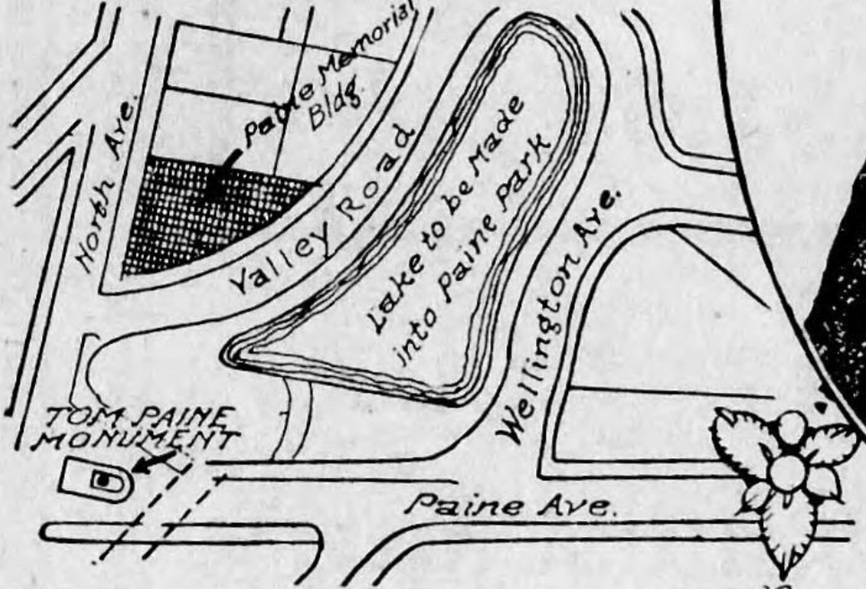
It is planned to open a Thomas Paine National Museum at New Rochelle, N. Y., on Memorial day in the old house presented to Paine by the state of New York in 1784 in recognition of his services in the Revolution. There will be appropriate exercises, including addresses by well known men representing different societies, and admirers of Paine from all parts of the United States will be present.
This house, which is now owned by the Huguenot Society of New Rochelle, stands on the Paine farm, which was presented to him with the house, a farm of 277 acres, confiscated by the state from a Tory named Frederick Devoe. The Thomas Paine National Historical Association, which was incorporated in 1905, is in charge of the arrangements.
The museum is to contain relics of Paine, and the association has a great number of cartoons and caricatures of the patriot, mostly of English origin and provoked by the publication of his “Rights of Man.” It has many Paine portraits and first or early editions of his works, “Common Sense,” “The Rights of Man,” “The Crisis” and “The Age of Reason.”
Life Sized Figure of Paine.
One of the most interesting things in the museum will be a life sized wax figure of Paine in a sitting posture, with quill in hand. This figure was made in New York city at a cost of $200. It will be seated in the very chair Paine used in his library at the New Rochelle house. This chair has been presented to the museum by the Badeau family of New Rochelle, in whose possession it has remained for a century or more.
The wax figure is a remarkably fine portrait of Paine, carefully modeled from the best pictures extant. It shows him at the height of his career, when he was about thirty-eight or forty years old. The costuming is exactly correct. On this wax figure James F. Morton, Jr., a New York lawyer, wrote the following sonnet:
This is no image, but the very man
Who lived and labored for the rights of all,
Unheedful of the calumnies that fall
On him who serves his kind. Since time began
No greater prophet faced the savage ban
Of priest and king—and raised the mighty call
Which shattered the foundations of that wall
Upreared by greed on its own evil plan.
He sits before us, calmly as in life,
Holding the pen which made the tyrant quail
And thinking lofty thoughts of liberty,
Still cheerful in the darkest hours of strife
And hearing through the roaring of the gale
The still small voice that bids all men be free.
The house stands about fifty feet from the monument erected by Gilbert Vale, one of Paine’s early biographers, a half century ago. On North avenue, directly behind the house, is the spot where Paine’s body was originally buried. He died in New York city, at a location now known as 59 Grove street, although the house was long ago replaced by another.
One of His Great Admirers.
He wished to be buried in the Quaker burial grounds, but the Friends refused to allow it, and three days after his death a little company of his faithful friends walked all the way from New York to New Rochelle and interred it on North avenue. Ten years after the burial William Cobbett, the noted English radical, came to America and removed the body to England. He was a great admirer of Paine and believed that America had neglected him.
Cobbett’s intention was to have a fine monument erected over Paine’s English burial place, but England was in the throes of great political events, and Cobbett was unable to get far with his project. When he died Paine’s body was still in his home in an attic room. It disappeared, and unavailing efforts have since been made to trace it. All that has ever been recovered is a small portion of the brain, which Dr. Moncure D. Conway secured four or five years ago and brought to America.
Dr. Conway was the first president of the Paine Historical Association, and he turned the relic over to that organization. On Oct. 14, 1905, with appropriate ceremonies, it was interred under the monument in its original resting place. With it Dr. Conway secured a lock of Paine’s hair, and this will be one of the relics that will be on exhibition in the museum.
The monument raised to his memory at New Rochelle was often mutilated by fanatics, but has been restored.