
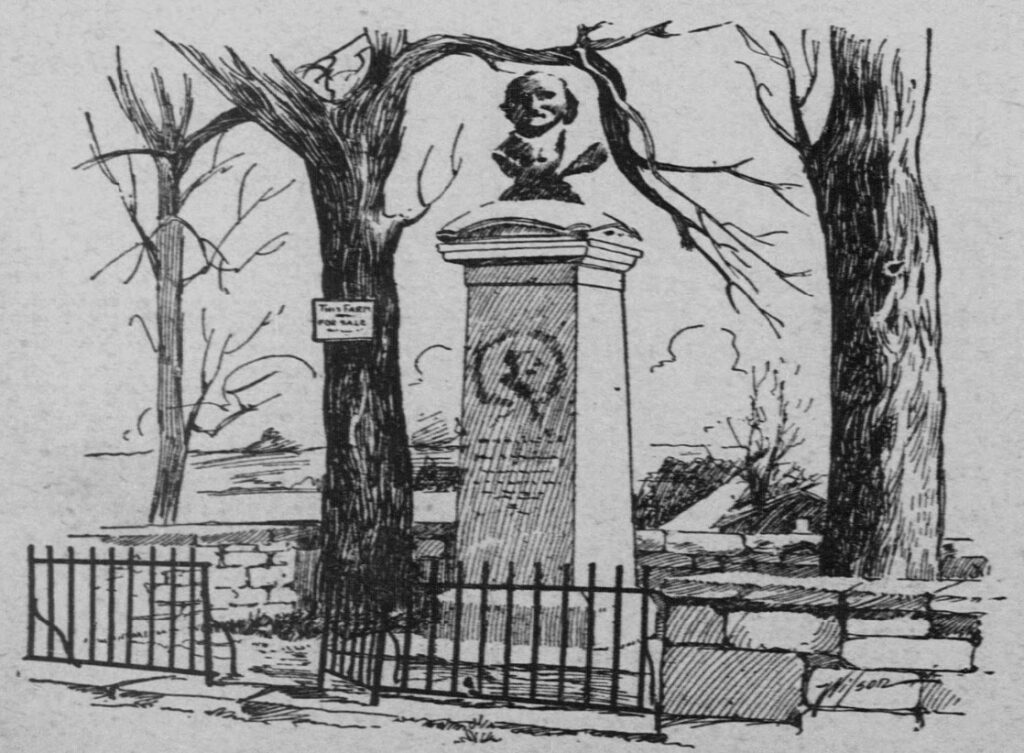
Blue-grass blade (Lexington, Ky.), July 25, 1909
Secretary Sends Particulars of the Recent Celebration—Some Information Concerning Paine and the Junius Letters
By James B. Elliott
I desire to inform the readers of the Blade that the Paine Centenary meeting at New Rochelle was a decided success and to thank those subscribers of the Blade who contributed funds that helped defray the necessary expenses incident to the event. The most interesting feature of the occasion was the interest taken by speakers who have never before spoken from the platform of Thomas Paine’s Associations. The interest taken by clergymen in Thomas Paine since the writing of his biography by Dr. M. D. Conway is indeed gratifying and the good work done by Thomas Paine is being discovered and is now acknowledged by those who formerly ignored his services. Indeed your Secretary was proud of his work. It took two meetings to give opportunity to express appreciation of Thomas Paine. At the Brooklyn meeting the Rev. Robert J. Lochark and Rev. Henry Frank and Henry Rowley spoke and at New Rochelle meeting Fra Elbert Hubbard, Dr. David Saville Muzzey, of New York Ethical Society and the Rev. Thomas R. Slicer delivered a most interesting address, which the Association hopes to print later, for the benefit of its members and those interested. I have received letters from all parts of the country giving particulars of Paine meetings. Those wishing to keep posted should address the Secretary for particulars.
I wish also to announce the death of two of our members Mrs. Carrie Burnham Kilgore on June 29th, age 71 years. She was the first woman to become a doctor in New York and the first woman admitted to practice law in Pennsylvania. Her husband was the President of the National Liberal League, 1876, and that raised the $1,500 to purchase the marble bust of Thomas Paine, accepted by Independence Hall in 1905, through this association. Mrs. Kilgore was a spiritualist and has addressed many Paine meetings, always willing to defend his character. The funeral services were held in the Unitarian Church, which I attended.
I am informed by Mr. John Cyrus, of New Rochelle, that Captain Lloyd, the veteran Paine defender and an old old resident, died July 9th, at 3 p. m. Captain Lloyd was present at the Paine Centenary on June 5th, and enjoyed the services very much. I shall have to defer particulars. I want the readers to get the news as fresh as possible. I wish to add that we are indebted to Mr. Van der Weyde, of New York, for his services to our Associations in photographing the Jarvis bust of Paine and for the views taken during the services. The number present was large, considering the threatening weather.
HOW TO READ JUNIUS UNMASKED
By B. O. Fenton
Philadelphia, Pa.
“The genius of Paine was a flower that blossomed slowly, but life is a sequence and the man who does great work has been in training for it.”
– Elbert Hubbard
Those who never read “J. U.,” should get a copy; also a bottle of red ink and in every instance where there is the same word, or a similar word underscore it, or as will be necessary in some instances to draw the red line from a certain word down across several lines to a similar word for instance, page 254. On line third are these words: “Repeated—petitions.” On the ninth line are “repeated petitioning:” draw the red line across six lines and all like instances throughout the book, and when you have critically read and marked as suggested, your book will look as if dipped in the blood of the lamb. There are hundreds of Freethinkers who never read the book, and doubtless but few who have made it a critical study. It aims to demonstrate two things, namely, that the Junius letters were written by Thomas Paine; also, the Declaration of Independence was written by Thomas Paine. I have a letter of Junius which was published in London in 1774. Hear him: “For to what regions of the habitable globe shall we go to find a set of men so detestable as our clergy, for their pride, haughtiness, covetousness, voluptuousness, indolence and self conceit.”
In “C. S.” in speaking of the continent, Paine wrote: “Of at least one-eighth part of the habitable globe,” the last two words are in both: Junius habitable globe — Paine habitable globe. There are over three hundred similar instances between Paine and Junius. In Modern Thinkers there is a chapter devoted to the end and aim that Paine was Junius. Right here I desire to ask the Freethinkers of England or elsewhere if they can prove Captain Payne to be Thos. Paine; further, can you ascertain if Dr. Wilmot, the brotherinlaw of that mysterious Capt. Payne, married a sister to the wife of Thos. Paine. If you have or can obtain any valid information on this point you will have served one fact, namely, that Capt. Payne was Thos. Paine. All who have Modern Thinkers can realize by study why I have made the above statement. Wm. Henry Burr says all of his biographers have represented him as being poor. Burr thought otherwise. See his pamphlet, Thos. Paine was He Junius. It appears reasonable to infer that if Thos. Paine was on the ocean and “just returned from several years privateering to the West Indies,” as Denslow says, page 347. I say that it is reasonable to infer that he gained a pittance which enabled him later in life to stand by Washington’s Army and contribute a year’s salary. How else could he have done it? Conway says nothing as I remember about Paine being a “Sailor,” as he wholly ignored the Paine authorship of Junius, perhaps he deemed the Paine “Sailor” matter of no importance. We want the facts. Burr has annihilated Conway on this issue. See “Junius, Casea, C. S., and Thos. Paine.” Let every reader of Conway’s Life of Paine obtain this tract, 10 cents. The facts are overwhelmingly in favor of Paine being the author of the Junius letters as well as the Declaration of Independence. One of the greatest living critics has discovered new additional matter against Jeffersonian hypotheses. Let every reader send $1.50 to Mrs. W. H. Burr, 1017 K. St., N. W., Washington, D. C., and obtain the work in question; also the pamphlets cited; and one more, Thos. Paine Was Junius. Do not confound the one called Thos. Paine was He Junius with the one Thos. Paine was He Junius. Three pamphlets in all, by Burr. Devote one year’s critical study to each and five years to “J. U.” You will begin to get one foot on the first round of the ladder in studying Thomas Paine. These have converted Jas. A. Randall. More about Mr. Randall later.