
By Terry Liddle

The ideas of the French Revolution, ideas so eloquently advocated by Thomas Paine, were liberty, equality, fraternity and the rights of man. For Pope Pius VI and the hierarchy of the Catholic Church such ideas were evil and heretical. For them man had no rights, only a duty to serve God in the situation in which the Almighty had placed him, obeying his masters and believing in and upholding the ideology of the Catholic faith.
By 1794 seditious literature, advocating the ideas of the French Revolution was circulating underground in the then Spanish colony of Mexico. The Catholic Inquisition alerted the viceroy and urged him to ban publication of Thomas Paine Rights of Man and the reading in any college of any book about the French Revolution The viceroy banned Paine’s book and hearing that three hundred copies were being sent to Mexico from New Orleans, he ordered his customs officials to seize and destroy “this extremely abominable book” and assured the Inquisition that he would do all in his power to defend “the public tranquillity of these rich and precious domains where flourish the most tender and true sentiments of religion, love and loyalty to the King.”
The viceroy was most upset when he discovered that the leading advocate of the French Revolution in Mexico was his French chef. When not cooking the chef was organising the distribution of revolutionary literature. The InquiMion found the chef guilty of advocating the abominable doctrine of liberty and irreligion. The chef, together with all Frenchmen, was deported.
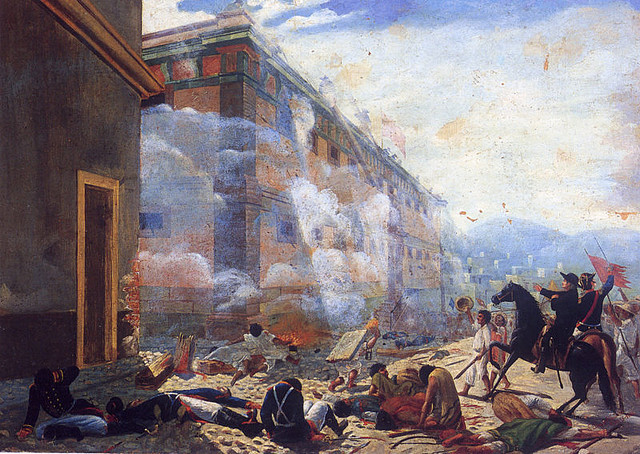
In 1810, Mexico struck out for independence from Spain. The leader of the revolution was an apostate priest and Freemason Manual Hidalgo who was shocked by the poverty and injustice suffered by the Indians who were his flock. Hidalgo was a social as well as a political revolutionary. He denounced the rich and demanded that their wealth be expropriated and divided between the state and the people.
After a six-month struggle, Hidalgo was defeated and captured. He was condemned as a heretic by the Inquisition, excommunicated and removed from the priesthood. It took the military three goes to execute him.
The Inquisition demanded that he be erased from memory. Anyone who had his writings or portrait was to be excommunicated. So effective was this ban that there are no known contemporary portraits of Hidalgo.The struggle was continued by Jose Morelos who in turn was shot in 1815. The Spanish Liberal Freemason Xavier Mina fled to Mexico where he aided the independence struggle. He was shot in 1817.
Mexico finally won its independence as the result of the coming to power of a Liberal government in Spain. A leading figure in this was Rafael del Riego. Having fought the French who came to influence his political ideas he was eventually hanged by Catholic reactionaries in a Madrid public square. The Song of Riego was a Republican anthem during the Civil war of 1936-1939. Those who came to power in Mexico were conservative reactionaries not Liberals.
The history of Mexico from then on was the history of a struggle between reaction backed by the Catholic church and the big landowners and progressives who wanted political and social democracy. One example was the struggle between the reactionaries who wanted to place the Hapsburg monarch Maximillian on the throne and the Indian lawyer Benito Juarez who led a successful guerrilla war.
In more recent times, we have seen the leaders of the democratic revolution of 1911 such as the Freemason and vegetarian Francisco Madero and the peasant revolutionaries Francisco Villa and Emiliano Zapata murdered and power falling again into the hands of reaction.
The end of the 20th century has seen the rising of Indian revolutionaries in South West Mexico who have named themselves for Zapata. They say they want to change the world but do not want to take power. A fascinating idea.
For all those fighting for democracy the ideas of Paine have provided a constant background of political thought.