
By Derek Kinrade
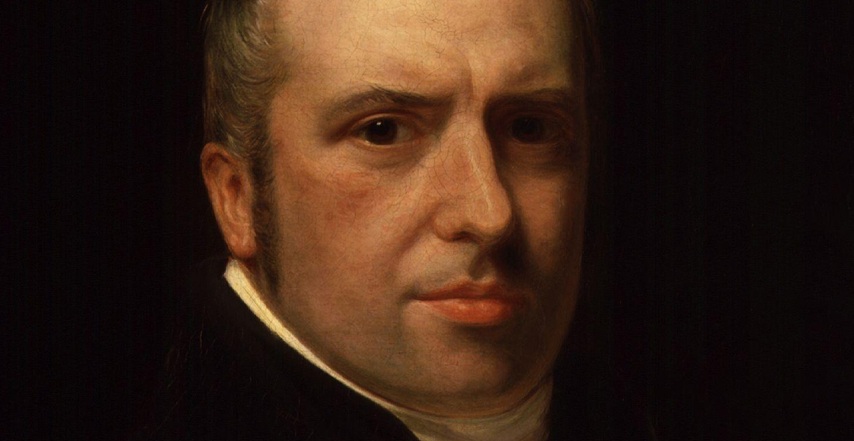

Anyone who looks at William Hone’s life in the round will discover some failings, notably a lack of a consistent sense of direction. His radical period was short lived, and he had neither the literary genius of Thomas Paine nor Henry Hunt’s rapacity to rouse an audience. He is best remembered for charming miscellanies rather than radical squibs, was regularly unsuccessful in business, and finally succumbed to the comforting embrace of religion. Writing of his late ‘conversion’ his biographer. Frederick Hack-wood, says:
“Hone was now long turned fifty years of age. and his life so far — as men count such things – had been a failure. Bankrupt in estate and broken in health, with the heavy responsibilities of a family still resting upon his shoulders, what outlook had he on life? What hope did he possess for the future? Would his old friends come to his assistance again? Or, did he not feel that by his incorrigible commercial incompetence he had wearied their patience, that he had completely exhausted their indulgence? Who shall say what his feelings were when he was now casting about for a new anchorage? Was he seeking new friends, or was he realising that there was some other support, some more abiding source of comfort, which hitherto he had always missed? Who shall judge him?”
Not then-a candidate for a lifetime achievement award; yet strangely this erratic man played one of the key roles in securing our freedom of expression.
Childhood
I could say of I lone’s early life — as some sources do- simply that he had a strict religious upbringing. That is true, but fails to explain why Hone turned his hack on a discipline of nurture that amounted to indoctrination.
In an extended note, written in 1835, he tells us that his father, having served as an apprentice to a law stationer. became intimate with “theatrical people” and was about to go upon the stage, when he was suddenly struck down by a severe illness. As a result of this experience he became “decidedly religious”. Hone could remember, as an infant. standing between his father’s knees. listening to Old Testament stories. The Bible was his father’s only book. He constantly read from it and used it to teach his first-born son to read.
The family moved to London in 1783, Hone’s father having secured employment as a solicitor’s clerk. His son’s education now passed to an elderly woman, Dame Bettridge, who taught local children in her own home, also making great use of the Bible. Hone loved her and was “happier there than anywhere”. It was infinitely sad, therefore. when he learned that she was dying. lie tells the story of her passing with great sensitivity and reveals an element of it that is of consummate interest: for as he had stood crying by his teacher’s bed he was told that “a gentleman was coming”. That gentleman was none other than John Wesley, a preacher roundly hated by Hone’s father and frequently spoken of among his associates as ‘the Old Devil’. On the contrary. however, the great man attended affectionately and reverently upon the dying old woman. As he withdrew he also laid his hands upon the young Hone’s head, saying “My child, God bless you, and make you a good man’.
Hone never again thought ill of Mr Wesley, a view confirmed in later life by a study of his writings. But as a child his knowledge was constrained by what his father gave him to read. He delighted in John Bunyan’s The Pilgrim’s Progress, taking it literally and reading it many times over. This was followed by the same author’s The Holy War, which he found less interesting
James Janeway’s A Token for Children (“an exact account of the conversion, holy and exemplary lives and joyful deaths of several young children”) and. later, Foxe’s ‘Book o fMartyrs. What really fascinated him more, however, was nature. With another, slightly older, boy he gained deep affection for quiet, solitude and the London countryside. This love remained with him throughout his life, detaching him from “alluring society and busiest occupations”.
In 1787, his education was continued in a boy’s day school, again with a strong religious flavour but he soon succumbed to the virulent disease of the age, smallpox, coming near to death. In the following years, after a very slow recovery, Hone’s father took over his son’s education, teaching him to write and requiring him to learn lessons from the Bible “thoroughly by heart”. It was during this period, in July 1789, that (as Hone tells us with exquisite detail) a boy he knew stopped him in Hand Court. Holborn from driving his hoop to say. “There’s a revolution in France”. At much the same time, the nine-year-old Hone first met his future wife. Sarah Johnson. the only daughter of friends of his father and mother.
It was inevitable that the young Hone could not be confined forever. He saved up from his penny- a-week pocket money to acquire hooks from local shops situated within the range he “was allowed for walking”. He was befriended by a nearby copper-plate printer who awakened his love for old books and a love of engravings. He also met people whose literary vision extended beyond that of his father. At the age of eleven he found a copy of Bishop Huet’s Essay on the Weakness of the Human Understanding, which, he recalls, first led him to “reflect”. He was also making good progress at school; that is until he was bullied by “the son of a parish officer”. His father took him away and this, he remarked. “ended his scholastic attainments”. Further instruction was given by his father, but limited to two hours a day, which given the nature of the instruction was perhaps just as well. Confined at home, Hone became listless and found that the tasks set him from the Bible made the book itself distasteful. The crunch came when, one morning at breakfast, his father required him to learn by heart a ‘heavy’ passage from the Bible in time for his return to dinner, warning him that if he failed to learn it perfectly he would strictly chastise him. Hone found that he was unable to learn a single word and was duly thrashed. From that time on the boy “regarded the Bible as a book of hopeless or heavy tasks”.
Seeds of doubt
At the age of twelve, Hone made his first serious attempt at writing. Unsurprisingly, given his background, it was anything but radical: an intensely patriotic panegyric in six verses, the first two of which suffice to demonstrate the thrust of its content:
“Come Britons unite, and in one Common Cause
Stand up in defence of King, Liberty, Laws:
And rejoice that we’ve got such a good Constitution,
And down with the barbarous French Revolution!
“There’s Egalite Marat, and famous Tom Paine
Had best stay where they are, and not come here to reign.
Be staunch for your King, and your good Constitution,
And down with the barbarous French Revolution!
The piece was accepted by the Association for Preserving Liberty and Property against Republicans and Levellers, and Bone received “presents” from those who had promoted the publication which just exceeded its expenses. He had known of Paine’s Age of Reason from a friend, who saw it as “a mischievous work”. This view was reinforced by his father, who gave him a copy of Bishop Watson’s Apology for the Bible, written as a response to Paine’s radical work. Hone thought that Watson proved the untruth of much that Paine had written, yet significantly he also found that the Bishop’s work created doubt in one who had never before doubted.
In the following years, as he grew into adolescence, Hone had several unfulfilling employments, mostly under his father’s watchful eye or. if not, governed by his own conditioned conscience. But within these constraints he had better access to books and even to the theatre (despite an acute awareness of “the vices inseparable from theatrical acquaintances”). An unexpected development, however, was his falling in with another young man with very different ideas: a “seducingly eloquent” friend who was convinced “that religion was a dream, from which those who dared to think for themselves would awake in astonishment at their own delusion”, and who looked forward to a ‘new philosophy’. By now Hone was beginning to think for himself. Ile saw God as the “great Creator”, who, being satisfied with what he had made, left those he had created to do the best they could for themselves. As to Christianity, he imagined that with the cultivation of the intellect, it would – like earlier obsolete religions – disappear, and that ‘Reason’ would become omnipotent. Nevertheless, upon a thorough perusal of the New Testament he concluded that ‘the character of Christ stood out as an example of inimitable virtue”.
With such conflicting thinking, and merely sixteen years old, Hone became a member of the London Corresponding Society, an organisation much at odds with the government of the day. His association with the Society and other debating groups greatly distressed his father but he was “determined not to be swayed”. Disregarding paternal admonitions and remonstrances, l Hone was making a bid for independence.
Steering clear of dangerous waters
Hone’s father had good reason to be concerned that his son had joined the London Corresponding Society. It had been formed in January 1792 to bring working men together, primarily to press for constitutional reform and an extension of suffrage in parliamentary elections. Some reformers advocated Paine’s idea of electing delegates to a national convention based on the French model. As such, the authorities saw the Society, and similar provincial groups, as subversive. In October 1793. Two of its members were sentenced to transportation, and in the following year three leading protagonists, including John Home Tooke, were charged with high treason, said to have encouraged people to disobey the king and parliament. In the event the prosecution was unable to convince the jury, which returned ‘not guilty’ verdicts, but the government then moved swiftly to suspend habeas corpus, so that perceived agitators could in future be detained without bail or trial. The Seditious Meetings Act of 1795 further curtailed the activities of the movement for reform, and there were further arrests in 1796.
Sensibly, Hone’s father found a place for his son in a solicitor’s office in Chatham, out of harm’s way. By the time of his return to London in 1798, the London Corresponding Society was virtually dead. But religion had also ceased to have any charm for him. He still attended a chapel, but privately regarded the sermons of Rowland Hill with detached scepticism. Rockwood describes him as “cherishing the doctrines of a deistic rationalism”.
By now his preoccupations were elsewhere. In 1799 he took lodgings in Southwark and in the following year married his childhood sweetheart, and opened a book and print shop, with a circulating library, in Lambeth Walk. Ile delighted in the world of books- especially antiquarian books – but, lacking adequate finance, signally failed to translate that interest into a viable business in any of a succession of businesses. In one of these he partnered Kidd Wake, a master printer who had recently spent five years in Gloucester Penitentiary for the offence of shouting `No George! No war!’ in the direction of George Ill’s carriage. In another partnership he teamed up with John Bone, the former secretary of the London Corresponding Society, who had been imprisoned without trial for three years on a warrant for treason. These business associates no doubt go some way towards explaining Bone’s emergence as a radical pamphleteer, but another important consequence of his involvement in this and later enterprises was that it also brought him into contact with a number of distinguished customers, some of whom remained friends in times of trouble. He was also busy with his pen, his early work involving books on gardening and farriery, editing Charles Millington’s The Housekeeper’s Domestic Library, and indexing Bemer’s Translation of Froissart.
But he was dogged with illness, and little of what he attempted achieved any measure of success. Ilackwood remarks that this was typical; he repeatedly embarked on commercial enterprises without sufficient capital: “He was constantly in a maelstrom of debt, struggling against heavy rents and grievous taxation…To the hour of his death life was one unsuccessful struggle”. He was declared bankrupt in 1810 and again in 1811, by which time he and his wife had seven children, barely supported by occasional contributions to literary journals. Even his philanthropic endeavours failed: an abortive project with Bone to establish a national savings bank and annuity plan, and the creation of a society for the gradual abolition of the poor rate. Both were too far ahead of their time, though it is interesting to notice, in the light of current proposals for welfare reform, that the prospectus for the latter society claimed that the Poor Law had failed in its purpose, and that rather the poor needed to be taught not to depend on ‘charity’ but to rely on their own exertions.
From 1806 to 1816 Hone appears to have written nothing truly radical, focusing rather on a miscellany of disparate subjects that attracted his interest, reported in the manner of an observant. critical journalist. Neither the banning of the slave trade throughout the Empire, nor the victories of Wellington, nor the Anglo-American war, nor the ill-fated French invasion of Russia provoked him to comment. But he was alert to social abuses and cases of injustice. In 1813 he proposed and joined a self-appointed committee of inquiry into the conditions in and treatment of patients in mental asylums. Visiting one asylum after another, they found that maltreatment and brutality was common. The resulting report reinforced the findings of official reports, not least by focusing on and illustrating the dreadful condition in which one patient, William Norris, was confined. Hackwood is in no doubt that “to Hone’s unwearied efforts may be attributed, to a great extent. the steady advance of humane treatment of the mentally afflicted.”
Late in 1814, lione and his family moved into a house with a bookshop at 55 Fleet Street, and in 1816 he opened a shop at 67 Old Bailey. Bookselling brought him into contact with many of the radicals of his time. ‘They included Francis Burdett (1770-1844), John Cartwright (1740-1824), Francis Place (1771-1884), and Robert Waithman (1764-1833).
Hone’s humanitarian concern next led him to take an intense interest in the trial and execution of a servant girl, Elizabeth Fanning, on a charge of triple murder. The case against her could not show motive, was based on purely circumstantial evidence, and so prejudiced as to persuade Hone to gather signatures for a petition for mercy. When this failed to save her from the scaffold, he published, in 1835, The Case of Elizabeth &ming and a pamphlet The Maid and the Magpie, his first collaboration with the illustrator George Cruikshank (1792-1878), whom he had known since 1911.
Truly radical
Circumstances soon conspired to thrust Hone firmly into the radical camp. It is difficult to say whether he was provoked or provocative, or perhaps merely saw an opportunity to make some money. In 1815 the government had raised the stamp duty on newspapers to 4 pence a copy, so that The Times cost an exorbitant 7 pence. ‘This was clearly intended to restrict the circulation of unfavourable news to the working classes, but the unwanted result was also to stimulate cheap, unstamped, radical and often disreputable publications. Even the eminent William Cobbett was moved to produce a slimmed-down version of his Political Register priced at two-pence. In his first two and a half years as a publisher Hone claimed to have issued upwards of one hundred and thirty pieces, mainly of his own production.
Favourite targets for disaffection were the Holy Alliance, the restored French monarch Louis XVIII and our own overweight and licentious Prince Regent, mercilessly caricatured by Cruikshank. In August 1816 Hone added a famous contribution when he published his View of the Regent’s bomb, now uncovered for the gratification of the public in St. James’s Park, majestically mounted, on a monstrous nondescript, supposed to represent legitimate sovereignty. A cannon presented by the Spanish government had been unveiled in the park, and Hone and George Cruikshank took the opportunity to lampoon the Regent, with suggestive analogies between ‘bomb’ and the Prince’s ample posterior (bum) Such scandalous material could hardly be challenged without giving it unwanted publicity, but Hone was now a marked man. The government’s view was made clear in the Regent’s speech at the opening of Parliament in January 1817, when he declared that its programme would “omit no precaution for preserving the public peace, and for counteracting the designs of the disaffected”. This did not go down at all well. On his journey back from Parliament a crowd hissed, jeered and, it was alleged, sought to assault him. In the same month, Hone, greatly assisted by another zealous reformer, Francis Place, had already launched a Weekly Commentary, and from February 1817 this was quickly absorbed into The Reformists’ Register, also selling for two-pence. It urged parliamentary reform and ridiculed the allegation that the Prince had been attacked. But the incident strengthened the government’s case. With the excesses of the French Revolution still relatively fresh in mind and fearful of a popular uprising, it brought forward so-called ‘gag acts’. which included legislation to suspend habeas corpus and allow indefinite detention without bail or trial. Lord Sicimouth, the Home Secretary, followed this up by ordering Lords Lieutenant to “apprehend all printers, writers and demagogues responsible for seditious and blasphemous material”. It was enough to persuade Cobbett to beat a retreat to the United States, causing the temporary suspension of his Register. Hone’s similar polemic filled the gap. It maintained the thrust of Cobbett’s incisive reports and, in April, left no doubt as to Hone’s political sympathies when he paid fulsome tribute to the great man, as having “sown amongst us the seeds of Reform, which have taken deep root, which all the harpies of corruption and violence can never eradicate, and which in good time will bring forth good fruit.” Cobbett’s Register reappeared in England in July with material sent from America, and with the withdrawal of Francis Place’s involvement Horn’s publication survived only to 25 October 1817.
In trials
The government employed a network of spies and informers intended to root out dissent, but in practice the authorities found it difficult to secure convictions on charges of sedition. They took no action against Hone’s Register, perhaps because he had provided them with an easier target. In January and February of 1817 he printed and published three parodies written in the style of parts of the Catechism, the Lord’s Prayer and the Ten Commandments, a device that laid bim open to charges of blasphemy contrary to religious sentiment and far more likely to be condemned by traditional jurors. The story is relatively well known, for it largely accounts for Hone’s celebrity. Informations were laid against him in April by Sir William Ganow, the attorney-general, and without warning he was arrested in the street on 3 May and kept in custody for two months. When he heard of the charges, Hone’s father came to him and said “William, what have you done?” And out of respect for his father’s concern, Hone suppressed any further sale of the parodies, much though he needed the money. While held, he received various invitations to support treasonable activities. all of which he saw as attempts to entrap him, and which he firmly repulsed. Indeed, remarkably, he was able to use his Register to relate the alleged perfidious dealings of government agents.
The eventual proceedings were brought in December. not on a single composite charge but on three, heard separately on successive days: firstly against a parody of the catechism, secondly of the litany, and lastly of the Athanasian (‘reed. There is not space here to detail the alleged impieties, but as an example one passage should suffice to capture the nature of the alleged profanity.
“Our Lord who art in the Treasury, whatsoever he thy name, thy power he prolonged, thy will be done throughout the empire, as it is in each session. Give us our usual sops, and forgive us our occasional absences on divisions; as we promise not to forgive them that divide against thee. Turn us not out of our places; but keep us in the House of Commons, the land of Pensions and Plenty; and deliver us from the People. Amen.”
Sir Samuel Shepherd, who had succeeded Garrow, led for the prosecution, whereas Hone, unable to afford legal representation, conducted his own defence. Crucially, he had succeeded in advance. with the help of a city solicitor, to disallow the appointment of special (i.e. chosen) jurors. At the trials he did not cut an impressive figure but despite his shabby appearance, his mind was acutely incisive. Taking his inspiration from the trial of John Lilburne in 1651, he was well prepared and conducted himself most ably, arguing that his parodies were essentially political and that the familiar religious associations merely served as a vehicle to carry his message. implying no disrespect for the original texts or their original content. Hawkwood rightly describes the three trials as amongst the most remarkable in our constitutional history producing more distinct effect upon the temper of the country than any public proceedings of that time. Hone spoke directly to the jury as an avowed Christian, disputing each charge successively for six. seven and finally eight hours. The second and third trials attracted a multitude of spectators and were presided over by no less a legal luminary than the severe Lord Ellenborough, the Chief Justice, determined to secure a conviction. At the opening of the last trial lion addressed the jury in lines which were not famous. deserve to be:
“Gentlemen, it is you who trying me today. His lordship is no judge of me. You are my judges, and you only arc my judges. His lordship sits there to receive your verdict…I trust his lordship today will give his opinion coolly and dispassionately, without using either expression or gesture which can be construed as conveying an entreaty to the jury to think as he does. I hope the jury will not be beseeched into a verdict of guilty.”
On each of the three historic days, on all three charges, Hone was found ‘not guilty’. It was a triumph for justice, as well as of sheer endurance, but one that left him exhausted. Nevertheless he emerged a hem, greeted by thousands of well-wishers and enshrined for all time as one of the great saviours of press freedom.
A fresh start
At the end of the trials Hone was showered with compliments from friends and admirers. One of them, John Childs (1784-1853). an ardent radical who ran a large printing firm in Bungay; was to remain a friend for life. He congratulated Hone on “the glorious victory you achieved over ministerial hypocrisy and judicial tyranny”. And from then on, every Christmas, Childs and his eight sons raised a toast to Hone’s triumph and hacked this up with the present of a turkey. Yet for all the glory, Hone was now quite without financial means. Well-wishers – aristocrats and commoners – rapidly promoted a subscription on his behalf which raised £3,000. But a third of this money was spent on advertising and another third stolen, so that only £1,000 ever reached the intended beneficiary. Nevertheless this was enough for him to open a large shop at 45 Ludgate Hill, from which he planned to make a fresh and more ambitious start. The trials had taken a toil on his health as well as his pocket. He was afflicted with severe physical problems and what he described as “habitual melancholy” which together limited his business plans and his involvement in public life. In February 1819 he confided to Childs that if he were able to provide for the future of his wife and children he would be happy to pass to “where the weary are at rest and the wicked cease from troubling” and confessed that his mind was not as it ought to be. Over the following years he continued to be plagued with ill health, fits and neuroses, probably aggravated by fatigue, and came to experience hallucinations, delusions that had also afflicted his father.
Despite all this, he continued to write, resuming in 1818 with a detailed account of his trials. In the same year he launched the first issue of his Facetiae and put his relationship with George Cruikshank which had begun in 1815 – on a business footing. Then, in the following year, an event occurred that reignited his radical tendencies. On 16 August at St Peter’s Fields in Manchester, an estimated 60,000 people had gathered at a rally calling for the reform of parliamentary representation. One of the rostered speakers was the radical orator Henry Hunt. Ordered by local magistrates to arrest him, local cavalry charged the crowd with sabres drawn, killing eleven people and wounding 400. The government’s response was to introduce even more repressive legislation, but for the people the massacre. dubbed ‘Peterloo’ (after ‘Waterloo’ ), defined and inflamed the movement for reform and stiffened their resolve. Hone’s personal response was to send for George Cruikshank. Together, this memorable partnership, produced the much admired and hugely successful The Political House that Jack Built (December, 1819) — the title a parody that had occurred to Hone after observing one of his daughters reading the old nursery rhyme. His verses and Cruikshenk’s etchings audaciously attacked the political establishment and, again, the Prince Regent. The pamphlet, priced at one shilling, caught the public mood and sold in thousands. This time, the government, fearful of another popular humiliation, took no action to suppress it.
Ridicule proved to him a powerful, and popular, weapon against the ruling elite. Among many of Hone’s publications which followed, the most popular and best remembered, hugely enhanced by Cruikshank’s illustrations, included The Queen’s Matrimonial Ladder (1819), representing the steps on Queen Caroline’s unhappy relationship with the monarch; The Man in the Moon t1820), a parody on a speech to Parliament by the Regent; Non mi ricordo (I don’t remember) (1820), a satirical blast against the trial of Queen Caroline that George IV took to the House of Lords, and the imperfect memory of one of the witnesses; Hare’s Political Showman – ar Horne (1821). caricaturing leading politicians of the day: and finally A Slap at Slop and the Bridge Street Gang (1822), a satire against Dr John Stoddard, a former leader writer for The Times, and the Constitutional Association, an organisation founded specifically to oppose seditious and immoral publications.
A change of direction
Quite what led Hone to turn his back on further radical pamphlets is unclear. Perhaps his poor health led him to seek quieter waters; perhaps the imperative was to find new means to stay financially afloat. But the transition to other interests was emphatic. In 1820 he published his Apocryphal New Testament, an academic recapitulation of material he had gleaned while preparing his defence in 1817. It brought together texts omitted by the compilers from the authorised version. Even this, while avoiding politics in one sense, proved highly controversial in another and was attacked from all quarters. Three years later he brought out Ancient Mysteries Described, a further product of his antiquarian research, and on 1 January 1825 launched his well- known Every-Day Book a miscellany of odd information that had come his way.
Debtors’ prison
Though successful, this project involved considerable expense and did nothing to relieve his parlous finances. These had been deteriorating for some years, and do not appear to have been helped by the employment of a clerk whose conduct was later described by one of Hone’s daughters as “a course of treachery”. In April 1826 Hone was arrested for debt and carried off to a lock-up house, so hurriedly that he had to leave behind, and lost, a perfect set of his publications. His considerable family was thrust out of their home at 45 Ludgate I fill and took temporary refuge with his father. Hone was confined in a tobacconist’s shop within the area outside the walls of King’s Bench Prison known as the ‘Rules’. Remarkably from there he was able to continue to produce copy for his Every-Day Rook or Everlasting Calendar of Popular Amusements, which was printed and published elsewhere. In all it ran in the two years of its publication to 104 weekly numbers.
By contrast, the work that was closest to his heart, a projected History of Parodies on which he laboured from about 1819, never materialised. In preparing the ground for it he had purchased. at considerable expense, a large number of books and prints dating back to 1611. But when “pressing embarrassments” assailed him the whole collection had to be deposited as security for cash advances from a few friends. Sadly, the loans could never be repaid and Hone’s treasured library was sold ‘under the hammer’.
Hone’s resilience, however, was unbounded. In January 1827, while still within the prison ‘rules’ (he remained confined for nearly two and a half years), he launched a new periodical, The Table Book, similar to the Every-Day Book. The writer Christopher North (John Wilson) of Blackwood’s Magazine described it as having “spirit-stirring descriptions of old customs, delightful woodcuts of old buildings, as well as many a fine secret learned among the woods and fields”. Among those literary correspondents invited to provide material was Hone’s friend Charles Lamb. He had previously supplied personal articles for the Every-Day Book, but now became a constant contributor, writing regular extracts from the collection of plays that David Garrick had left to the British Museum. The enterprise lasted less than a year, impeded by Hone’s continued illness, the loss of his son William and a severe injury suffered by a second son, Alfred. Despite its literary success, sales of The Table Book did little to assist I lone’s recovery from debt, which was quantified by an account rendered by the publishers. Messrs Hunt and Clarke. This revealed that, despite the enormous effort that Ilone had made. £400 was still needed to satisfy his creditors and secure his release.
New ventures
In the event, Hone gained his liberation only by again submitting to bankruptcy at the end of September 1828 (a fate to be shared by his publishers in the following April). With his family. he promptly removed to 54 Newington Green. This famous property remains as part of the oldest terrace in London, having been the home of Dr. Richard Price (1723-91). minister of Newington Green Unitarian Church and one of the foremost champions of British political dissent and civil liberty. At this address Price had welcomed such luminaries as Benjamin Franklin (a close friend). Thomas Jefferson, Thomas Paine, John Adams, William Pitt, David Hume, Adam Smith and Mary Wollstonecraft. My research has failed to discover the circumstances that led to the impoverished Hone being able to take up residence in such a prestigious home. It cannot be that, penniless and bankrupt, he could have secured the tenancy of such a house without help; moreover, the synergy between his views and those of its former resident strongly suggests that such help must have had some basis in the values he shared with the illustrious cleric.
Bone immediately began work on an illustrated calendar for 1829, advertising his third daughter. Matilda, as publisher. And in the same year he spent three weeks in Liverpool on a mysterious mission which he described as “an affair of the utmost importance to my family” which would alter their and his own destination in life. Hackwood speculates that this “momentous expedition” was made as a desperate effort to raise money to put an end to his financial difficulties. Be that as it may — and the purpose remains undiscovered it was unsuccessful. Hone appears to have been rebuffed and he returned to London disappointed.
The failure of Hunt and Clarke had resulted in the stock and plates of Hone’s works being sold to another publisher, Thomas Tegg of Cheapside, who, according to one of Ilone’s daughters, was to reap a ‘rich harvest’ from the sale of reprints. As usual, Hone was less fortunate. After 15 months he found himself unable to sustain his family’s occupation of 54 Newington Green. The prosperous Tegg took action to raise a further subscription among Hong’s friends to enable the unfortunate writer to take over The Grasshopper, a coffee-house and hotel in Gracechurch Street. This was followed by a national public subscription to finance its fitting out. Tegg, with an eye to new business. also paid Hone £400 to provide the text and illustrations for a year’s issues of a 64- page monthly magazine The Year Book ft) Daily Recreation and Information. to build on the success of his previous miscellanies. The first issue appeared in 1831 and continued into the following year. though not without difficulties. The idea had been that the coffee-house would he run by Hone’s daughters, leaving him free to pursue his literary pursuits: but in practice they could not keep up, and Hone was obliged to labour there from morning to night with scarcely any time for writing, until its eventual failure in 1833.
Nevertheless, taken together, the three non-radical publications- (of which a well-chosen selection is reproduced in John Wardoper’s The World of William Hone), arguably represent his most memorable contribution to English literature.
‘Conversion’
Shortly after the move to Gracechurch Street Hone began regularly to attend services at All Hallows in Lombard Street. It had been a long time since he had attended a place of worship, and he felt moved by “most of” the supplications in the church liturgy, but was less than satisfied by the discourse from the pulpit. It happened that on New Year’s D-ay 1832, having sent his children into All Hallows, he went on. without any firm purpose, to Basteheap. There it struck him that as there had been a change of ministry at the King’s Weigh House chapel, the new man might be worth hearing. Ile had been there about 38 years earlier, and now went in just before the text was given. The new minister was the Rev Dr Thomas Binney (1798-1874), a Congregationalist who was to become popularly known as the ‘Archbishop of Nonconformity’. Its sermon had a dramatic impact on Hone. To quote his own words: “To my wonder, everything appeared changed the world and its pleasures, literature and its choicest works, had lost their charms — in short, I found that I myself was changed. and the mystery of salvation, through the blood of Christ, God made manifest in the flesh, is to me, through the eye of faith, and by the power of grace, a precious truth, by which my rebellious will has been subjugated, and my heart reconciled to God.”
Hone continued to attend the Weigh I louse, apart from an unexplained three months in temporary lodgings at Kingsland Green (close to the intersection of Boleyn Road and Bails Pond Road). In this period he attended Whitefields Tabernacle (presumably the offshoot in Moorfields) where the minister was the dissenting Congregationalist Rev John Campbell (1795-1867).
A move to Camberwell
Despite his ‘conversion’, misfortune, rather than blessing, continued to he Hone’s lot. On 27 January 1833, while attending a service at the Weigh ]louse, he suffered a paralytic stroke that deprived him of the use of his right side, was carried into the vestry “as one dead”, and for many weeks anticipated his end. With his wife and younger children, he was removed from Gracechurch Street in a helpless state to lodgings at Woodland Cottages, Grove Lane, Camberwell. Creditors of the coffee-house business took possession of his home and all his pose lions, and the rest of his family was dispersed, leaving him (as he wrote to his brother): “without a friend 1 could look to, other than Almighty God, who had been my merciful support throughout my affliction”. Then in April came the news that his mother had passed on, with her son still so afflicted as to be unable to attend the funeral.
Hone’s new-found faith (it may be thought remarkably) held firm.
Renunciation of his past
Hone’s priority was to make his peace with his reclaimed religious regime; more specifically to seek admission to fellowship at the Weigh House. His first approach, in October 1834, was met generously, but with some circumspection, by Dr. Binney, who was mindful of “outsiders’ opinion” of the “notorious Mr Hone”. He also felt that it would help if members of the Hone family joined him in his application. Binney invited him to prepare a formal statement of his “change of views and feelings”. The remarkable document that Hone carefully prepared in response is reproduced in full in Hackwood’s biography. It summarised much of the information contained in this article, but presented it as being from one who had seen the error of his ways. hone had come to believe that rational Christianity did nothing to give succour in times of distress, whereas submission to the “Divine grace” created an avenue for intercession and spoke to him “Peace, be still”. But for some readers credulity will be tested when, towards the end of his lengthy statement, he attributes his paralytic stroke to the Almighty having suddenly suspended his mental and bodily functions while engaged in His worship. The statement went on: “Every infliction from His hand has driven me closer to Him, and been sanctified by His holy spirit to enlarge my views of His abundant mercies, and ne’er-failing Providence”.
Indeed, some readers may find the whole statement whereby Hone “humbly !presumed] to claim fellowship with the Church of God”, unduly penitential. As he had said himself in Aspersions Answered (1824), in everything he had until then put on paper there had been;
“Not one immoral, one indecent thought,
One line which, dying, I would wish to blot!”
We have seen that he was essentially a humane person and certainly no firebrand. Samuel Carter Hall (1800-89) described him as “a small and insignificant-looking man; mild, kindly, and conciliatory in manner, the very opposite of a traditional demagogue”. Nor were his radical squibs misplaced. He lived in a despotic age, headed in. Britain by a monarch of notoriously dissolute habits. Distress and discontent were widespread, the populace hungry and repressed, parliamentary voting reaffirmed and concepts of equality and human rights barely considered. Justice was cruel and open to abuse, with harsh penalties for minor offences. Throughout his ‘radical phase’ he upheld Christian values, detested injustice, and, though some alleged it, could never have been considered an atheist. Frances Rolleston (1781-1864), his neighbour in Camberwell, was in error (or at least exaggerated) when in 1853 she brought out a retrospective of his life under the title Some account of the conversion from atheism to Christianity of the late William Hone. It is true that at the age of 16 Hone declared that he was “a believer in all unbelief”, but this was surely no more than a teenage rebellion. lain MoCalman points out that even at his most radical Hone was among those “Puritan rebels” who made the Bible an emblem of truth. He “deployed this legacy brilliantly in his celebrated court defences of 1817 land with] Cruikshank featured the Bible conspicuously beside Magna Charta and the Bill of Rights as part of ‘the Wealth that lay in the House that Jack Built”‘. Thus while Hone became more conventional in religious expression, and undoubtedly presents us with a paradox, there was no question of a conversion in the sense of a heretic turned believer.
The Congregationalists had no such reservations. Hare’s expression of a change of heart was enough to satisfy a Weigh House church meeting. Hone, his wife and several of their children were admitted to membership on 30 December 1834.
By this time Hone and his family had somehow been able to move to Rose Cottage, Peckham Rye Common, where they were to spend the next three years. It was an agreeable move. Even while recovering from his stroke, he was able to attend Mr ‘Thomas Powell’s Baptist meeting in Rye Lane: “a small Church. of poor and despised people”. On one occasion, Hone even managed (with difficulty) to deliver a short and simple address at a tent meeting on the Rye.
The surroundings in this “quiet and remote place- were peaceful and congenial and his health gradually improved. The family delighted in frequent Sunday-school treats on the Common. Frances Rolleston recalled one such outing in the summer of 1834:
“I found him there, happier than ever, boiling the tea-kettle over his cottage hearth for the rejoicing party of a Sunday School Anniversary on Peckham Rye, running backwards and forwards with it. followed by his own little girls, with all the glee of a child.”
Back to work
Hone was eventually able to return to gainful employment: first undertaking the revision of evidence previously taken in a Thames navigation inquiry, and then in December 1835 also being appointed as ‘sub-editor’ of the journal Patriot at a weekly salary of £2. This was a publication for evangelical non-conformists, for which he was well suited. The paper was pro-active in taking on ‘issues’, protesting against church rates and other inequalities and abuses of the times. On one occasion. Hone even left his desk to seek the support of Sir Francis Burdett in the campaign to abolish church rates. This was almost like the old days, but Hackwood slyly suggests that the baronet “probably regarded him as an extinct volcano”. Be that as it may, Burden resisted Hone’s pleas.
What Hone had not anticipated, however, were the hours. He had been led to expect that his attendance at the Patriot offices would be “trifling”, whereas in practice the business of the paper often detained him until midnight. While he was also involved with the Thames inquiry evidence. he found that he had scarcely any leisure time, often rising at 4 am and returning home early the next morning. In the course of the Thames work he had taken on the compilation of an index of the evidence, a task that caused – in his own words – “distressing symptoms of having over- laboured”. On one Saturday he did not get home until 3 am on the following day, when not even a walk on the Common could restore him. Having progressed only a few hundred yards his mind became confused and his sight obscured. His doctor resorted to the application of leeches.
He gave up on the index. but his small salary was important to him and he persisted in his other work. So much so that a few months after joining the Patriot he took up residence at the office of the paper at 5 Bolt Court. But even this strategy was insufficient The journal became bi-weekly in 1836, and the strain on Hone began to tell. He found it difficult to sleep because “the reporters were here in the house all night, and all night the doors were slamming between the goings to and from of them, and the compositors in be news-office.- Though he struggled on for a year he periodically suffered paralytic attacks, and in June 1837 became so ill as to be unable to come down from his upstairs room. He overcame even this episode, but his powers continued gradually to diminish. As he wrote to Miss Rolleston: “The mind, as mind, is clear and firm. I am only to others seeming idiotic or idiot-like.
To make matters worse he was quite unable to make ends meet on £2 a week, and resorted to selling off his cherished library. Finally in June 1840 he found himself unable to continue his editorial work. lie moved yet again, to Tottenham. where death came to his aid in 1842. Shortly before he drew his last breath on 6 November, George Cruikshank and Charles Dickens came to see him. as did Rev Binney and Rev John Davies, minister of Tottenham Baptist Church. All four attended his funeral. He was 62 years old.
Sources
Frederick Wm. Hackwood: William Hone, his life and times (Fisher Unwin, 1912), which has quotations from [Tone’s own notes.
The Hone Archive: https://honearchive.org
Bill Ure: Cobbett and Hone, tribulations and trials (Cobbett’s New Register, v.10, no.4, 2003)
J.B. Priestley: The Prince of Pleasure, and his Regency 1811-20 (Heinemann, 1969)
Samuel Carter Hall: Retrospect of a Long Life (Appleton & Co. 1883) ii, p.29.
Who was William Hone? (Adelphi University) at hup://libraries.adelphi.edu/bar/hone/intro.htm€
lain McCalman: Radical Underworld — prophets, revolutionaries and pornographers in London 1795-1840 (Clarendon Press, Oxford, 1993 — paperback edition)
Frances Rolleston: Some account of the conversion from atheism to Christianity of the late
William Hone (Keswick, 1853) John Wardroper The World of William Hone (Shelfmark Books, 1997),