By Denis Cobell

Religion For Atheists. Alain de Botton, London Hamish Hamilton. Hardback ISBN 978-0-241-14477-0 £18.99
Alain de Botton describes his book as a non-believers’ guide to the uses of religion. Looking at religious practices, he thinks we have thrown the baby out with the bathwater in our modern secular society. He looks only at the bathwater, he believes sacramental processes are needed to form the gel of a caring community. At a low level, he fails to notice the squabbles these generate; what happens when flowers are arranged in a church to the dislike of certain parties, and similar issues?
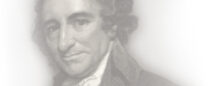
How can the ‘nice’ bits of religion be separated from their ideologies which have generated fear, hatred and persecution ? Practically all enlightened progress since the Renaissance has been made in the face of opposition by representatives of religion. Paine, and his publishers were no exception.
Atheism until recently was only admitted with caution. This book comes close on the heels of other publications taking a ‘soft’ approach to atheism; Londoners may note this is akin to waiting for a bus, then several turn up at once!
In 2008, the English translation of French philosopher Andre Comte-Sponville’s, The book of Atheist Spirituality1 appeared. This attempted to re-discover a spiritual heritage lost through being too closely intertwined with religion. Comte-Sponville writes, “it is possible to do without religion but not without communion, fidelity or love”. De Botton finds these latter essential qualities found in religion! A third book, Ariane Sherine’s compilation, The Atheist’s Guide to Christmas (2009)2 was a lighter look at how non-believers can celebrate the winter solstice; it contained contributions from, among the usual suspects, Dawkins and Grayling. Taking a more robust view, Robert Stovold’s, Did Christians steal Christmas? (2007)3 is an historical stance on pagan and more modern origins of the December festival.
De Botton is a non-believer of Jewish parentage, a multimillionaire, founder of The School of Life’ and proponent of a vast atheist temple. He is often heard on the radio and television. But there is a great deal missing in this book.
Religion for Atheists is a curious book. The author has nostalgia
for something he never experienced. But he finds remnants in Jewish, Christian and Buddhist religions which appeal to his sense of community which these faiths provide. I have heard this called ‘belonging’ rather than ‘believing’. At the outset he dismisses debates about the truth of any religion as “the most boring and unproductive question one can ask”. I have been involved in discussions about the existence of god and I’m inclined to agree. There are no answers to convince those of the differing camps. De Botton sees only the good he wants to see in religion. Nineteenth century secularists, Bertrand Russell and Richard Dawkins might never have existed. In this book we are stuck with the old conventions of BC and AD, not the updated form of BCE and CE.
The longest chapter deals with education. The author derides too much concentration on grades and exam performance. This may be good; education, education, education was the mantra of New Labour in 1997. What we got was war, war, war. De Botton finds the concentration of book learning in such as John Stuart Mill and Matthew Arnold in the nineteenth century at the root of our move from true education. As he has a double-starred first in history at Cambridge, he should know!
In this book of some 300 pages, there is lots of white space, and also paintings and photographs; some Old Master paintings, albeit only in black & white, enhance the text while other pictures leave the reader wondering as to their significance. The word Islam, and the religion associated with it, get no mention. He loves so much about the rites and rituals; but male circumcision in Judaism and Islam is not included. As this practice is considered barbaric by some, and certainly rarely consensual, it provides further examples of de Botton’s blinkered approach. He admires the spirit of neighbourliness, the joining of congregations for singing, communion and feasting. He extols the way religion brings abasement of monarchs at feet washing ceremonies for the poor and its lack of concern with worldly success or wealth. He should tell that to the Vatican City and those who shunned the ‘occupy’ camp at St Paul’s recently. The tents may have deterred some paying visitors to the Cathedral, but otherwise it was the nearby Starbuck’s customers who were most discomfited!
So what are we left with? The word secular is used in the sense of non-religious, not the purist definition of separation of church and state touted by the National Secular Society. Humanism, as a positive code of morality without religion or superstitious back-up fails to gain entry. Yet new ways of celebrating a life at time of death, as well as baby naming and weddings are the most common source of knowledge about humanism and the British Humanist Association. These ceremonies without god are on the increase year on year.
De Botton applauds all the wonderful human gatherings and festivities generated by religious organizations; he also praises the works of humans in music, poetry, art and architecture. True many patrons have been found through religion for the creation of these artefacts. But there are many secular equivalents, and just a few which have been borne out of non-religious ethical groups. In London, Conway Hall is home of the South Place Ethical Society; its roots may have been religious, but it has long dropped the connection to become a centre of humanist thought and action. Above the proscenium in the main hall are proclaimed Shakespeare’s words: ‘To Thine Own Self Be True’. In Leicester is the even older Secular Hall, with statues of Socrates, Owen, Paine, Voltaire and, perhaps surprisingly, Jesus.
In the nineteenth century Auguste Comte put forward ideas for a Religion of Humanity, with institutions and buildings for ‘secular churches’. This did not succeed; de Botton sees in Comte recognition that humans have a need for religion. Durkheim, one of the founders of sociology, used this as part of his theory about the part religion plays in human ‘camaraderie and solidarity’. De Botton recognises our sense of anomie, but barely accepts attempts to overcome this in the past.
Visiting cathedrals, ministers and churches are notable aspects of modern pilgrimages, which we call tourism. I think walking into a centuries old country church gives one a feeling for history and the past in a very human way; it has nothing to do with religious observance, it is just somewhere to find a place that has been trodden by forbears and find out about their lives. Before a certain date, all records of birth, marriage and death were in the parish registers.
In common with some of his generation, de Botton finds Buddhism offers ‘something’ missing from the Judeo-Christian tradition. Even Sam Harris, in his 2004 The End of Faith4 veers in this direction; though Harris spoilt it by suggesting Islamic terrorists should be nuked before they get us!
Apart from the humanist rites of passage mentioned, there is a clear need for this ‘something’ in our lives as non-believers. In the 1960s, with more optimism than we appear to have now, Richard Robinson wrote in An Atheists’s Values5: “We need to create and spread symbols and procedures that will confirm our intentions without involving us in intellectual dishonesty. The need is urgent today. For we have as yet no strong ceremonies to confirm our resolve except religious ceremonies., and most of us cannot join in religious ceremonies with a good conscience. When the Titanic went down, people sang ‘Nearer my God, to thee’. When the Gloucester’s were in prison in North Korea they strengthened themselves with religious ceremonies. At present we know no other way to strengthen ourselves in our most testing and tragic times. Yet this way has become dishonest. That is why it is urgent for us to create new ceremonies, through which to find strength in these terrible situations. It is not enough to formulate honest and high ideals. We must also create the ceremonies and the atmosphere that will hold them before us at all times. I have no conception how to do this; but I believe it will be done if we try”. That is the challenge.
References
- THE ATHEIST BOOK OF SPIRITUALITY. Andre Comte-Sponville. Bantam 2008 ISBN 978-0-553-81990-8
- THE ATHEIST’S GUIDE TO CHRISTMAS. edited by Mane Sherine. Friday Books 2009 ISBN 978-0-00-732281-9
- DID CHRISTIANS STEAL CHRISTMAS. R J Stovold. National Secular Society 2007 ISBN 978-0-903753-05-3
- THE END OF FAITH. Sam Harris. W W Norton 2004 ISBN 0-743-26809- 1.
- AN ATHEISTS VALUES. Richard Robinson, Oxford 1964 ISBN 978-0- 631-159704.