
In June 1775, American soldiers had to retreat from a battle they would likely have won just because they ran out of gunpowder. That shortage was not alleviated until yearslater when the French began sending gunpowder to America.
250 years ago this month, while Paine was speed writing Common Sense, he addressed this critical shortage of gunpowder that threatened to bring the American rebellion to a grinding halt. He and a colleague conducted experiments on how families could make gunpowder from commonly available materials, with his report on the process and the results being printed in newspapers in Pennsylvania and other colonies.
Here is an image of the article that was published at the Pennsylvania Mercury and Universal Advertiser on Friday, November 24, 1775:
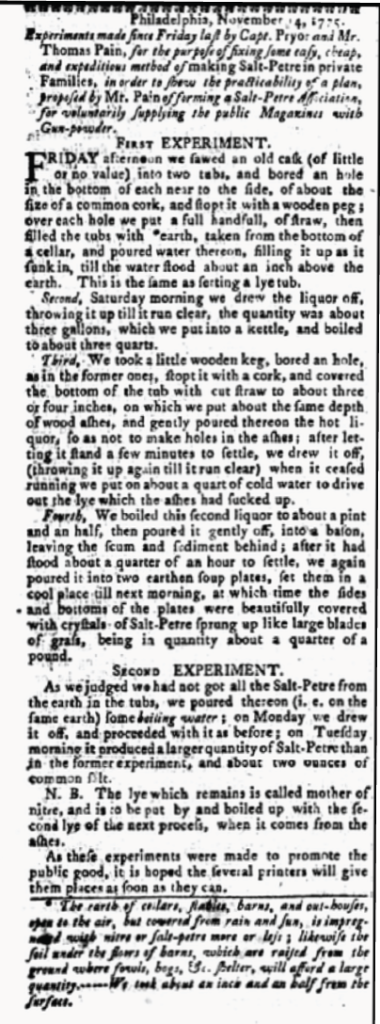
Here is a transcript of the article:
Philadelphia November 14, 1775
Experiments made since Friday last by Captain Pryor and Mr. Thomas Pain, for the purpose of fixing some easy, cheap, and expeditious method of making Salt-Petre in private Families, in order to shew the practicability of a plan, proposed by Mr. Pain of forming a Salt-Petre Association for voluntarily supplying the public Magazines with Gun-powder.
FIRST EXPERIMENT
Friday afternoon we sawed an old cask (of little or no value) into two tubs, and bored an hole in the bottom of each near to the side, of about the size of a common cork, and stopt it with a wooden peg; overeach hole, we put a full handful of straw, then filled the tubs with earth, taken from the bottom of the celler, and poured water thereon, filling it up as it sank in, till the water flood about an inch above the earth. This is the same as serting a lye tub.
Second, Saturday morning we drew the liquor off, throwing it up till it run clear, the quantity was about three gallons, which we put into a kettle and boiled to about three quarts.
Third, We took a little wooden keg, bored an hole, as in the former ones, stopt it with a cork, and covered the bottom of the tub with cut straw to about three or four inches, on which we put about the same depth of woodashes, and gently poured thereon the hot liquor, so as not to make holes in the ashes; after letting it stand a few minutes to settle, we drew it off, (throwing it up again till it ran clear) when it ceased running, we put on about a quart of cold water to drive out the lye which the ashes had sucked up.
Fourth, We boiled this second liquor to about a pint and a half then poured it gently off, into a basin, leaving the scum and sediment behind; after it had stood about a quarter of an hour to settle, we again poured it into two earthen soup plates, set them in a cool place till next morning, at which time the sides and bottom of the plates were beautifully covered with crystals of Salt-Petre sprung up like large blades of grass, being in quantity about quarter of a pound.