
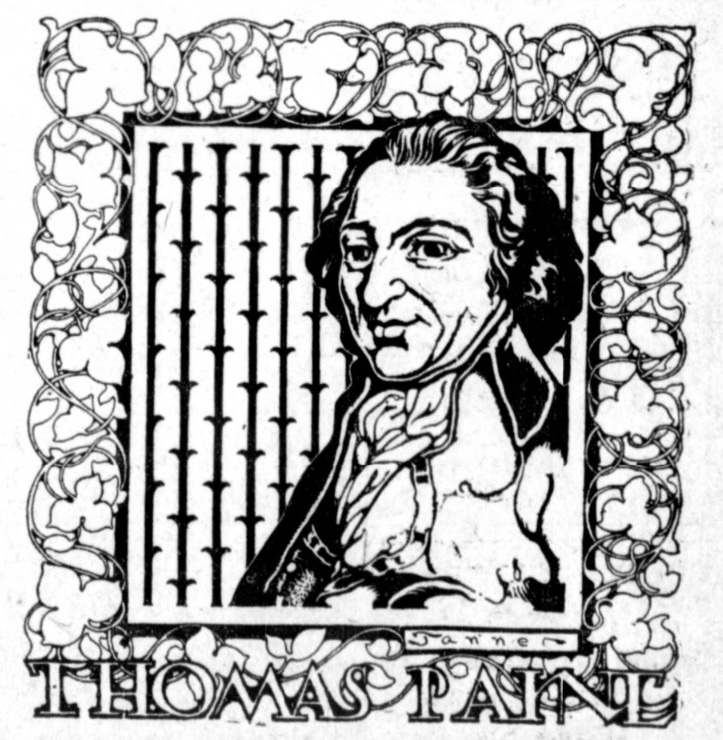
Harrisburg telegraph (Harrisburg, Pa.), May 9, 1914
By Ella Wheeler Wilcox
Thomas Paine (1737-1809): “The world is my country; to do good is my religion.”
The man who named our country.
The man first to advocate independence for our country.
The man who did more to achieve this independence than any other man, giving his pen, tongue, sword and pocketbook to the cause.
“These Are the Times That Try Men’s Souls”
The man who in the darkest hour of the Revolution wrote the “Crisis,” commencing with the words, “These are the times that try men’s souls.” (General Washington ordered this mighty work to be read to the army once a week.)
The man who was joint author of the Declaration of Independence with Jefferson.
The man who borrowed ten million dollars from Louis XVI. to feed and clothe the American army.
The man who established the Bank of North America in order to supply the army.
Napoleon said in toasting him at a banquet, “Every city in the world should erect a gold statue to you.”
The author of the “Rights of Man,” acknowledged to be the greatest work ever written for political freedom. This masterpiece gave free speech and a free press to England and America.
The man known as “The Great Commoner of Mankind,” the “Founder of the Republic of the World.”
The man first to urge the making of our Constitution.
The man first to suggest the Federal Union of the States and to bring it about.
The man first to propose the Louisiana Purchase.
The man first to demand justice for women.
The man first to plead for dumb animals.
The man first to advocate international arbitration.
The man first to propose old age pensions.
The man first to propose “The land for the people” (single tax).
The man first to propose the care for the children of the poor at public expense.
The man who invented and built the first iron bridge.
For a century the world has forgotten its debt to Thomas Paine.
Indeed, that name has been branded by biggots and fanatics with all imaginable obloquy.
He was called an atheist, a Free Thinker, a blasphemer, simply because he could not believe in some old traditions which to-day are known to be allegorical, and which few intelligent minds regard seriously.
Thomas Paine was one of the founders of our great United States of America. We would undoubtedly be under British rule to-day but for the wise and wonderful efforts of Thomas Paine.
In January, 1776, he wrote and published a plea for American independence. Previous to this he had made a strong argument, urging separation from the mother country.
No one had been daring enough to think of such a move before.
All the colonists had rebelled against the unjust taxes and impositions, but Paine was the bold rebel who dared say Liberty.
After his pamphlet, “Common Sense,” was published the people were electrified. No pamphlet ever written sold in such vast numbers, nor did any ever before or since produce such marvellous results. Paine donated all the financial proceeds of the pamphlet to the cause of liberty (as he did with all of his other works). Washington, now converted, wrote to his friends in praise of “Common Sense,” asserting that Paine’s words were “sound doctrine and unanswerable reasoning.”
All Great Statesmen Fell in With His Words
Jefferson, John Adams, Franklin, Madison, all the great statesmen of the time, wrote praisefully of Paine’s “flaming arguments.
In July, six months after “Common Sense” had awakened the people, the Declaration of Independence, embracing the chief arguments of Paine’s great pamphlet and much of its actual wording, was signed by the committee of patriots in Philadelphia.
The Great Revolution commenced at once. The oppressed colonists took up arms at a great disadvantage, by reason of the lack of food, clothes, money and munitions of war, but inspired by the forceful message of “Common Sense,” they fought bravely and well.
His Writings Inspired the Poorly Clad Soldiers
When winter set in, however, the ill-clad, poorly nourished little army had been greatly reduced in numbers by desertions from its ranks. Many of the soldiers were shoeless and left bloody footprints on the snow-covered line of march. All were but half-hearted at this time and many utterly discouraged. Washington wrote most apprehensively concerning the situation to the Congress.
Paine, in the meantime (himself a soldier with General Greene’s army on the retreat from Fort Lee, N. J., to Newark) realizing the necessity of at once instilling renewed hope and courage in the soldiers if the cause of liberty were to be saved, wrote by campfire at night the first number of his soulstirring “Crisis,” commencing with the words:
“These are the times that try men’s souls. The summer soldier and the sunshine patriot will in this crisis, shrink from the service of their country, but he who stands it now deserves the love and thanks of man and woman. Tyranny, like hell, is not easily conquered; yet we have this consolation with us, that the harder the conflict the more glorious the triumph. What we obtain too cheap we esteem too lightly; it is dearness only that gives everything its value. Heaven knows how to put a proper price upon its goods; and it would be strange indeed of so celestial an article as freedom should not be highly rated.”
Washington ordered the “Crisis” read aloud to every regiment of the army. The effect was magical. Hope was renewed in every breast. Deserters returned to the ranks; men who had half-heartedly withheld from joining the patriot army took courage from Paine’s thrilling words and shouldered muskets with the rest. The great cause, tottering on the brink of dissolution, was saved. Paine’s “Crisis” did it.
Following the first number of the “Crisis” came others—thirteen in all—the last commencing with the words: “The times that tried men’s souls are over.”
Paine was not only a great author and statesman, but he was distinctly a pioneer, an originator; an inventor and creator. To him we are indebted for many of the world’s greatest ideas and reforms.
It was Paine who first proposed the abolition of negro slavery; Paine was the first to suggest arbitration and international peace; Paine originally proposed old age pensions. These are a few of the other great ideas he fathered. He first suggested international copyright; first proposed the education of children of the poor at public expense; first suggested a great republic of all the nations of the world; first proposed “the land for the people”; first suggested “the religion of humanity”; first proposed and first wrote the words “United States of America”; first suggested protection for dumb animals; first suggested justice to women; first proposed the purchase of the Louisiana territory; first suggested the Federal Union of States.
Paine to Be Put in the World’s Temple of Fame
It is time the world awakened to his merits. With that end in view the Thomas Paine National Historical Association was organized in New York some years ago. Through the efforts of this association, Thomas Paine is at last coming into his own. The association intends that Thomas Paine shall occupy that niche in the world’s Temple of Fame where he properly belongs, and to that end it bends its every endeavor. The association has established its home at New Rochelle, N.Y., in the house that Paine built.