
Blue-grass blade (Lexington, Ky.), July 14, 1907
MARBLE BUST OF PAINE
JUSTICE COMES AT LAST WHERE IT IS DUE
Thomas Paine is at Last Granted a Place in Independence Hall by an Overwhelming Vote in Honor to Him
Time is not ungrateful and the save-thought and as such has come to the character of liberty.
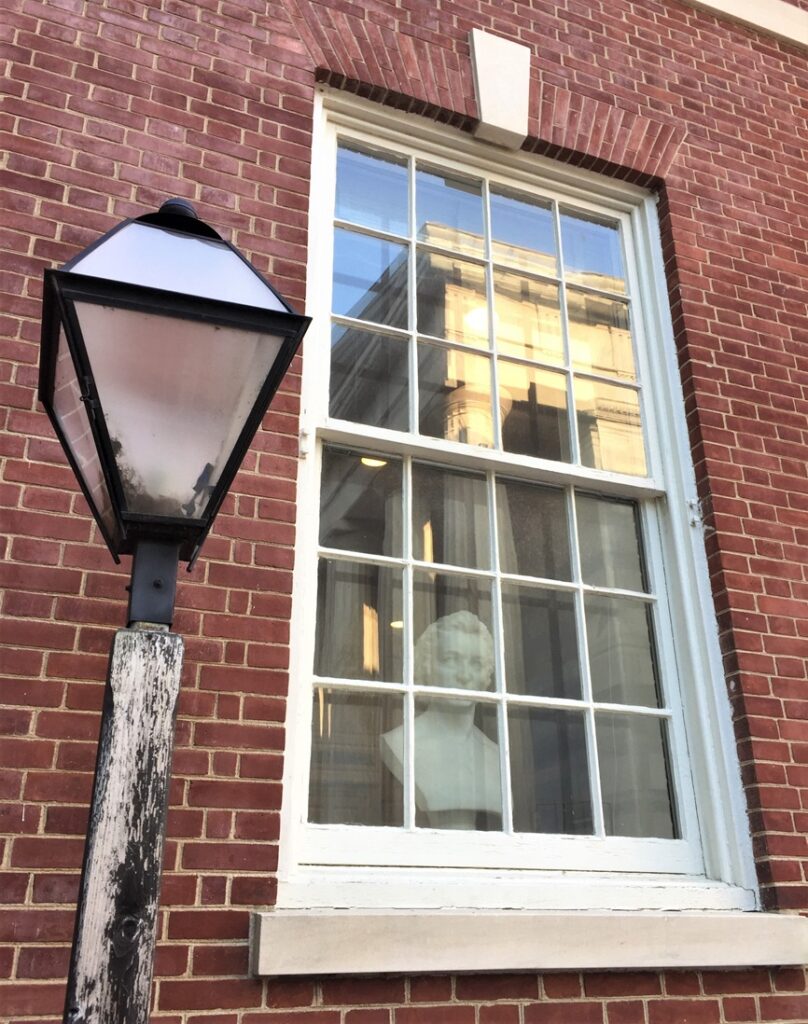
Proof of such a declaration is offered by an article from the pen of James B. Elliott, of Philadelphia, secretary of the Paine Memorial Society, published in the July issue of Tomorrow which explains how a marble bust of Thomas Paine, once refused, was at last given a place in Independence Hall. It reads:
The marble bust of Thomas Paine by Sydney Morse, now in Independence Hall, Philadelphia, was first presented to the city council Nov. 20 1876. It was accepted by the Common Council by a vote of 31 to 2, one of the latter being a saloon keeper. In the select council the motion to accept was lost owing to the violent speech made against the character of Paine by Charles Thompson Jones, who has since passed to the undiscovered country and public sentiment has changed, and the bust was accepted Sept. 11, 1901.

The story of the twenty-five years contest with pious bigotry and the perseverance of a few faithful momuments as stated by the Promotor. He received the following letter from the Freethinker the following messages:
The motion was made by Mr. ——. The motion was lost by Mr. —— and Charles Thompson Jones made the following speech, objecting to its reception:
I feel great diffidence in speaking on this question from the fear that I may not do justice to the subject, but I hope I may be able to show the character of Thomas Paine to have been treacherous to General Washington the Father of His Country. He also wrote a bitter pamphlet against the Christian religion and the Holy Bible, in which he maintains that the resurrection of Jesus Christ as told by the Apostles, is told, is a blasphemous power spoken of the matter in the New Testament—the health forone, of God as being an heathenish and barbarous declaration, worse than the mythology. Do you think, gentlemen of councils, that the marble bust of Tom Paine should be given to the Hall of Independence with Washington, Franklin, Jefferson and Robert Morris? I hope that not a member of the select council will vote in favor of the resolution.
I pride myself upon no ancestry. My aversion to this man, or I may say my prejudice, was formed in boyhood and from what I heard from the last of the American revolution in the neighborhood in which I lived—those who fought from pure love of country.
Mr. President, you are aware that the leading men of the revolution were divided in opinion as to the merits of the political writings of Tom Paine, some contended that he did more harm than good to the cause and the pious, God-fearing portion of the community believed that this violent, vindictive man tried to retard the civil and religious rights that they were contending for, therefore religious people who hold in contempt him whom you propose to honor.
Mr. Paine received great credit for articles he wrote against England during the struggle with that country, but it was of very little consequence to his mind which side he wrote that was his profession. It is not generally known that he was paid out of a secret fund, in addition to his salary as clerk of the Pennsylvania assembly, which he received $5000 per year in continental money. He would not accept Washington’s word, but demanded Robert Morris as security.
He went to France, after which he was found in intrigue against this nation, and was placed in prison and pretended to believe that General Washington was the cause of his imprisonment—the man who had been his benefactor. He had the audacity to say to him: “You have not served America with more disinterestedness or greater fidelity than myself, and the glory of Washington.” He claimed to have received forty thousand dollars from the French King as a loan for the army, and that he started a bank with 200,000 pounds sterling, and started the Constitution. The Federal Constitution is a defective out-of-date instrument, anyhow, and it is useless to stretch that document to court.
But Constitution or no Constitution, we have got the men we went after, they are here, they are acting here until we have had our final decision, and I would like to know what is going to be done about it. No wonder that the wise Herbert Spencer wrote: “Paper constitutions are also the faces of those who have left their results.”
All of these statements can be answered in the gross and laughable recrudescence of barbarism is the term of another of the journal, the erudite Sydney Morse.
The matter in the select council was sick and unable to be present to reply to the charges made by Charles Thompson Jones, but he died and the members of the Council again its reception.
The marble bust cost $1,200, the money being raised by subscription through the Boston Index and but few of the original subscribers remain in the select council roles in the very many are dead, many indifferent, but the memory of the service of Thomas Paine on three continents and personal character led him to die a peaceful death at the age of three score and ten, has also been permanent at the acceptance by Independence Hall of the bust of Paine, which was presented on the 100th anniversary of the Declaration of Independence, of which Thomas Paine was the real promoter.
I am also grateful that I am permitted to tell the history of the struggle, and hope to be present in the city of New York with Dexter Phillips at the home of Thomas Paine in Bleecker St., and attend the centenary of the death of Paine at the invitation to all to visit the Hudson.