Blue-grass blade (Lexington, Ky.), April 28, 1907
DEATH HAS TAKEN HIM
WAS FIRST PRESIDENT OF THE ASSOCIATION
By James B. Elliott, Secretary
In announcing the death of Major Forrester L. Taylor of Lawyer, Va., the first president of the Paine Memorial Association, The Paine cause loses an efficient worker, the country a brave soldier, and the home of Virginia a valued friend.
Major Taylor was born in Philadelphia, Oct. 30, 1833, and removed to St. Louis where he remained until 1844. Then he returned to Philadelphia, where he graduated with honors from the High School. He became a salesman in a book publishing house and joined the church of which the Rev. J. F. Berg, D.D., the noted Bible scholar, was pastor.
Mr. Taylor placed a high estimate upon the ability of his pastor to defend the Bible from the attacks of the infidels, and looked forward with pride when a debate was announced between the Ex-Rev. Joseph Barker of London and Mr. Berg upon the Bible as a Divine Revelation.
Mr. Taylor attended every meeting in Washington Hall and reported. Strange as it may appear, Mr. Taylor was disappointed in the ability of his pastor to answer the arguments of his opponent. He withdrew from the church and joined the Secularists of Philadelphia.
Having carefully studied the life and character of Thomas Paine, and being a brave man, he decided to defend his good name from the attacks by the pulpiteers. He investigated Paine’s record during the Revolutionary War, his conduct during his voyage to France, and his return to Boston in the ship Alliance with the 25,000 livres of silver, the gift of the French King; his Secretaryship of Congress at York, Pa.; his gift of $500 to help pay General Washington’s army at Morristown, N.J.; also his conduct while in France as a member of the National Assembly and his conduct while in prison. He found his record in every place to be worthy of a place with those who fought for American independence.
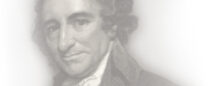
At that time there were liberal societies in every state of the Union and men and women who would back their opinions with liberal subscriptions of money. Major Taylor decided to present to Independence Hall a portrait of Thomas Paine, and with little difficulty secured the $500 necessary to obtain a good oil painting of the author-hero of the Revolution.
But he was unable to persuade anyone to act, or permit their names to be used, as endorsing Paine’s principles, fearing business and social ostracism.
Through the efforts of Mrs. Ernestine Rose he secured the portrait of Thomas Paine painted by Thomas Thompson, then hanging in the Hall of Science in New York, and engaged the leading portrait painter of his day, Bass Otis, to paint a copy of that portrait.
He drew a formal paper reciting Paine’s services for liberty during the American Revolution and presented it to Independence Hall, asking that it be hung with those of Jefferson, Washington, Franklin, Ethan Allen, and the other patriots.
But Charles Thompson Jones, a strict Baptist of Manayunk, entered his protest against any admission to the Hall of Fame of one who had rebelled against the Bible and Christian religion. He argued that to place Paine in the Cradle of Liberty would be to give the author of The Age of Reason too much notoriety, and that hanging the portrait of Tom Paine near George Washington would cause God-fearing and Bible-loving people to absent themselves from the Hall. It would make infidelity popular and infidels would pride themselves upon the success of their victory.
In Select Council, Jones’s eloquence carried the day and the admission of Paine’s portrait was postponed indefinitely. Major Taylor was requested to remove the portrait from the building, which he did reluctantly, resolving to offer it again the next year.
The clergy then commenced a tirade of abuse selected from old hostile biographies, which contributed to a second defeat.
Mr. Taylor felt confident that there would eventually be a change of sentiment and resolved to continue the fight as long as he lived.
In August, 1862, Mr. Taylor enlisted as a private in Company A, New Jersey Volunteers, and rapidly rose through the ranks to Captain and then Major, receiving the gold medal awarded by Congress for bravery on the battlefield. He was mustered out of service on Paine’s birthday in 1866.
Having carried The Age of Reason in his pocket and read it by the campfires to his men, he made many converts thereto.
Returning to Philadelphia, he became acquainted with Joseph N. Morean, who wrote the article on Thomas Paine in the American Encyclopedia. Together they visited New Rochelle, the home of Paine.
He induced Morean to publish his testimonials to Thomas Paine, and every member of council was presented with a copy. He again offered the portrait of Paine, which was again refused. The members of council were frightened by the sermons that were preached against it.
In 1873 Major Taylor made the acquaintance of General Hector Tyndale and Colonel Etting and enlisted their services in behalf of Paine. In 1874, on the eve of the one hundredth anniversary of the Battle of Lexington, he was finally victorious. His efforts were crowned with success when Paine’s portrait was hung upon the walls of Independence Hall.
He said to me, as Paine desired that upon his monument should be inscribed “Thomas Paine, Author of Common Sense,” he himself would like written upon his headstone:
“I placed the portrait of Thomas Paine in Independence Hall.”
Let us hope that some brave Virginian will comply with his request.