
Blue-grass blade (Lexington, Ky.), January 27, 1907
Two Statues Have Been Erected To His Memory In Last Few Years—Religious Hatred Makes Freedom’s Love More Intense—None Shine More Resplendent Than He Who Guided Our Infant Feet In Freedom’s Path
Paine Emerging From the Religious Conspiracy of Silence
By J. B. Wilson
This issue is dedicated to the memory of a man who left behind him a name that brightens the track of time; a man whose genius commands an admiration and whose character, ever growing, commands a deep and lasting respect.
Perhaps there has been no name in the history of the world that has been so calumniated and traduced. The very calumny that has been employed to render his name despicable among men has only served by contrast to brighten his glory. As the great planet of the summer skies shines with increased splendor through the clouds and obscured by lying fanaticism, breaks through the rents and gaps of superstitious night and glows with a lustre as steadfast and brilliant, as serene and pure, as ever shone from the primeval orbs of the new-born world.
After a hundred years of lying vituperation, the world is coming to love his name and revere his memory. The hate which has been heaped upon him has only served to excite curiosity to know more about him.
The persistent hate that is shown to Thomas Paine has thus advertised his importance to the world, and has inclined fair-minded men to find out what he said and did that he should be so despised and hated by men who profess to love their neighbors as themselves, and who do good to their enemies.
They have but to read the first page of the Age of Reason to realize that the clergy are the blackest set of liars that ever infested decent society.
They have but to read the next page, to be charmed with his wisdom, the style of his expression and the sweetness of his disposition. They have but to read it all, to become free, independent and thoughtful individuals.
This is why the clergy hate him so, and the people are fast finding it out. If the Age of Reason was carefully read by every man, woman and child every year for three years, there would be very little of Christianity, except the Salvation Army. The preachers know this, and the infernal rascals keep their pious dolts from reading Paine by incessantly trying to poison them in the hearts of children.
My own experience reflects the experience of most freethinkers. I was brought up in a Methodist Sunday School. I attended Quarterly Love Feasts and big revivals, and became so saturated with amazing grace that it just oozed out of me.
As I grew older I was kept at the woodpile nearly the whole of every Saturday, whacking up old knots so mother would have an extra supply of fuel for Sunday cooking. I remained at home Sunday carrying in wood, chasing chickens, wringing their heads off, picking the feathers, peeling the potatoes, opening fruit cans, beating eggs and otherwise helping my mother, a frail, sickly woman, who ought to have been in bed.
About one o’clock my father would march in with the preacher and six to ten other grave and brilliant intellects, who would sit down and eat as though they were testing the capacity of their stomachs.
I thought it was all right. Indeed, I thought it an honor to thus entertain these Saints of Israel. But gradually it dawned upon me that Sunday was a day of rest for my father and the preacher and the visiting brethren, but a day of drudgery for my poor little mother as well as for Yours Truly.
Why should she stay at home and cook, I asked myself, when the Bible said, “Remember the Sabbath Day to keep it Holy. Thou shalt do no work, neither thy man servant, thy maid servant, nor thy ox”?
It dawned upon me that the preacher was inconsistent to uphold such doctrine and then come to our house and partake of a royal feast that required four hours of hard labor upon the part of my mother to produce.
This is the first rebellious thought I remember to have entertained against Christianity, and when I look back and think of the many, many Sundays my mother spent in the kitchen drudging her life out to entertain a lot of pious scalawags, when she ought to have been resting, I grow indignant at this holy abuse of womankind.
If for no other reason, this alone is enough to incline one in favor of Woman’s Rights.
I thought of this injustice to my mother, but said nothing. Religion seemed all right. I had a dying soul to be saved and Hell was to be escaped, and there was only one way under the sun to do it, and that was to believe in Jesus.
I went to church and Sunday School. Death was pictured in all its horrors, especially the death of the unbeliever. Tom Paine was the one great example.
Over and over again I was told the story of “Don’t unchain the tiger,” and his dying words, “I am taking a fearful leap in the dark,” and how he abused his wife, and how he believed in neither Heaven, nor God, nor the Devil, and how he had cursed and blasphemed God, and how at last he called upon God to save him and how he recanted.
But the favorite story ran this way:
When Paine’s daughter came to die she called her father to her bedside and said, “Now, father, you have taught me lying; which road shall I take?” And Paine, weeping, left the room and said, “Take your mother’s road.”
This was always given in that blubbering tremolo which Methodist preachers affect when they want to make a handkerchief display and see the dear sisterings wipe their weeping optics. I have shed the briny myself more than once at this dreadfully affecting tale.
I learned to hate the name of Tom Paine.
My father warned me from ever reading the Age of Reason. He said that he had read it and, to take his word for it, that it was an evil book, denying God and injurious to any one who read it.
I was taught to associate his name with physical Pain. I despised him. I hated the very sound of his name.
In the course of a few years I visited Dayton, Ohio, just for a day. I wandered about the streets gawking at this and that, like a country boy will. Finally I came to a newsstand and stopped to look at the magazines and books.
My eyes fell upon a paper-covered pamphlet, upon the back of which was printed:
The Age of Reason, by Thomas Paine.
“Ah ha!” said I, “here is the terrible book I have heard so much about.”
I was seized with an almost uncontrollable desire to look into its pages. I picked it up, but dropped it as an evil thing and walked away.
I walked around several squares, and the first thing I knew I found myself in front of the newsstand again, and there lay the awful book before my eyes.
I wanted more than ever to look into it, but I said:
“No. My father is a good man and would not advise me wrongly. The preachers are good and truthful men, and what they say about that book is sufficient evidence that it is not fit to read. I will obey my father and respect the judgment and advice of my preacher, and so walked away again.”
I know not how or why, but in thirty minutes I was back there.
I trembled at the sight of those awful words:
The Age of Reason.
Then came the first fight of my life, when my own individuality asserted itself and boldly challenged accepted principles and beliefs.
Why should I not read it? I asked.
Am I never to know more than my father, good man though he is? He has made many mistakes—may he not be mistaken in this?
I am only accepting his judgment and not exercising my own at all.
How do I know that the preachers are telling the truth?
May there not be some mercenary motive in their hate of Paine?
They are only human, and some of them are so ignorant they don’t use good grammar.
Why should I submit my judgment to theirs?
When am I to begin to do my own thinking?
If the book is bad as they say it is, I will only hate it the more—then why do they fear that I will believe it if I should read it?
Something is wrong.
It is inconsistent.
What’s the use to have a head of my own if I do not use it?
I’m going to look in that book if I go to Hell for it.
And look into it I did. The first words my eyes fell upon were:
“I believe in one God, and no more, and I hope for happiness beyond this life.
I believe in the equality of man; and I believe that religious duties consist in doing justice, loving mercy, and trying to make our fellow-creatures happy.”
“Oh! What liars!” I exclaimed.
They said he denied God and an after life, and almost his first words are a belief in God and hope for eternal happiness.
I read the words over again and they seemed so consistent, so reasonable and so beautiful to me.
I read the next page and, like a flash, I discovered that I was permitting myself to be made a systematic fool.
I bought the book, walked over to the court house steps, sat down and read it through.
Those six hours changed me from an humble, submissive, quiescent, unthinking child to a self-assertive, opinionated, questioning, thoughtful youth.
I opened the book hating Tom Paine.
I closed it with the deepest reverence I have ever felt for any man or for any God.
I then understood why the clergy hated him so.
I could account for their lies.
I judged the effect it would have upon others by the effect it had upon myself, by setting my powers of thought into action.
Before this I had stupidly and unquestioningly accepted what others told me.
I soon discovered that he was the author of other books besides the Age of Reason.
I read them and also his life.
I found out that every good thing the man had said and done had been carefully concealed from me; that his patriotism, his love of suffering humanity and his many personal sacrifices in the interest of American independence was never given any credit by the clergy at all; that they were wholesale liars about his religious belief.
Not only that, but they had systematically obscured and suppressed the important story of his patriotism.
Every free and patriotic American should know that no man, not even Washington himself, did more than Thomas Paine to establish American independence.
Nothing surprised me more than to learn that he was an Englishman who opposed his own country and people in the interest of strangers; that he joined the Continental Army and shared the privations of the common Revolutionary soldier; that he gave all the money he had in the world for the support of the cause; that he wrote political pamphlets which held the army intact and kept it from disbanding; that he was the foe of Kingcraft as well as Priestcraft and upheld the rights of man and self-government all over the world.
I learned to know him as a friend of the downtrodden and oppressed, the champion of human rights, free government, and of the religiously and politically enslaved.
I found the name I once hated and associated with physical pain, I have ever since loved and reverenced.
I learned that all the death-bed scenes which had been so horribly pictured to me by the preachers were lies—lies, nothing but lies.
I learned that it was Hobbes, the English Deist, and not Paine, who said, “I am taking a fearful leap in the dark.”
I learned that Franklin had been dead three years before Paine wrote a word of the Age of Reason, and therefore the oft-repeated story of Paine submitting the manuscript of the Age of Reason to Franklin, and Franklin saying to him, “Don’t unchain the tiger,” was another malicious and sacred lie.
I also learned that the terribly affecting story of Paine telling his daughter to choose her mother’s road when she lay dying was another holy lie, for he never had either daughter or son.
The fact of the case was that his wife was sexually deformed and they never even sustained the relations of man and wife.
It was for this reason that they mutually separated.
His wife offered him a divorce, but as such action would necessarily expose her physical weakness, he shrank from giving her pain and making her the subject of indelicate gossip, and told her that she might always bear his name; that he would not permit that she should be humiliated, but would suffer himself before such should be done.
This was the manly, respectful attitude of Paine toward the woman who bore his name but who was incapacitated as a wife.
How often have I heard the clergy tell how he beat and pounded her and otherwise brutally treated her.
And these lies are continued to be told all over this country.
Well, let them be told.
The more frequently they are told, the more Infidels they make.
The lie will be apt to be discovered and once known, then farewell to Jesus and his lying legions.
The lying about Paine’s religious views is the least part of the clerical abuse given him.
The suppression of the credit that should be given him for the heroic part he took in establishing American independence is the meanest of all.
The youth of the land are not permitted to know this part of his life.
He is credited with nothing good and everything bad.
I was almost a man grown before I knew that he was anything else but a blasphemer; that he ever did anything else but deny God; or that he ever wrote anything else but the Age of Reason.
The clergy systematically suppress all knowledge of him, only such as may come out of their lying mouths.
Public libraries are not permitted to contain either his political or religious works, or even his biography.
They haven’t the good sense to know that this suppression has the opposite effect of leading inquiring minds to know more about him.
In the Capitol at Washington there is no statue or painting of him, while the walls are covered with men, his contemporaries and inferiors, whose words and deeds in behalf of America are as insignificant in comparison with Paine’s as the light of a firefly in the face of the sun.
At the Chicago World’s Fair his portrait was stuck away back in an obscure corner where no one would be apt to see it except those who knew of its presence and made inquiry for it.
Why wasn’t the friend, the companion, the co-worker of Washington placed beside him in the gallery of American statesmen?
Why should the picture of the man whom Washington and Jefferson and Franklin had folded to their hearts in an affectionate embrace, and thanked him for what he had done, be hidden away where it would be seen as little as possible?
Why, they even refused at first to permit his picture to be placed upon exhibition at all.
Oh, the mean subterranean deviltry of these pious lying knaves.
That the memory of the man who did perhaps more than any other man to establish religious and civil liberty in this country, and the Republican form of government among the nations of the world, should be thus blotted from the minds of men and given no place in the history of the nation which he had done so much to help found, is the rankest ingratitude the American people have ever exhibited.
Buy the time will come when his picture will be familiar to American school children as that of Washington’s.
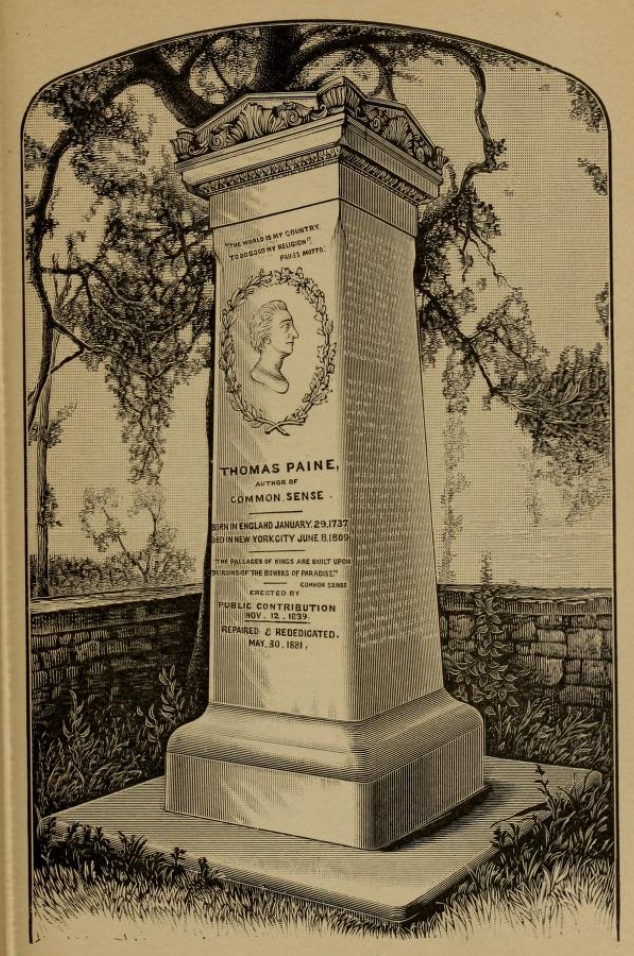
Within the last few years two statues have been raised to his memory.
Other cities will follow in doing him honor.
His birthday has become a day of celebration by all the Freethinkers of this country.
Little by little his name and his fame are becoming known, and it is only a question of time until he will assume his rightful place in American history.
The more the clergy lie about him, the more they advertise his importance.
The injustice they have done his memory will meet with a fearful and just retribution.
The hate which they inculcate against him only makes love of him more intense when their deception is once discovered.
There is not a preacher of Paine’s time who is remembered today with the exception of Jonathan Edwards, and he is only regarded as a crazy theological curiosity.
They have all passed into hopeless oblivion, and the present age remembers them not, while today Paine is reverenced by countless thousands.
Meetings everywhere are held to do honor to his memory, and children are being told the story of his life.
Brighter and brighter grows his memory among the races of men.
Higher and higher he mounts in the esteem of liberty-loving mankind.
“The world was his country and to do good was his religion.”
He was the friend of suffering humanity, of whatever race and beneath whatever sun.
In the constellations of the world’s great men, where every one doth shine and hold his place in the fiery galleries of the dome bespangled sky, there is none in all that meteor train that shines more resplendently than he who guided our infant steps in freedom’s paths, and helped to make America a lesson of liberty to heart-weary and despairing humanity in every land and clime.
Paine, Washington, Franklin and Jefferson, those Infidel heroes who so nobly worked together were the guiding and intellectual spirits of the Revolution.
No religious hate can separate their fame or dim the glory of their individual achievements.
As they worked together in the cause of liberty they will live together in the pages of history.
In the constellations of light they glow with the brilliant radiance that emanates from each individual intellect.
Among the groups of men who have founded nations and established governments they shine the brightest galaxy in Freedom’s blazing sky.
Like royal travelers, their silver chariots axle-deep in stars and curtained with aurorian clouds, they rifle the burning labyrinths of the worlds of fame, while Popes and Kings and babbling priests hover faint and darkling in the pale horizon of Oblivion’s night.