
Sunday dispatch (New York [N.Y.]), February 4, 1849
THOMAS PAINE.
Thirty guns were fired on Boston Common, last Monday, in commemoration of the birth of Thomas Paine, whose natal day it was.
In that same city, it used to be the fashion to speak, with distended nostril and curled lip, of “Tom Paine, the infidel!” Then, children were whipped if they stole away to hear “old Kneeland, the infidel!” How men and things, and opinions, as well as old clothes, change!
The religion of Massachusetts—by which we mean the creed subscribed to by the majority of the people of that State—is pure Deism, which has taken the name and is known as Unitarianism. It is a respectable creed—respectable, we mean, in the numbers, wealth, education and respectability of its adherents—and this poor, despised “Tom Paine,” as it was the fashion to call him, was a Unitarian—only the name was not known in his time.
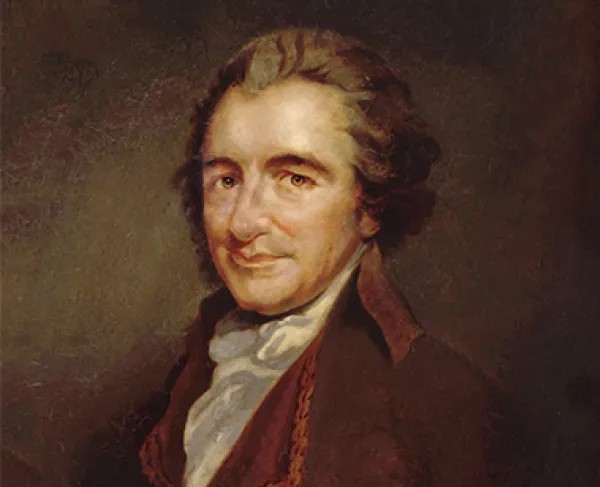
Forgotten were his patriotic services. Who cared to know that Tom Paine was the father of our national independence—that the subscribed and sworn to declaration of Jefferson was but the child, born of Paine’s fearless patriotism, and of Paine’s great mind?
Who heard but with the fool’s sneer, that when Robert Morris, the patriot financier of the revolutionary struggle—whose faith was equal to his works—that when even he despaired, after pledging his plate, his goods, his credit, aye his honor, to sustain George Washington at that perilous time, when the great warrior lay in the Jerseys, with his half fed, badly clothed, worn, wearied, and desponding followers, who stood naked, hungry as they were, like a wall of fire, between the statesmen of the revolutionary time, and the tyrant’s emissaries—that then, when all seemed to be lost—Thomas Paine, the despised infidel as we have been taught to regard him, laid on the speaker’s table of the Pennsylvania House of Representatives, (Paine was then the clerk to that body,) his plan for a Bank of North America, and with the plan fifty pounds sterling, every penny he had in the world?
Who thought it worthwhile to remember that Robert Morris, when he was informed of this great financial movement of Paine’s, rubbed his hands and exclaimed, “the crisis is happily passed; thank God, the Declaration of Independence will be sustained—thank God, these colonies are free!”
It is fitting that the vindication of Paine’s character should come from the capital of Massachusetts, whose people so long, so foolishly, with so much bigoted, fanatic, and misdirected zeal, have trampled on his name and memory.
If Thomas Paine was an infidel, Harvard University, which yearly receives from the State thousands of dollars, is a systematic teacher of infidelity. If Thomas Paine was an infidel, Freeman, the old rector of King’s Chapel, the father of Unitarianism in this country, lived the latter part of his life an infidel, and died, full of years and honors, glorying in his infidelity.
If Thomas Paine was an infidel, all the leading schools of New England, all the great statesmen of New England, are infidel.
We should learn to be just. Paine has not yet filled the page he is entitled to in his country’s history. A purer man, a more devoted patriot, lived not, in a time which, fortunately for us, was prolific of purity and patriotism. Blind, rabid fanaticism has done its worst to defame his character, to exaggerate his faults, to hide his virtues. It is time to awe back the slanderers, and come to the rescue of that mighty mind which first conceived the idea of absolute, unconditional independence, and that exalted patriotism which remained firm and unshaken, when the brave faltered, and the timid were willing to shrink back to vassalage and chains.
In his religious sentiments Thomas Paine was what is now known as a Unitarian. Beyond his religious opinions, in his public life, he stands forth a peer of that glorious nobility which broke down a throne and established a Republic.