
The liberator (Boston, Mass.), March 28, 1856
We have received a neatly printed pamphlet, embodying the proceedings at the celebration of the 119th anniversary of the birth-day of Thomas Paine, at Cincinnati, January 29, 1856; published by Valentine Nicholson & Co. It contains the addresses made to the assembly by Isaac E. Hedge, Esq., President of the Festival, T. L. Nichols, M. D., and F. Hassaurek, Esq., together with the resolutions adopted on the occasion. These all evince an excellent spirit, a clear perception of the principles of civil and religious liberty, and a warm appreciation of the labors of Thomas Paine in behalf of American Freedom and Independence, and the sacred Rights of Conscience.
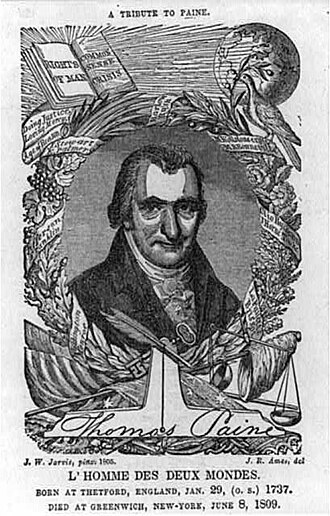
If there is a disposition on the part of some of the special admirers of Thomas Paine to exaggerate his merits, or to overlook or deny some of the bad qualities ascribed to him, it is certain that his priestly and sectarian enemies are determined to concede to him nothing worthy of respect or honorable remembrance—treating his memory, as they have done, with an almost hyena-like ferocity, and covering it with the blackest infamy. Their sweeping injustice and intense personal malignity are clear indications that he did his work thoroughly, in laying the axe at the root of the tree of popular superstition, and unmasking religious imposture, whatever may have been his short-comings in other matters. He was a man of masterly ability; his metaphysical and logical powers were very great; his moral courage and love of liberty equal to any exigency; his sufferings and sacrifices in behalf of the rights of man, on both sides of the Atlantic, as signal as they were voluntary, and borne with heroic cheerfulness and fortitude; and his inspiring appeals in the struggle for American independence as timely as they were irresistible.
In the darkest hour of that struggle, he published his “Crisis,” which “went forth to the country like the clarion peal of victory, in the midst of disaster and defeat,” and which opened with the sentiment which has become proverbial:—“These are the times that try men’s souls. The summer soldier and the sunshine patriot will, in this crisis, shrink from the service of his country; but he that stands it now, deserves the thanks of man and woman.” All this may fairly be put down to his credit, without endorsing any thing beyond it in his writings or labors.
His alleged gross intemperance, (a disputed point,) towards the close of his life, is maliciously dwelt upon as the result of his “infidelity”—as though it had the remotest connection with his theological opinions; as though it at all affected the many unpopular truths which he had the intrepidity to enunciate; as though none but skeptics ever became drunkards; as though bishops, priests, clergymen, and deacons, of every denomination, had not gone down as sots in scores to the grave! What can be more preposterous or more unjust? Grant all that his most venomous detractors say of him on that score—what then? Remember that one of the legitimate fruits of “our glorious revolutionary struggle” was a vast increase of intemperance, among all classes—for war and whiskey are essential to each other, whether on the side of freedom or despotism. Remember, too, that the American church was a tippling church, and the American clergy were tippling clergy—both moderate and immoderate drinking being the “order of the day,” while Paine was living. If, being in the fashion, he at last fell, like many others, eminent for their talents and services—others, too, who regarded his religious opinions as deadly heresies—how does this prove that he was either an inherently bad man, or “a sinner above all others”? The doctrine of total abstinence is a modern doctrine, as yet but partially accepted and carried out. Had the clergy of his day, who so bitterly reviled him, but enforced this excellent doctrine by precept and example, instead of putting the poisonous cup to their own and their neighbors’ lips, perhaps he might have been saved, (if he really committed any excesses,) for he never took exceptions to the strictest morality, though his standard, unhappily, was no higher than that of his traducers.
Thomas Paine indulged in no proscriptive spirit, but wished the conscience of every man to be respected, however mistaken. “I have always strenuously supported the right of every man to his opinion,” he says, “however different that opinion might be to mine. He who denies to another this right, makes a slave of himself to his present opinion, because he precludes himself from the right of changing it.” And he nobly adds—“The most formidable weapon against errors of every kind is Reason. I have never used any other, and I trust I never shall.” He wrote his “Age of Reason,” he tells us, as “exceedingly necessary, lest, in the general wreck of superstition, of false systems of government, and false theology, we lose sight of morality, of humanity, and of the theology that is true.” He summed up his religious belief thus:—“I believe in one God, and no more; and I hope for happiness beyond this life. I believe in the equality of man; and I believe that religious duties consist in doing justice, loving mercy, and endeavoring to make our fellow-creatures happy.” Query—whether his priestly assailants ought not to renounce their belief in one God, in immortal blessedness, in human equality, and in the religious duties specified by him, to avoid the imputation of “infidelity”? What can evince more faith in the truth, or what can be better expressed, than this sentiment from his pen?—“An army of principles will penetrate where an army of soldiers cannot; it will succeed where diplomatic management will fail; it is neither the Rhine, the Channel, nor the Ocean, that can arrest its progress; it will march on the horizon of the world; and it will conquer.” Again he says—“Such is the irresistible nature of truth, that all it asks, and all it wants, is the liberty of appearing.” Again—“Religion is man bringing to his Maker the fruits of his heart, the offering of his adoration. It is the right of each to do this in his own way; and the grateful tribute of his heart is acceptable to the Almighty.” Surely, that is not bad infidelity! Finally—for we might occupy columns with similar quotations—he says: “The Word of God is the creation we behold; and it is in this Word, which no human inventors can counterfeit or alter, that God speaketh universally to man. It is the ever existing Word of God, in which we cannot be deceived. It proclaims his power; it demonstrates his wisdom; it manifests his goodness and benevolence.”
We remarked, last week, that no man can be true to his conscientious convictions, and at the same time be an infidel. Hence, Thomas Paine (not Tom Paine, as he is sneeringly called) was no infidel, but an honest dissenter—a Protestant—carrying out the great doctrine of the Reformation, at all hazards to his reputation and worldly interest, and to the extent of his ability, the right of private judgment in all matters pertaining to the worship of God and the quality of the Scriptures. Claiming no infallibility for himself, he properly refused to concede it to others. Whatever may have been the errors of his head or of his life, one thing is certain:—he was not a trimmer, a time-server, a coward, or a hypocrite, but a brave, outspoken man, animated by a patriotic and philanthropic spirit, and seeking to put down nothing that he did not conceive to be hostile to religious freedom and the rights of man. Let no fear of being stigmatized as an infidel deter any one from doing justice to his memory.