
The New York herald (New York [N.Y.]), February 4, 1854, (MORNING EDITION)
THE PAINE ANNIVERSARY.
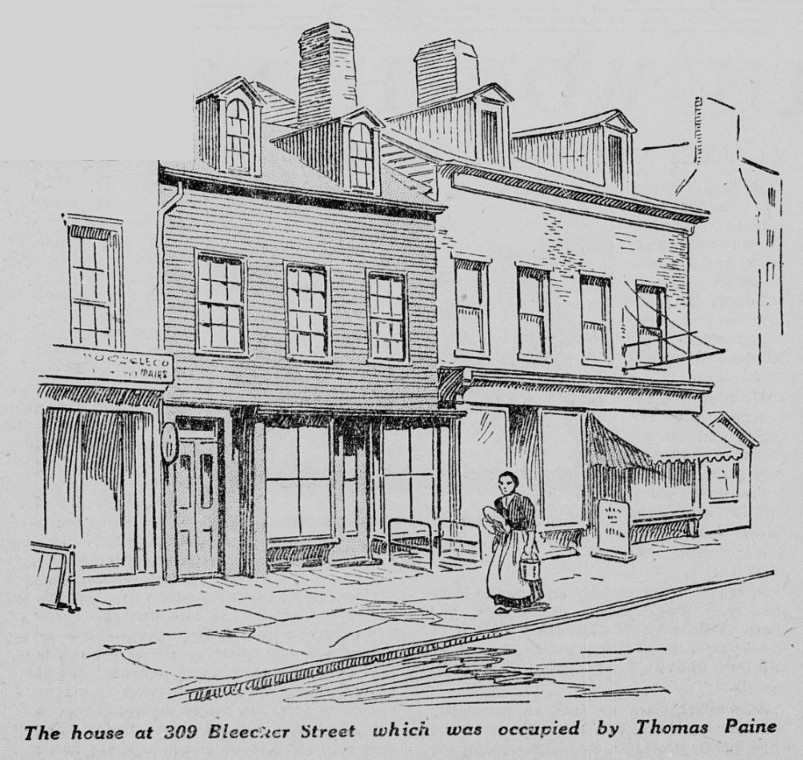
The anniversary (the 117th) of Thomas Paine’s birthday, was celebrated at the City Assembly Rooms last Monday evening by a ball and supper. The usual proportion of infidels, anythingarians and votaries of Terpsichore assembled to do honor to the memory of the old freethinker, who looked benignly down from a gilt frame suspended on the front of the orchestra, on the evolutions of his admirers. Supper was served shortly after twelve o’clock, when about four hundred persons sat down to it. Mr. F. Pears acted as President, and was assisted by Mr. J. D. Brown as Vice President.
After the eatables, which, by the bye, were not of the most attractive quality, had been fully discussed, the chairman read from a written paper a speech in which he reviewed the services which the great man whose memory they had met to honor, had rendered, not only to his country but to mankind. His addresses and writings had done more to bring about the Declaration of Independence than those of any other man. He was the friend and benefactor of the human race. The world was his country and to do good his religion. He concluded by giving as the first toast,
THE MEMORY OF THE MAN WHOSE BIRTHDAY WE CELEBRATE.
The memory of the boldest spirit,
The matchless writer, Thomas Paine,
Who proved that kings and priests agree
To check the spread of liberty.
Then all who do admire his pen,
With one assent will say Amen!
Mr. Barker responded to the toast in an exceedingly well delivered and ingenious speech, in which, however, there was a good deal to shock the Christian believer. We do not feel that we would be conferring any benefit upon the community by reporting such effusions.
The second regular toast was,
“WE WISH HEALTH AND HAPPINESS TO ALL TRUE HEARTS WHO HONOR US.”
Mrs. Ernestine Rose, the advocate of woman’s rights, was consistently called upon to respond to it.
After expressing her fears that a severe cold would prevent her from being heard at the farther end of the hall, she proceeded to say that it was a redeeming quality in human nature, that, however little true greatness was recognized and appreciated during the lifetime of the actors, succeeding generations rescued the past from the stigma of ingratitude, by honoring the memory of departed worth. Thus, anniversaries were celebrated to commemorate their natal days, songs were composed in praise of their deeds, and monuments were erected to immortalize their names. It was well that it was so, for not only did the appreciation of greatness and goodness in others ennoble our own natures, but it had a beneficial tendency on coming generations, in influencing them to imitate the example of departed worth, and to strive after those attainments that lead to distinction. This redeeming quality was fully exemplified on this interesting occasion, for, notwithstanding that the clergy had done and were still doing all they could to traduce the character, vilify the deeds, and disgrace the memory of the man in whose honor they had met that evening, yet from year to year they had the pleasing consciousness of a marked increase in the number of true-hearted men and women who attended these celebrations. History could point to no man who had done more for the cause of human freedom, had labored with greater devotion, or exhibited a more self-sacrificing spirit, than Thomas Paine. In the stormy days of the Revolution, when the strongest hearts sank with fear, and when the horizon of liberty was clouded with darkness, it was his powerful mind that swept away its gloom, and sent the voice of freedom ringing through the land. Had Paine been less true to his own convictions, less anxious for liberty, and less desirous to overthrow despotism, he would long since have been considered and recognized as the greatest champion of human freedom, and as the greatest friend to the rights of man, and as such, a national monument with the name of Thomas Paine would long since have graced the national capital at Washington. But he dared to be free, he dared to step on priestly forbidden ground, he dared to establish man’s highest prerogative to examine all things, and reject that which appeared to him false in religion as well as in politics, and hence the ingratitude of this nation towards Thomas Paine. Mrs. Rose then proceeded to indulge in speculations on the Eastern question, which, from her Polish origin, naturally diverged into a strong diatribe against the Czar, and concluded by saying that Germany would soon be roused to shake off its own despots, Italy would once more stand erect in her freedom and glory, Hungary would show the world that she was worthy of Kossuth, and Poland would again shake with the volcanic throes of insurrection, and would rise like the Phoenix out of her ashes, to proclaim her independence. There was no better occasion than the present to plead for the cause of poor, crushed humanity; for history could point to no man whose clear head and warm heart responded more readily to the cry of freedom than that of Thomas Paine. Mrs. Rose was interrupted by frequent and enthusiastic bursts of applause during her clever speech.
The following are the remainder of the regular toasts:
3. Education.—The lever of intelligence, the lever of nationality, the lever of liberty and truth.
4. Agriculture, the parent commerce.—May promoting industry and science, peace among the nations, friendship among mankind, and the welfare of the world.
5. The United States.—The Hercules of the Western Hemisphere, while she is the refuge of the oppressed of other lands, will have free religion and political liberty, yet be watchful of our own liberty.
6. Kings and Priestcraft.—May they soon have to become republicans and useful citizens, or be driven down to that pit of darkness from which they came.
7. The Press.—Free discussion. It is the best safeguard to liberty and the worst foe of tyranny and superstition.
8. The Ladies of our Republic.—They can compare with those of any land either in personal attractions, moral worth, or mental endowments. May all, like those present, shun the net of priestcraft and exhibit the intelligence, manners, reason and good sense.
After supper the company returned to the ball room, and dancing was kept up until an advanced hour in the morning.