
In December 1776, Paine’s electric lead, “These are the times that try men’s souls,” was spurred by the Continental Army repeatedly evading near-death experiences.
Less than a year after Common Sense inflamed patriotic fervor, the thrill of the Declaration of Independence dissipated, and Washington despaired. The Army had evacuated from Brooklyn under cover of fog, escaped from Manhattan Island with serious losses, lost Forts Washington and Lee, suffered the capture of thousands of valuable soldiers, and retreated across New Jersey into Pennsylvania. Enlistments were expiring, and a decisive and devastating British victory seemed inevitable. On September 30, Washington railed against militia members in his troops. On November 27 he complained that “the enemy’s progress” was checked by bad weather rather than “any resistance we could make.” On December 13 he despondently predicted that, absent “speedy recruitment of a new army,” the “game is pretty well up.”
Paine, with his first Crisis as with Common Sense, filled the breach. Seeking no compensation and encouraging widespread publication, the first Crisis traveled “through the country as fast as galloping horses could carry it” and likely circulated in Washington’s camp “within a day of its first publication.”
Paine’s choice was either telling the truth or consequences that the Republic might fail. He chose truth-telling. In a February 1942 Fireside Chat, FDR quoted the opening phrases. FDR’s choice was either telling the truth or consequences that the Republic might fail. He, too, chose truth-telling.
SIDEBAR: After Pearl Harbor, the prospect that the Allies would prevail against fascism was more tenuous than that America, in late 1776, would prevail against Britain. FDR, in a Fireside Chat, enlisted the whole nation to transform itself into an “Arsenal for Democracy” in ways that no one else would have deemed feasible. Appropriately, he closed with phrases from the first Crisis that similarly made the presumably impossible seem inevitable. https://www.youtube.com/watch?v=z0Stpw1TYH0
MYTH-MAKING
Though the core of Paine’s first Crisis was truth-telling, it is encased in myths. The general public “knows” two “facts” about Paine:
- Paine’s first Crisis was written on a drumhead; and
- Washington, before crossing the Delaware on December 25, 1776, ordered the first Crisis read to his troops.
Each “fact” is a persistent evidence-free fable.
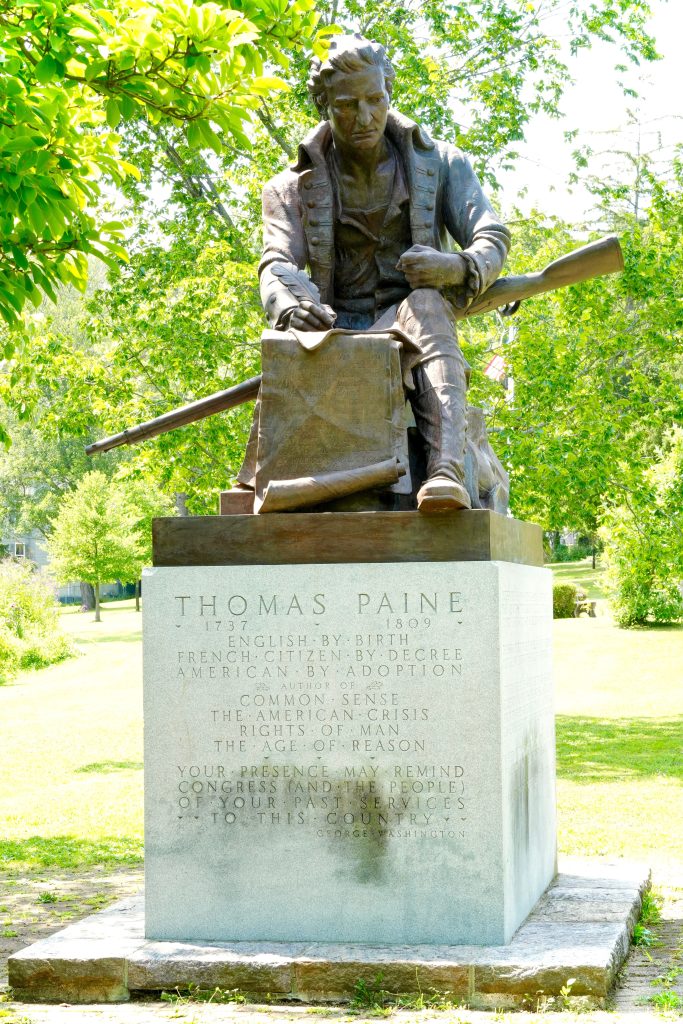
In 1950, a statue in Morristown, New Jersey, carved into stone the myth that Paine wrote the first Crisis on a drumhead, with his rifle at the ready. That stirring story is contrary to all reliable evidence. The myth inspired the statue, one of only two full-length statues of Paine in the United States. Paine himself said that the first Crisis essay was composed entirely in Philadelphia.
The drumhead myth resonates because it is slightly tethered to reality. With firm writing surfaces scarce in army camps, drum heads doubled as desks. On October 28, 1776, an anonymous journalist—often assumed to be Paine—said he was using “a wooden pen on a drum head.” But no records suggest any other association between Paine and drumheads, much less his using them as writing surfaces. On close inspection, the potential that Paine wrote the first Crisis essay on a drumhead vanishes into mist, with concrete evidence firmly to the contrary.
WHAT?REALLY?HAPPENED?
Paine related a detailed account in a January 1779 letter stating that he left Washington’s camp in early December 1776 for Philadelphia and, upon arriving, persuaded a printer who had suspended operations to reopen and publish his planned pamphlet. Paine said that he then “sat down,” in Philadelphia, “and in what I may call a passion of patriotism wrote the first number of the Crisis.” Paine’s own words, two years after publication, declared that he was not in Washington’s camp when he authored the essay, much less writing on a drumhead.
Paine’s January 1779 account is tempered by a later statement. Thirty years after publication, he responded angrily to a James Cheetham accusation that he avoided danger during the Revolution by asserting that he began the first Crisis while Washington’s Army retreated “from Fort Lee” and “continued writing it at every place we stopped at.”
Strong support for the 1779 version derives from circumstantial evidence and its relative proximity to publication. Paine’s calm and considered 1779 recollections were more detailed and reliable than his angry contentions three decades after the event. Reconciling these recollections, however, one could conclude that Paine jotted down notes while traveling with Washington’s Army. Alternately, Paine created the first Crisis in his mind while with the Army, occasionally observing the effects of his phrases in conversations with colleagues, and committed it to paper as a coherent whole in Philadelphia.
It stretches credulity to conclude that Paine’s 1779 account was erroneous and that, remaining in Washington’s camp, he sent a completed manuscript to Philadelphia for publication. Independent sources confirm that— as the 1779 account said—Philadelphia printers suspended operations in fear of a British invasion. Had Paine remained at Camp, what would have instigated any printer to reopen in order to print the first Crisis?
The most probable scenario confirms Paine’s courage and stamina. Paine recalled leaving Washington’s Camp for Philadelphia a few days after December 8, 1776. With the Camp then at Trenton Falls, on the west bank of the Delaware, walking or riding to Philadelphia was at least a 30-mile journey, and Paine likely traveled a circuitous route to avoid capture as his first Crisis gelled in his head.
He arrived in a nearly deserted Philadelphia with Congress in Lancaster with residents expecting an imminent British invasion. Paine perceived “the deplorable and melancholy condition the people were in, afraid to speak and almost to think,” and “nothing in circulation but fears and falsehoods.” After persuading a printer to publish the first Crisis, he “gave that piece to the printer gratis, and confined him to the price of two coppers, which was sufficient to defray his charge.”
Though the January 1779 version is eminently credible, we may never determine with certainty where and when the first Crisis was created. Still, all reliable evidence is opposed to the drumhead myth.
A WASHINGTON ORDER?
Similarly mythical is the “fact” that Washington ordered the first Crisis read to the troops. Washington, an aloof micro-manager, favored written orders that often dwelled on minutiae, such as three different written orders addressing the right of a Major to wear a sword. Of his carefully preserved written orders, those issued during December 1776 were silent regarding Paine and the first Crisis. Neither Paine nor his works were mentioned in any written Washington order during the entire Revolutionary War.
Expanding the inquiry to Washington’s letters and other papers, Washington praised Common Sense in April 1776 in a private letter. By contrast, no Washington writing mentioned Paine during the year following publication of the first Crisis and no writing during Washington’s lifetime ever referenced it. Washington only alluded to the entire Crisis series (published between 1776 and 1783) once, by implication, in a 1784 letter.
But did Washington issue a written order regarding the first Crisis that somehow escaped preservation or, uncharacteristically, issue an oral order? If so, why does no contemporaneous first-hand account hint at any such order? Records confirm that in July 1776, Washington ordered the Declaration of Independence read to his troops. Had Washington ordered that the first Crisis be read to the troops, some secondary or tertiary contemporary evidence would surely signal that action.
Benjamin Rush left Philadelphia on December 20, 1776 to join Washington’s camp as a volunteer physician. Did Rush give the first Crisis to Washington upon arriving? Rush did not say so, instead reporting that Washington was in deep despair even as he prepared to cross the Delaware. More democratically than the top-down myth, did copies of the pamphlet circulate in the Camp? Did soldiers consume and repeat Paine’s prose, pass copies amongst colleagues, and absorb his inspired phrases as they mentally prepared for the daunting tasks of crossing the ice-choked Delaware River and waging the Battle of Trenton?
These two myths about Paine and his first Crisis resonate because they are slightly tethered to reality. Whatever occurred may have originated in garbled retellings of actual events: an anonymous journalist reporting use of a “drum head” in October 1776 and Washington ordering the Declaration read to his troops in July 1776.
MORE MYTH-MAKING
Historians repeatedly state that the first Crisis was published on December 19, 1776 in the Pennsylvania Gazette. But the Gazette suspended operations throughout that month. All evidence indicates the essay was first published as a pamphlet and only later reprinted in newspapers.
In 1895, William S. Stryker wrote that during the Battle of Trenton, soldiers cried out “These are the times that try men’s souls. ”Paine’ opening lines becoming a battle cry—while appealing and even likely—is another unverifiable myth.
TELL?THE?TRUTH
As in 1776 and 1942, the choice is either telling the truth, or consequences that the Republic might fail. Will we choose truth-telling? The opening phrases of the first Crisis are as relevant now as 250 years ago:
THESE are the times that try men’s souls. The summer soldier and the sunshine patriot will, in this crisis, shrink from the service of their country; but he that stands by it now, deserves the love and thanks of man and woman. Tyranny, like hell, is not easily conquered; yet we have this consolation with us, that the harder the conflict, the more glorious the triumph. What we obtain too cheap, we esteem too lightly: it is dearness only that gives every thing its value. Heaven knows how to put a proper price upon its goods; and it would be strange indeed if so celestial an article as FREEDOM should not be highly rated….
Read Paine’s Crisis.
MARIE’S CRISIS CAFÉ
The building at the location where Paine died in Greenwich Village, 59 Grove Street, was reportedly a brothel in the 1850s and a “boy bar” in the 1890s. In 1923, the Greenwich Village Historical Society installed a plaque to honor Paine. In 1929, Marie DuMont, a French citizen, created a restaurant/speakeasy named Marie’s Crisis Café in honor of Paine. She commissioned a WPA project—etched glass murals—depicting the American Revolution on one side and the French Revolution on the other. For many decades, it’s been a gay bar specializing in showtunes. One may envision Paine smiling and raising a glass.
Richard Briles Moriarty, a TPHA Board member, has often written about Paine. He is the author of a forthcoming book, Paine Portraits on Trial: Why the Laurent Dabos Attributions are Wrong and Why That Matters.