
By Gary Berton
Part One of Two Parts
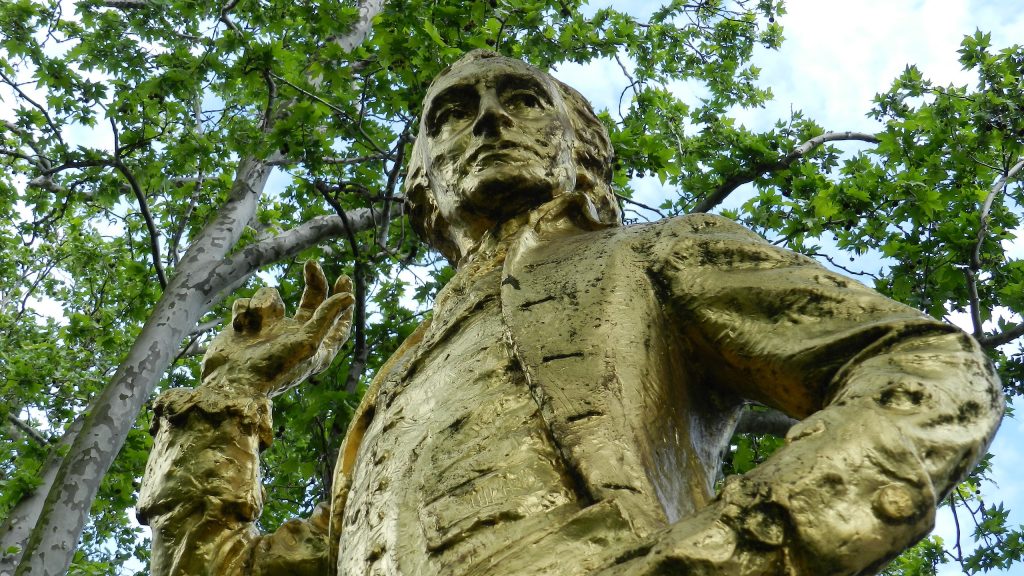
Thomas Paine is the founder of modern democracy. In word and deed, he crafted the democratic movement in three countries, and it spread on its own around the world. As a result, Paine was slandered, attacked and marginalized for 200 years, a victim of the largest disinformation campaign in history. His image and words were actually banned, right up to and including the McCarthy era in America, when his books were banned, even the fictional accounts like Citizen Tom Paine (1943) by Howard Fast.
The pre-eminent founder of American democracy was not recognized as such for centuries. “But such is the irresistible nature of truth,”Paine said, “that all it asks, and all it wants, is the liberty of appearing.”
The Thomas Paine Historical Association was founded to correct this situation. In 1884 New York City, dozens of leaders of the progressive era came together under this organization to hold up Paine as the symbol of democratic rights and government. United by their commitments to civil rights, free speech and women’s reproductive rights, they were key suffragists, socialists, anti-clericalists, antimonopolists, anti-imperialists, and idealists. An organization with Paine’s name on it must have the soul of Paine as its engine.
We cannot discuss the roots and ideology of democracy without Thomas Paine. The literal origin of modern democracy is Common Sense, Paine’s call for revolution against British rule, in particular, and against monarchy itself. Among all the Whigs (the name back then for the progressive-leaning political figures), only Paine endorsed this qualitative leap of ending monarchical government. Paine started and popularized among people the idea of democracy without kings — not Locke, not Montesquieu, who looked after their class, not common people. Paine later followed up with Rights of Man, which became the bible for the Age of Democratic Revolution.
Paine himself, in his life and works, is the “Democratic Manifesto.” In 1777 Philadelphia, in the heat of defeating not only Britain but also the American Tories, Paine formed the Whig Society, the first revolutionary party in the world. He followed it up in 1791 Paris by forming the Social Circle of anti-monarchical activists, the second revolutionary party in the world. [For clarity, The Sons of Liberty was not a political party.
The militant Boston group in the early 1770s focused on disrupting the British militarily, but it lacked an ideological foundation or vision of government to be a real political party.] In Philadelphia and in Paris, Paine helped craft the world’s first two truly democratic constitutions. The first lasted 14 years in America before succumbing to the oligarchic structures of the Federalist Party’s new constitution. The second was never enacted due to the 1795 counterrevolution in France. These documents reveal the origins of today’s struggle.
Do not be confused by the antiquated structures called “democracy” from ancient Greece, where every landed elite sat together and made laws as slaves served them food and drink. Modern democracy could not emerge until the Enlightenment took root, and the political theory of Paine was deeply rooted in it. The emerging new classes coming out of the Dark Ages would contend for dominance. Paine stood with the lower classes, where he came from, and never wavered.
The very word “democracy,” as we use it today, originated with Paine’s Rights of Man. Before that, “democracy” only referred to the Greek’s elite government. The term is still used in that context today, when we hear oligarchs using it to defend their privileges while the majority still languishes in need.