In March, 1775, an article appeared in the Pennsylvania Journal in Philadelphia denouncing the institution of slavery in America – “African Slavery in America”. It was signed “Justice and Humanity”, and the pseudonym, a predominate practice of the period, left authorship open to interpretation. It lay unattributed until Moncure Conway included the article in his four volume set of The Writings of Thomas Paine1 in 1894, since then repeated in other collections, and still referred to as Paine’s work by many to this day.
Thomas Paine was the philosophical leader of the age of democratic revolutions. Through works like Common Sense and Rights of Man, he opened the possibility of a democratic republican system of government, grounded in natural rights and equality. Fighting for the universal application of “the natural rights of all mankind” (in the Introduction to Common Sense)2, Paine’s life was a selfless struggle for liberty, equality and fraternity.
So it was natural to assume that he wrote this important essay in 1775. The article is one of the earliest strong statements against slavery, whose language and salient points led to the creation of the Society for the Relief of Free Negroes Unlawfully held in Bondage a month later. The Society was led by Anthony Benezet3, but disbanded due to the Revolutionary War, and re-established by most of its founding members in 1784 as the Pennsylvania Society for Promoting the Abolition of Slavery and for the Relief of Free Negroes Unlawfully Held in Bondage. Paine was not a founding member in 1775, per the Society’s founding documents at the Historical Society of Pennsylvania, but after the Society relaunched after the Revolution in 1784, Paine did join and by records attended meetings in 17874.
Other scholars have questioned Paine’s authorship of “African Slavery in America”, led by James V. Lynch5. There are specific clues in the text that do not point to Paine: the article was sent to the Pennsylvania Journal, not the Magazine where Paine was editor at the time; the essay includes religious references that Paine would not use, like referring to “our religion” of Christianity (Paine was not a Christian) and referring to the slave trade as in “opposition to the Redeemer’s cause”; and Paine uses references to other authors which he never used in other works, or would use, as Lynch points out.
Paine’s authorship of “African Slavery in America” can be analyzed now by a more objective criteria: computer text analysis. During the process of this analysis, the real author has come to light. I am taking the opportunity to demonstrate Author Attribution Methodology (AAM) which will become a vital tool for historians to settle many questionable claims which have little basis, such as this slavery essay. It was used to uncover undiscovered Paine works, and clarify collaborative writings that have gone unknown for centuries, as was done in the forthcoming Thomas Paine: Collected Works, due out in January, 2026 from Princeton University Press.
Misattribution
The source of the attribution of “African Slavery in America” to Paine traces back to Benjamin Rush in a letter in 1809, after Paine’s death, who claims he was told that Paine was the author.
“About the year 1773 I met him [Paine] accidentally in Mr. Aitken’s bookstore and was introduced to him by Mr. Aitken. We conversed a few minutes, when I left him. Soon afterwards I read a short essay with which I was much pleased, in one of Bradford’s papers, against the slavery of Africans in our country, and which I was informed was written by Mr. Paine. This excited my desire to be better acquainted with him. We met soon afterwards at Mr. Aitkin’s(sic) bookstore, where I did homage to his principles and pen upon the subject of the enslaved Africans. He told me the essay to which I alluded was the first thing he had ever published in his life. After this Mr. Aitkin employed him as the editor of his Magazine…”6
However Rush has numerous errors in recounting these events more than thirty years after the events. The year is wrong: they would have met in early 1775 since he did not arrive in America until November 30, 1774. The allusion to “the first thing. . .ever published” was a statement Paine made about Common Sense, not this article. For example John Adams complained: “There was one circumstance in his conversation with me about the pamphlets, which I could not account for. He was extremely earnest to convince me that “Common Sense” was his first born; declared again and again that he had never written a line nor a word that had been printed, before “Common Sense”.7 Paine would have said something similar to Rush a year after the meeting referred to by Rush. Rush also confuses the hiring of Paine by Aitken after the essay appeared, when Paine started two months before in January, after Paine contributed 3 articles in January, and took over editorship in February.
And Rush also claims elsewhere in this letter that he gave the idea of writing Common Sense to Paine8 (Paine said Franklin gave him the idea in October 17759), as well as its title, which appears to be an aging Rush exaggerating his role in history. Secondary sources are not reliable, as demonstrated here. New tools are needed, and AAM is the most reliable, accurate tool to use.
Attributed by Moncure Conway in his breakthrough biography completed in 189310, and since repeated by most Paine collections and biographies, “African Slavery in America” was accredited to Paine, as a key treatise of the abolitionist movement. Conway went so far as to anoint Paine as one of the first abolitionists11. It is safe to say that in sentiment he may well have been, but as an author, there is no clear justification to support the contention. It is most probable that Paine did not write “African Slavery in America” based on a lack of evidence, on the language used in the essay, and on our computer analysis of the text.
Paine’s Support for the Abolition of Slavery
Paine referred to his support of the abolition of slavery in letters and elsewhere with unreserved hatred for the practice, upholding the revolutionary principle that people must free themselves. For example, in a letter to Benjamin Rush, March 16, 1790 (the letter has been mistakenly assigned as 1789 by Foner):
“I despair of seeing an abolition of the infernal traffic in Negroes. We must push that matter further on your side of the water. I wish that a few well instructed could be sent among their brethren in bondage; for until they are enabled to take their own part, nothing will be done.”
This letter may have fixed the association of Paine to “African Slavery in America” in Rush’s mind. Lynch is correct to an extent however in demonstrating the dichotomy of Paine’s private views and public efforts.
Paine’s support for the Haitian slave uprising, his comments in congratulations to Thomas Addis Emmett on his work against the slave trade12, his association with abolitionists in England in the early 1790s and his support for the abolitionist bill in England in 1790, and his intimate friendship with two of the leading abolitionists in New York in the years before his death, with whom he made the executors of his will – Morton and Emmett, demonstrate Paine’s abolitionist sentiment. But most notably, his close association with Franklin and their political comradeship led to his membership in Pennsylvania Society for Promoting the Abolition of Slavery when Franklin was its President. Mariam Touba sums up this allegiance to antislavery in an essay presented at the 2012 First International Conference of Thomas Paine Studies at Iona College.13
Paine’s support for the abolition of slavery can be seen in other contexts. His support for the Haitian slave uprising and his statements in letters to Jefferson, such as the following, exhibit a profound hatred of slavery:
“It is chiefly the people of Liverpool that employ themselves in the slave trade and they bring cargoes of those unfortunate Negroes to take back in return the hard money and the produce of the country. Had I the command of the elements I would blast Liverpool with fire and brimstone. It is the Sodom and Gomorrah of brutality.”14
From the Forester’s Letters in the spring of 1776 Paine was an early opponent of slavery:
“…can America be happy under a government of her own, is short and simple, viz. As happy as she please; she hath a blank sheet to write upon. Put it not off too long.” Footnote by author: “Do not forget the hapless African.”15
In 1796, in a poem to a female acquaintance, “On the Descent upon England16”, where his stanzas iterate the crimes of Britain, is this notable one (Lynch also refers to this poem):
“See Afric’s wretched offspring torn
From all the human heart holds dear,
See millions doomed in chains to mourn,
Unpitied even by a tear. . .”
Other scholars have questioned Paine’s authorship of “African Slavery in America”, such as Hazel Burgess and Jonathan Clark (who take their lead from Lynch17). There are specific clues in the text that do not point to Paine: the article was sent to the Pennsylvania Journal, not the Magazine where Paine was editor as I mentioned; the essay includes religious references that Paine would not use, like referring to “our religion” of Christianity (Paine was not a Christian) and referring to the slave trade as in “opposition to the Redeemer’s cause”; and Paine uses references to other authors which he never used in other works of this time period, as Clark points out. Clark assigns it to Anthony Benezet, based on the note accompanying the article to the publisher signed “A.B.” But A.B. was also used by Hopkinson in several essays, so that is not proof, just a guess.
Lynch is correct in scolding many noted academics for using faulty references for proof of Paine’s abolitionism, something that will only be corrected by an official Collected Works. Despite a few errors18, the Lynch article makes a sound argument about the dichotomy of Paine’s private and public views, and correctly attributes to Paine the strength of his overarching ideology of universal human rights, and how abolitionism is ensconced under that banner, despite Lynch’s hostility to Paine.
But Lynch assumes also that Paine “joined other revolutionaries in the conviction that American citizens would only be white.”19 And Lynch goes on to use examples from Louisiana and Haiti to support his contention that Paine saw only a white republic. But here is where Lynch’s bias rooted in his conservative world view oversteps the complete analysis. He attacks Paine for opposing expansion of slavery into Louisiana on practical grounds, yet ignores the fact he is trying to convince the power structure through Jefferson to do what is good for them, and so Lynch denies Paine’s humanitarian desires. He does the same in regards to Haiti, where Paine was writing to the President about the best approach to the revolution in Haiti for American interests. Lynch rightly asserts that Paine was not focused on individual issues, but on the wider era of democratic revolutions, where these particular issues would be resolved. And Lynch selects passages that suit him, and ignores the others: for example, the conclusion of “To the French Inhabitants of Louisiana”, Paine sums up his argument by making two points: “The case to which is being found in direct injustice is that which you petition for power, under the name of rights, to import and enslave Africans! Dare you put up a petition to heaven for such a power, without fearing to be struck from the earth by its justice? Why, then, do you ask it of man against man? Do you want to renew in Louisiana the horrors of Domingo?”20 Lynch talks about the last sentence not the vehemence of the first part. Paine uses both the moral and the practical, so Lynch’s claim that Paine never publicly denounced slavery is not correct, just from these few quotes mentioned in this article.
And Lynch does quote Paine’s true reasons for not writing about slavery, which belies other parts of his essay: “an unfitter person for such a work could hardly be found. The cause would have suffered in my hands. I could not have treated it with any chance of success; for I could never think of their condition but with feelings of indignation.”21 Lynch also repeatedly denies that Paine “seems” to deny blacks equal citizenship, that only whites could rule a republic. But here too his concept of civilization was paramount, not his attitude towards races, and it is misleading to say Paine only supported a Republic of whites . There are many out of context quotes in Lynch’s essay, which must wait for another article to lay out.
But the question then remains, who wrote “African Slavery in America”?
The Petrovic Method22 of Author Attribution
Moncure Conway and Philip Foner in their collections of Paine’s works included “African Slavery in America,” however they did not have the tools we have today.
The Text Analysis Project at the Institute for Thomas Paine Studies at Iona University developed a computer-based author attribution procedure to help in the problem of identifying authorship of texts attributed to Paine, or texts previously not attributed to Paine that should be. Several articles have been published, and peer reviewed to great acclaim. We focus on the style of the documents in the computer analysis, not the content, but then confirm the results through thorough analysis of its content by Paine scholars familiar with the philosophy and approach to political issues of Paine, and the forensic clues to geographical, personal content, and internal evidence in the document. Techniques to identify other styles not yet in JGAAP (Java Graphical Author Attribution Program), like the use of alliteration, were being developed by the Institute, but abandoned, and will be put to use in future analyses as we continue to perfect the Methodology. JGAAP is a free source of programmed style features that can be used to test texts using style(s) features.
Stylistic features identified in JGAAP are often used unconsciously and consistently by authors, and, if correctly identified, will correctly reveal the identity of the author. It is much like fingerprints, which are hardwired in the author’s head, who can only explain, argue, or express themselves with their unique brain patterns. We use machine learning where special algorithms use documents of known authorship as training examples to train the computer to recognize each author’s writing style, or syntax, based on the use of 17 accepted author attribution features. Once the computer is trained, the completed model is tested against the disputed document to assess the nearest fit to the author training sets.
Using JGAAP as a starting point, the method takes accepted features of style identification from established software of lexical features, and combines them in four types of machine learning methods and features that our team developed in a statistical array to generate percentages of likelihood of authorship. The results produced a self-testing, accurate measure of authorship attribution. Author files need to be created, from 2000 to 3000 words from definitive works of each author, as well as a program to group selective author files to which to test.
The number of authors used was twenty-nine here, including Paine, Franklin, Benezet, Jefferson, Hopkinson, Price, Priestley, John and Sam Adams, Hopkins, Witherspoon, Madison, Monroe, Young, Cassandra, Matlack, G. Morris, Peale, Rittenhouse, and others. Authors are selected by time period and physical availability. A “leave-one-out” method of testing each author’s file is done: one of the works in an author’s file of works is tested against the remaining works, and so on through all the works. When using this method of testing the integrity of Paine’s file, we noticed that “African Slavery in America” stood out with a very low percentage. By removing it, the remaining works tested at 100%, assuring that Paine’s file was accurate. The same tests were done on all the author files to be certain of their purity. In all we use over 100 author files that we have covered French, English, and American authors in testing. Non-English texts are Google-translated, which has proved to be extremely accurate so that all tests are done in English.
Some of the features used:
Character NGrams (Cg) – uses a sequence of n (2 or 3) characters to compare. For example, “Character NGrams” has these 2-grams: Ch, ha,ar,rc,ct,te,er,r_, _N, NG, Gr,ra,am,ms. This has proven very reliable in text mining applications.
First Word In Sentence (Fwis) – compiles the first words used in all sentences and compares.
MW Function Words (Mwfw) – from Mosteller-Wallace “Federalist Papers” work. Function words are the most common words, like prepositions, pronouns, articles, etc. They are content neutral and are used in a subconscious manner, and are most reliable in author attribution works.
Prepositions (Prep)
Special Words 2 (Sw2) – developed by our Text Analysis Project, these include use of period words like “hath”, “juster”, “wilfull”.
Suffices (Suf) – looks at the last three letters of each word.
SW French Origin (Swfo) – words are compared to an English words of French origin compilation.
Vowel-initial Words (Viw)
Word NGrams (Wg) – uses a sequence of words for comparison
Linear SVM (Lsvm) – generates a linear separator to divide the feature space into regions, each corresponding to a specific author
Multilayer Perceptron (Mp) – an artificial neural network that maps sets of input data onto appropriate outputs.
Using individual features separately, the results obtained only ranged from 37% to 73% accuracy in predicting authorship. With the combined method that we are employing, the accuracy was at 78% consistently in 2012, and then the accuracy was improved to over 90% through 2021.
Random guessing would only expect to see a 6% result for each of 16 authors on a random test. The precision of the “leave-one-out” tests showed accuracy of 90%. This was achieved by weighting the features for each author for the features that work best for that author. Some authors showed, for example, a more reliable outcome consistently using function words, while it performed badly consistently using French origin. So we weighted function words for that author. The 62% threshold that we use ensures that only features that show effective accuracy above the median are used for the analysis.
Testing “African Slavery in America”
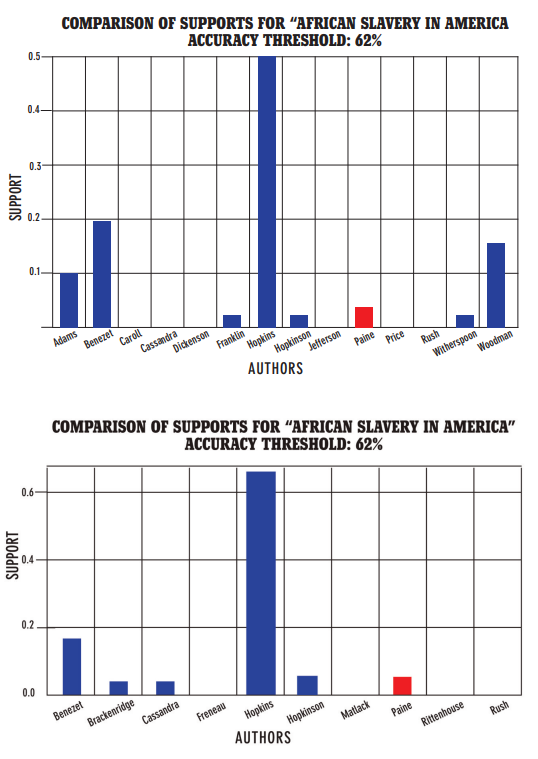
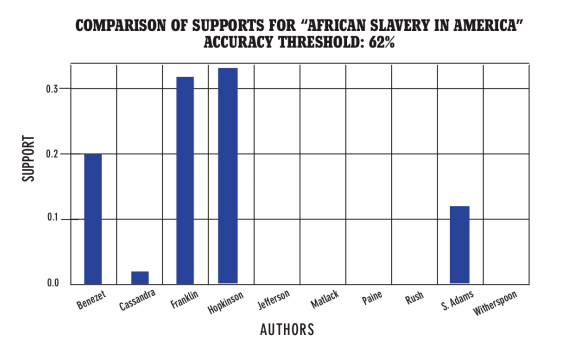
With different combinations of all possible authors, here are some results, taken from testing all the above authors:
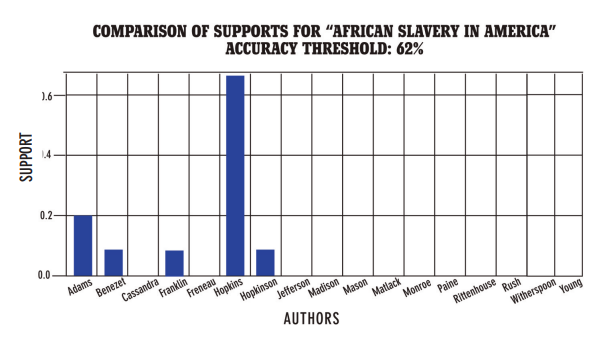
There are several things to notice in these tests: first, Paine shows little to no support; second, Hopkins shows very strong support; third, Anthony Benezet also shows little support; and lastly, there are no indications that the author is not present. Normally in leave-one-out testing procedures to insure accuracy, if one author among several achieves over 40%, with no other author above 20%, it is a strong indication that the 40% one is the author. A consistent 50% result shows a very high probability that the author has been found. If the real author is not present, the results would show several authors with under 40% support, with no clear winner. For example, here is a test that does not include Hopkins for “African Slavery in America”:
Without Hopkins in the author choices, there is no clear probable author, a pattern that recurs whenever the actual author is not included in the test.
Who is Samuel Hopkins?
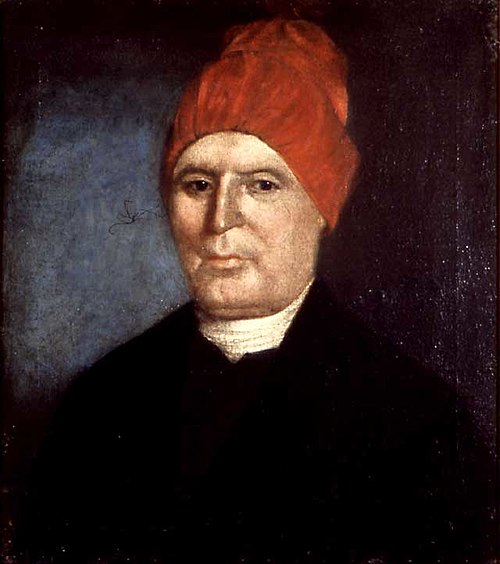
Samuel Hopkins was a Congregational minister and theologian from Rhode Island. Hopkinsianism bears his name, also referred to as the New Divinity, which he helped develop with Jonathan Edwards. He was a type of Calvinist. And he was one of the original ministers to denounce slavery, and his Congregationalist Church was the first to publicly denounce slavery. Hopkins wrote at least three other articles against slavery. He would have been familiar with Anthony Benezet’s Quaker objections to slavery who had written against it since the 1760s. It is likely that he sent this article to Benezet to be published in the center of political activity, Philadelphia, thus explaining the note to the publisher, signed A.B.
The content of Hopkins’ “A Dialogue concerning the Slavery of the Africans,” written a year after “African Slavery in America,” exhibits the same arguments.
From “A Dialogue”:
“And I take leave here to observe, that if the slavery in which we hold the blacks, is wrong; it is a very great and public sin; and therefore a sin which God is now testifying against in the calamities he has brought upon us, consequently must be reformed, before we can reasonably expect deliverance, or even sincerely ask for it.. . . we have no way to exculpate ourselves from the guilt of the whole, and bear proper testimony against this great evil, but by freeing all our slaves.”
From “African Slavery”:
“How just, how suitable to our crime is the punishment with which providence threatens us? We have enslaved multitudes, and shed much innocent blood in doing it; and now are threatened with the same. And while others evils are confessed, and bewailed, why not this especially, and publicly; than which no other vice, if all others, has brought so much guilt on the land?”
From “A Dialogue”:
“Let no Christian then, plead this permission to the Jews to make bond slaves of their neighbours, as a warrant to hold the slaves he has made, and consequently for universal slavery.”
From “African Slavery”:
“But some say, “the practice was permitted to the Jews. To which may be replied. The example of the Jews, in many things, may not be imitated by us . . .”
The two essays exhibit the same philosophy, with the same religious arguments, and the same remedies –
From “A Dialogue”:
“Let them be subject to the same restraints and laws with other freemen; and have the same care taken of them by the public. And be as ready to direct and assist those who want discretion and assistance to get a living, as if they were your own children; and as willing to support the helpless, infirm and aged. And give all proper encouragement and assistance to those who have served you well, and are like to get a good living, if not put under peculiar disadvantages, as freed negroes most commonly are; by giving them reasonable wages for their labour, if they still continue with you, or liberally furnishing them with what is necessary in order to their living comfortably, and being in a way to provide for themselves.”
“To turn the old and infirm free, would be injustice and cruelty; they who enjoyed the labors of their better days should keep, and treat them humanely. As to the rest, let prudent men, with the assistance of legislatures, determine what is practicable for masters, and best for them. Perhaps some could give them lands upon reasonable rent, some, employing them in their labor still, might give them some reasonable allowances for it; so as all may have some property, and fruits of their labors at their own disposal, and be encouraged to industry; the family may live together, and enjoy the natural satisfaction of exercising relative affections and duties, with civil protection, and other advantages, like fellow men.”
Conclusion
The aim of the use of this Author Attribution Methodology article is to exhibit and assist in learning this methodology, is provide an objective, scientific method to help analyze texts attributed to historical authors, and discover text not attributed to the proper author(s), in order to be able to significantly close the debate on many documents. With this tool, we will be able to bring the full collected works of Thomas Paine to the forefront in the discussion on his legacy, his place in the history of political philosophy, and his continuing role in the struggle for democracy. In the process, we have discovered other documents that can be attributed to specific writers of the period. By determining that “African Slavery in America” with high probably is not Paine’s work, it does not diminish his role in the history of human freedom. And especially after the “Slave Letter” has been proved to be Paine’s using this Methodology.23 And it does allow for the full recognition of the early abolitionists, like Anthony Benezet and Samuel Hopkins, to take a position of greater importance in American history.
AAM also has demonstrated that most political and philosophical essays in the 18th century were written collaboratively, and several years were directed towards testing collaborative works. We have developed accuracy in authorship down to the paragraph level, and in individual sentences if necessary. The Collected Works will demonstrate it, as Paine led a group of writers in a collaborative manner to avoid discovery. No secondary references could break down the collaborative works. For example, it appears by our testing analyses, that the Federalist Papers are mainly inaccurate, having relied on secondary sources, and by using only one feature by Mosteller and Wallace.24
“But such is the irresistible nature of truth, that all it asks, and all it wants, is the liberty of appearing.” (Rights of Man)
By Gary Berton, President of the Thomas Paine National Historical Association and Founder of the Institute for Thomas Paine Studies at Iona University
Appendix: Paine’s Antislavery Legacy: Some Additional Considerations
By Miriam Touba
When assessing his legacy, modern commentators have noted Thomas Paine’s consistent objections to African slavery. Paine’s strong antislavery stand was, however, seldom cited and often unknown to those “in the trenches,” the 19th-century abolitionists who were actually fighting the peculiar institution in antebellum America. Reasons for this ignorance can easily be found: Paine’s religious writings made him unpalatable to the churches, many of whom provided the energy for the abolitionist and reform movements of the first half of the 19th century. Thus, the very Christian-based publications that printed arguments against slavery ran them virtually side-by-side with denigrating stories about the “infidel” Thomas Paine. Furthermore, most of Paine’s antislavery writings were either unsigned articles, ephemeral newspaper remarks, or were entirely unknown before being brought to light by his dedicated biographer, Moncure Conway (an abolitionist in his own right) only late in the 19th century, when the fight against North American slavery was over.
Not previously cited in this context is the wide circulation in the antislavery literature of the letter addressed to Thomas Paine by the British abolitionist Edward Rushton sometime around 1805. Rushton’s persistent fight against slavery was admirable, carried on despite his blindness. Among his efforts were letters written to George Washington and Thomas Paine pleading with them to use their influence against slavery. To these pleas, Rushton never received a reply from Washington and, apparently, never a formal answer from Paine, then living in New York. His letter to Paine, wrongly suggesting that Paine never published a syllable against slavery, would find its way into such influential abolitionist papers as The Liberator and the National Antislavery Standard much later in the mid-19th century.
This presentation will discuss Rushton, his letter, and whatever influence it may have had on 19th-century abolitionists in viewing Paine as indifferent, timid, or lukewarm in the antislavery cause. This study will also then briefly try to answer Rushton’s reasonable question: Why did Paine oppose slavery and yet devote so little of his writings to the injustice of slavery?
Finally, this paper will bring to light one piece of evidence of Paine’s commitment to the cause of antislavery just about the time Rushton was writing to him. It is found in a greeting in a letter in the TPNHA/Iona Collection. From New Rochelle, Paine sends on his congratulations to Thomas Addis Emmet, the Irish émigré lawyer who would later serve as Paine’s executor. In this unpublished 1805 letter, Paine wishes to commend Emmet, whose first case before the bar in the United States was a successful effort on behalf of fugitive slaves. While the details of the case appear lost to history, Paine’s passing reference to “the Affrican Affair” [sic] is just a reminder that there are new things to be discovered in the collection as it is being catalogued and made more widely available.
Mariam Touba is the Reference Librarian at the New-York Historical Society, March 2012
ENDNOTES
1. Conway, Moncure, The Writings of Thomas Paine, Vol. I, G.P. Putnam’s Sons, New York, 1894, pg. 4. 2. Philip S. Foner, ed., The Complete Writings of Thomas Paine, (New York, 1945), I, 3. 3. Antony Benezet (1713-1784), born in France as a Huguenot, converted to Quakerism in America. 4. Papers of the Pennsylvania Abolition Society, March 5, 1787, Historical Society of Pennsylvania. 5. James V. Lynch, “The Limits of Revolutionary Radicalism: Tom Paine and Slavery,” Pennsylvania Magazine of History and Biography, (July 1999) CXXIII, 3, 177. 6. L.H. Butterfield, Rush, Benjamin, ed., Letters of Benjamin Rush, (Princeton, 1951), II, 1007. 7. John Adams, Collected Works, (Boston, 1850) II, 510. This insistence by Paine to have never written before was a means of protecting his Whig writing group in England starting in 1758. His revolutionary, underground activity using the printing press included a dozen like minded writers of note, and Paine was its leader (proof to be published in January, 2026 in Thomas Paine: Collected Works, in January, 2026.) 8. L.H. Butterfield, Rush, Benjamin, ed., Letters of Benjamin Rush, (Princeton, 1951), II, 1008. 9. Philip S. Foner, ed., The Complete Writings of Thomas Paine, (New York, 1945), I, 89. 10. Moncure D. Conway, The Life of Thomas Paine (2 vols., New York, 1892,1893), p. 41. 11. Ibid., p.95. 12. From an unpublished letter to John Fellows, April 18, 1805 in the TPNHA Collection at Iona College. 13. See Appendix for the essay. 14. See Paine’s letters to Jefferson in January, 1805, in Foner, Vol. II, ibid., pgs. 1453-63. 15. Foner, V. II, Letter 3, pg. 82. 16. Original at the Morgan Library. 17. XXX footnotes await access to these books. 18. Lynch for example refers to Paine’s religion as Quakerism. Paine was not a Quaker, but he was exposed to its teachings. See p. 188. 19. Lynch, p. 180. 20. Foner, II, pg. 968. 21. From John Epps, The Life of Thomas Walker (London, 1832), p .142, quoted by Lynch on p. 196. 22. Dr. Smiljana Petrovic of Iona University led the programming to create two packages needed to analyze text. 23. For a detailed look at Paine’s anti-slavery view, see “Identifying “A Slave”: The Iona College Text Analysis Project Explores a Mystifying Letter to Thomas Jefferson”, Gary Berton, Smiljana Petrovic, Michael Crowder, Lubomir Ivanov, in Mark Boonshoft, Nora Slonimsky, and Ben Wright, eds., American Revolutions in the Digital Age (CornellUniversity Press, 2024) 24. Frederick Mosteller (1916-2006) was professor of statistics at Harvard University. David L. Wallace (1928-2017) was professor emeritus of statistics at the University of Chicago. Their feature is one of the 17 features we used in our methodology. Unfortunately, using only one feature only results in less than 50% accuracy, and thus the Federalist Papers, which they tested, are only 50% accurate. That will be a future study, to correct the authorship of the Federalist Papers.