
Thomas Paine on Government at the Birth of Democracy
By Gary Berton
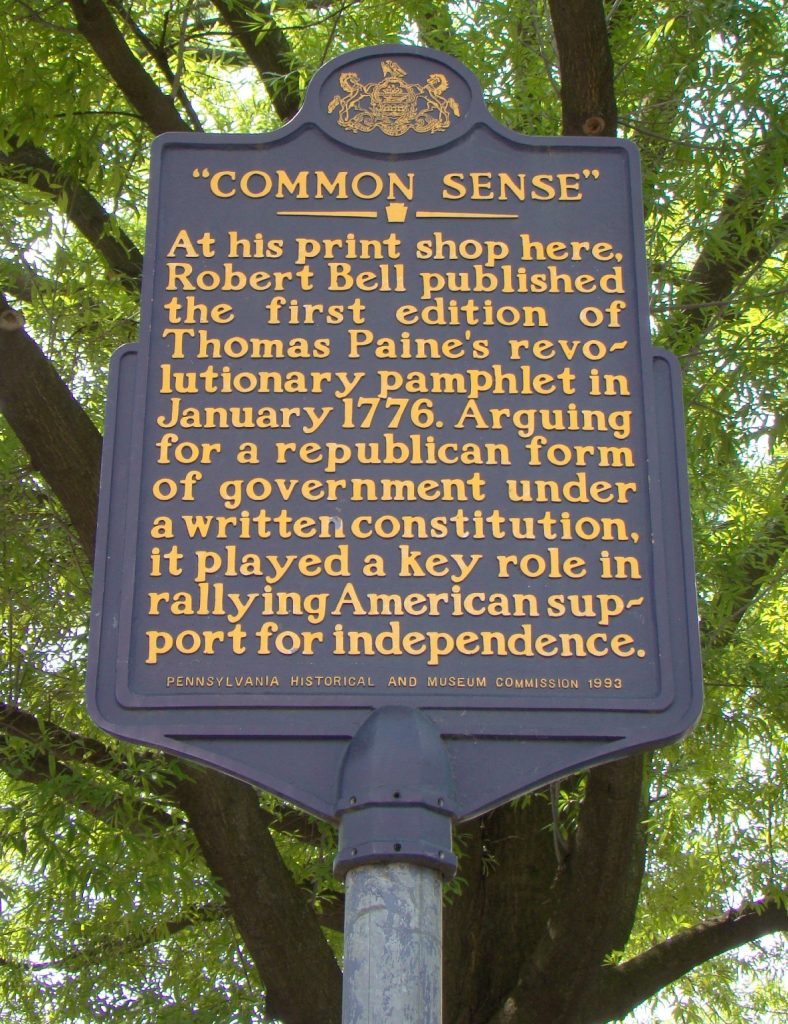
In Common Sense, Thomas Paine introduced the concept of modern democracy. This idea is what the “revolution” in the American Revolution rested upon. Self-rule was a by-product of the concept of government “of the people, for the people, by the people.”
Before Common Sense, the meaning of “democracy” was diffuse. Multiple meanings of the term since have been used by other forms of government, even oppressive regimes. Holding elections, no matter how corrupt, has become the definition of democracy.
In Common Sense, Paine began his discussion about government by defining it for his readers:
Society in every state is a blessing, but government even in its best state is but a necessary evil; in its worst state an intolerable one…. Government, like dress, is the badge of lost innocence; the palaces of kings are built on the ruins of the bowers of paradise. For were the impulses of conscience clear, uniform, and irresistibly obeyed, man would need no other lawgiver, but that not being the case, he finds it necessary to surrender up a part of his property to furnish means for the protection of the rest; and this he is induced to do by the same prudence which in every other case advises him out of two evils to choose the least. Wherefore, security being the true design and end of government, it unanswerably follows, Thomas Paine on Government at the Birth of Democracy that whatever form thereof appears most likely to ensure it to us, with the least expense and greatest benefit, is preferable to all others.
Anarchists and libertarians, plus conservatives, love this quote. They refer to it constantly, but like many historians, they do not read further.
The paragraph names security as the only purpose of government. This idea became an excuse for oppression. Government ensures the rich are “secure,” but the majority of the people are insecure due to corrupt government.
To explain the origins of government, Paine told a parable imagining that “a small number of persons settled in some sequestered part of the earth, unconnected with the rest; they will then represent the first peopling of any country, or of the world.
”In this state of natural liberty, society will be their first thought. Thus necessity, like a gravitating power, would soon form our newly arrived emigrants into society, the reciprocal blessings of which, would supersede, and render the obligations of law and government unnecessary while they remained perfectly just to each other; but as nothing but heaven is impregnable to vice, it will unavoidably happen, that in proportion as they surmount the first difficulties of emigration, which bound them together in a common cause, they will begin to relax in their duty and attachment to each other; and this remissness will point out the necessity of establishing some form of government to supply the defect of moral virtue.”
Six paragraphs later, after laying out his “design and end of government,” Paine sums up his thesis:
Here then is the origin and rise of government; namely, a mode rendered necessary by the inability of moral virtue to govern the world; here too is the design and end of government, viz. freedom and security. And however our eyes may be dazzled with show, or our ears deceived by sound; however prejudice may warp our wills, or interest darken our understanding, the simple voice of nature and of reason will say, it is right.
Paine changes the design and end of government (“end” meaning the goal) by adding freedom to security. Both are needed.
His opening paragraph was about the need for security; this last paragraph sums up his thesis. Security and freedom together is Paine’s definition of republican government. “Republican” was the term used at the time for popular government. The “democratic” term came into use from Rights of Man in 1792.
Sadly, self-interest does darken our understanding, as does fake news, propaganda, and blind obedience. As Paine observed in Rights of Man, “Ignorance submits to whatever is dictated to it.”