
By R.W. Morrell
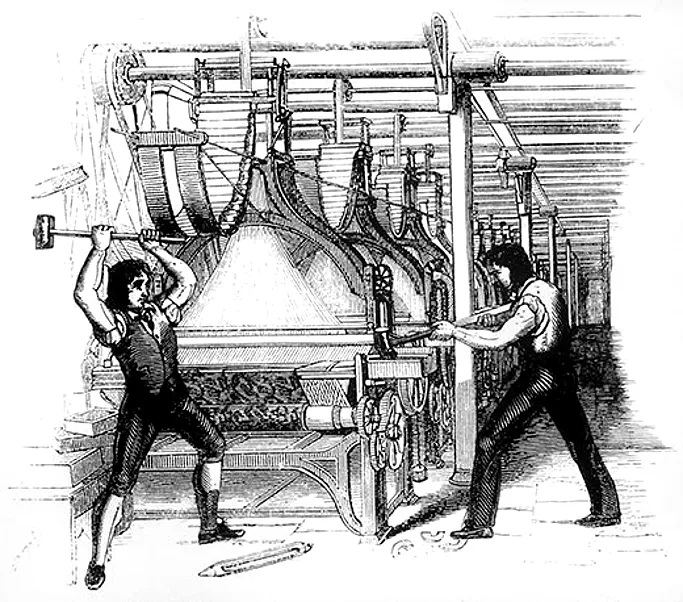
On July 22, 1815, Charles Sutton, founder, proprietor and editor of the Nottingham Review was charged with libel against the government and the British army, although it was not until February the following year that he was actually brought to trial before a special jury on an ex officio information.1 Predictably found guilty, he was sentenced on February 17 to a year in Northampton prison, plus a substantial fine. According to the charge, it had been his ‘intention to breed discontent in the minds of His Majesty’s subjects’ by publishing in the October 14, 1814 issue of the Review a letter purporting to have come from ‘General Ludd’ which contrasted the destructive activities of the British army in the United States, the two countries being at war, and the approval given this by the government with the attitude they took in respect of the Luddites, however rather than present isolated passages I give the letter in full as it does not appear to have been republished since it first appeared in Sutton’s newspaper:
‘I take the liberty of dropping you a few lines to inform you of the good fortune of one of my sons, who is come to very high honour. You may know that some time ago, owing to some imprudent conduct, my eldest son Ned decamped and enlisted into his Majesty’s service, and as he was notorious for heroism and honourable enterprise, he was entrusted with a commission to exercise his prowess against the Americans, and I am happy to say he has acquitted himself in a way which will establish his fame to generations yet unborn. I assure you Mr. Editor, I scarcely know how to keep my feelings within bounds, for while all our former and united efforts in breaking frames, were commented upon with some severity, and in a way which cast an odium upon my character and that of my family, I now think the scales are turned, and our enemies are converted into friends; they sing a new tune to an old song, and the mighty deeds of my son are trumpeted fourth in every loyal paper in the kingdom. My son is not confined to breaking a few frames, having the sanction of the government, he can now not only wield his great hammer to break printing presses and types, but he has the license to set fire to places and property which he deems obnoxious, and now and then even a little private pillage to wink at. Even the GAZETTE EDITOR of Mr. Tupman’s who was formerly one of my greatest enemies, and threatened to pursue both me and my family to the uttermost, is now in my favour, and is become a patron, and an admirer of my son, on account of his achievements in Washington.2 There is one thing though in the conduct of this Gentleman which has caused me some little uneasiness; a few weeks ago he strongly recommended to the magistrates to offer a very large award to any person who would disclose our secret system of operation in the neighbourhood; he went so far as to say 5,000f ought to be offered, enough he said to enable the informant to live independent in another country, intimating that such a character would not be considered a proper person for the society of this country, and therefore he should emigrate to seek other associates. I hope it is not true that this notorious Editor has any secrets to disclose against me and my family, and that he is waiting for this very large reward to be offered, that he may avail himself of such an opportunity of making his fortune, and fleeing his country. Now, I really think, as my son is become truly loyal, and is working for his country’s good, and under the sanction of the Crown, and as his achievements have been first rate “old grievances ought not to be repeated;” though bye and bye, I of the opinion that all which I and my son have done in Nottingham and neighbourhood, is not half so bad as what my son has done in America; but then you know he has supreme orders from indisputable authority, for his operations in America, and that makes all the difference.
I am, Sir, your obedient servant
GENERAL LUDD
Ludd Hall, October 5, 1814.
In some notes prepared for his defence, Sutton describes the letter as ‘an ephemeral trifling article’ which the Attorney General, Sir William Garrow ‘would not conceived the idea of prosecuting …. had he not been instigated thereto by some of our own townsmen who (shame on such hypocrisy) wore the mask of whiggism’.3 In other words, Sutton was of the opinion that some people had masqueraded as radicals whereas they were actually anything but so. The Home Office is known to have kept newspapers critical of government policies and supportive of reform under close surveillance, which in the case of the provincial press was undertaken by ‘innumerable Tory magistrates and clergymen in all parts of the country’ who sent the Home Secretary those papers and pamphlets they considered should be subject to prosecution,4 these included the Nottingham Review, which had been under official scrutiny from 1814,5 although it is likely this had commenced earlier. A reader of the paper, a Mr. Orgill, who may well have been one of Sutton’s pseudo-Whigs, had sent a copy of the issue containing the letter to the Attorney-General, as he revealed in a letter he sent to Sutton in which he demanded the dismissal of the paper’s editor, who he names as being John Blackner, in addition he also accuses Blackner of being the author of the ‘General Ludd’ letter.6
Despite the decision of the court in Sutton’s case, Orgill was probably correct in naming Blackner as the author of the letter, perhaps having heard him talk about it and his other contributions to the paper, incorrectly concluding from the latter that he, not Sutton, was the editor. According to Derek Fraser, Blackner had assisted Sutton from 1809 to 1812 with editorials,7 basing this claim on a paper written by C.J. Warren, who actually says nothing of the sort but limits himself only to asserting him to have been a regular contributor.8 However, following Sutton being jailed it does seem Blackner then assumed some sort of editorial responsibility, although in this he appears to have been assisted, or overseen, by Sutton’s son Richard,9 The Attorney-General appears not to have taken Orgill’s claim seriously and no action was ever taken against Blackner. It is, of course, possible that Sutton had incorporated material written by Blackner into his own contributions but this would not constitute assisting with editorials in the formal sense, Sutton could do as he wished with material he had paid for, there being no copyright laws to worry about.
The sentiments expressed in `Ludd’s’ letter reflect Blackner’s known sympathy for the Luddites, in addition to which his eldest son, also named John, had joined the army and been sent to the United States where he participated in the war between that country and England, and during which he was killed in action in 1812, the first year of the war. This must have been a terrible blow to Blackner and his wife who appear to have enjoyed a happily married life together. Of all Sutton’s known associates, Blackner was the most likely to have written such a letter. Moreover, Blackner could speak from personal experience about the problems the framework knitters were encountering and he was very sympathetic to their complaints. As a Paineite he also tended to look upon the newly established United States as the democratic ideal which most radicals saw as the blueprint for a new society in Britain. Such unquestioning idealism may have been flawed, but this fact was not obvious at the time.
During the late 18th and first quarter of the 19th centuries Luddism was a major political and economic thorn in the side of the government, consequently newspapers considered sympathetic towards it such as the Review became targets for prosecution, unless, of course, their owners and editors, frequently one and the same, could be pressured into publishing government propaganda against the Luddites, perhaps while still seeking to create the impression they were sympathetic to the ‘Luddite cause. This plan of action can be seen in the case of Thomas Paine, for in order to reduce his support and influence the government paid George Chalmers (who used the name Francis Oldys) to write an ostensibly friendly biography of him which was really an exercise in character assassination. We do not know if the government sought to pressure Sutton into working for them, but one suspects they may have attempted to, particularly as his paper was popular and had attained a considerable circulation, this in 1812 being around 1,500 copies per weekly issue, of which half were sold outside Nottingham.
At a Cabinet meeting held on January 29, 1812 to discuss action to be taken against the Luddites, time was devoted to exploring means by which articles hostile to them could be inserted into Nottingham newspapers. During the ensuing discussion it emerged that the Home Secretary had serious doubts whether there was a single paper in the town likely to cooperate, or ‘that could be relied upon’ to convince ‘the lower orders’ that their own ruin would be the result of further machine breaking. If this was not sufficient doubts were also expressed as to the difficulty in finding suitable writers for the proposed articles.10 One wonders whether these observations were made in light of a refusal on Sutton’s part to accept a secret subsidy to ensure his newspaper took a pro-government stance. Such payments, using unaccountable secret service funds, had been paid to several publishers including John Stockdale, who received close to £300, and John Heriot, who had been paid over £172 for producing pamphlets and advertisements.11
Although the political nature of the prosecution was obvious to Sutton, he was convinced that the real reason for it was not the letter, but his sustained opposition to the war with France and believed that Attorney-General had given into pressure at the urging of ‘an enemy’ who’ stood at his (the Attorney-General’s) ear… as Satan of old stood at the ear of Eve’.12 Although he does not name the individual he had in mind one can speculate it was the lawyer, D.C.Coke, who had been, with one short but significant break, Tory MP for Nottingham from 1780 until 1812. The break occurred in 1802 when following a bitterly fought election campaign lasting several days Coke lost his seat to Joseph Birch, a radical. Coke was mortified and petitioned for the election to be declared invalid, arguing that the pro-radical Nottingham Council had failed to ensure his supporters protection when they sought to vote, as the radicals had intimidated them. A House of Commons committee accepted his complaint and ordered a re-run of the election in 1803.
Birch had been nominated to contest the 1802 election without his foreknowledge by two artisans, one a journeyman stockingmaker, the other, a woolcomber, but this notwithstanding he had agreed to accept nomination. This set the proverbial cat among the political pigeons, for Tory supporters were horrified by the fact that two members of an inferior social order had interfered in what was said to be an unofficial agreement to ensure that one of Nottingham’s two Parliamentary seats went to the Whigs and one to the Tories. The ‘lower orders’ were supposed to know their station in society, this pair obviously did not. One hysterical supporter of Coke wrote of this being ‘a frightful omen on the part of the labouring class’.13 Faced with a similar ‘omen’ a quite useless society ornament, the duchess of Buckingham, had spluttered in rage about workers being ‘tinctured with impertinence and disrespect towards their superiors’. To this Coke would have no doubt have added a sincere `amen’.
Intimidation came from both sides during the 1802 election, for certain of Coke’s supporters amongst local employers sought to pressure their employees eligible to vote into supporting him by threatening to dismiss them. This was instrumental in catapulting Sutton into the political arena, as in association with certain other prominent local radicals he established a benevolent fund from which payments would be made to assist anyone who had voted ‘according to Conscience, and irrespective of party, and for which they had been oppressed `by the Iron-hand of power’ until they had obtained further employment.14
The 1803 election became known as the “paper war” on account of the sheer volume of electoral posters, handbills, broadsheets and such like that were produced and circulated in the town. Sutton, a Birch supporter, must have benefited financially as he printed much of the material issued by Birch and his supporters. Whether he wrote as well as printed any of the largely anonymously written handbills, etc., cannot be determined, nor do we know whether Blackner was involved, but one suspects this to have been likely. Did he have a vote and was one of those dismissed and so turned to the benevolent fund for assistance, and having done this did he make his first acquaintance with Sutton at this time? If so then it could also be when he decided to become politically active.
During the campaign Coke sought to show Birch as being if not the devil incarnate at least his right hand demon, while his supporters, if not himself, were depicted as being followers of Thomas Paine, and as such intent upon the destruction of the monarchy.15 In contrast, Coke represented himself as ‘venerating the monarchy’.16 Sutton, one might add, is reputed to have held republican views and the coverage he gave republican radicals in the Review following its foundation in 1808 would tend to support this belief.
Charles Sutton was born 1765, his parents being Unitarians. He received a good education and was apprenticeship as a printer, establishing his own busi- ness in Bridlesmith gate, Nottingham, in 1792. He converted, probably due to the influ- ence of his `pious’ wife, from Unitarianism to Methodism, joining the breakaway Methodist New Connection in 1783. Like so many of his fellow co-religionists he had been greatly influenced by Thomas Paine’s Rights of Man, indeed Paine himself had sought, without success, to become a Methodist minister.17 Although Sutton never mentioned Paine in his paper, or listed any of his titles in his book catalogues, these did contain many radical classics and accounts of the trials of radicals such as Thomas Muir, in which Paine loomed large, Muir being sentenced to transportation for having books by Paine. If he stocked Paine’s works, which one suspects he did, Sutton would have done so on an ‘under the counter basis’, a common practice amongst booksellers. Despite his radicalism Sutton does not appear to have written any separate political works, his political feelings being expressed anonymously through the pages of his paper following its establishment in 1808, he did, though, produce several religious essays of no particular significance.
Little is known of John Blackner’s early years apart from him having first seen the light of day in the small Derbyshire town of Ilkeston, a few miles from Nottingham. There is no record of his mother’s marriage in the register of the parish church, there is an entry for the marriage of a John Blackase to a Martha Brambury, which took place on December 4, 1769. There is no evidence of any connection and the only reason I mention it is the fact that Blackner’s mother’s name was Martha. Nor is there any mention of his baptism, but this is not surprising as his parents are known to have been nonconformists who worshiped at the town’s Independent Chapel. Many nonconformists objected to participating in an Anglican rite, even if only for infant baptism and are known to have deliberately ignored their legal obligation to have their children baptised in an Anglican church. It was not until the passing of the 1836 Registration Act that nonconformists were allowed to baptise children in their own places of worship. There is, of course, the possibility that the family did not live in Ilkeston. Whether Blackner had any brothers and sisters is also unknown. His father is said to have died while he was an infant, but there is no entry for him in the parish burial register. However, his widowed mother remarried a man named Joseph Large, a tailor by profession, who came from Greasley, Nottinghamshire, on November 14, 1791, according to the parish marriage register. To all effect and purpose she then disappears from the Blackner story, although John retained fond memories of his step-father, who he described as ‘a kind parent, a father to the fatherless, a meek Christian and a good man’.18
Blackner is said to have been apprenticed to an Ilkeston stocking- maker, although at what age is not on record, but one suspects it was when he was either ten or eleven, although boys as young as none were apprenticed, particularly if they came from poor families and required assistance from the Guardians of the Poor in order to obtain an apprenticeship, in such cases they remained in servitude until they reached the age of twenty-one, thus making them a source of cheap labour. On May 11, 1788, presumably after he had finished his apprenticeship, Blackner married Sarah Brown, both bride and groom are said not to have been able to write.19 As can be seen documented biographical details about him are all but non-existent until around 1805, by when he had become an accomplished writer, publishing in that year his first known political essay The Utility of Commerce Defended…., which Sutton printed for him. This combines a discussion of the ill effects of the Corn Law with a passionate plea for radical reform, and concludes with a restatement of the argument in verse, a most unusual, but not unique, feature for a political pamphlet. In this essay Blackner provides one of the few fragments of biographical information he ever presented his readers, stating that he had been a father for sixteen years.20 This means his first child was born in 1789, however, he omits to say whether it was male or female. He incorrectly gives the number of his children as six children, whereas he actually had seven, a son he named Alfred having been born in 1804, being baptised on February 27 of that year according to an entry in the baptismal register of St. Mary’s church, Nottingham. His other children were John, Algernon, Lucius, Mary, Sarah and Letitia.
Some time during the 1790s Blackner moved from Ilkeston to Nottingham, though the year he did so is not known. Most of those who have written about him opt for 1792, but some say it was the following year. To move from one place to another in order to settle required an official Certificate of Settlement, but there is no record of one ever having been issued to him in either year, or any other for the matter. The only certificate carrying the name Blackner was for a 12 year boy named Michael Blackner, who moved from Arnold to Nottingham in 1773. Nevertheless, John Blackner moved to Nottingham certificate or no certificate and found accommodation in Narrow Marsh along with what is said to have been a well-paid job in the lace industry. We now meet another of the stories circulated about him, namely he started to drink heavily and having spent his wages on the demon drink was forced to resort to poaching to feed his family, although whether a drunkard would have made a good poacher is anyone’s guess. Although no one has produced a shred of evidence to support this tale I am inclined to think there might be some substance in it as a period of prolonged drinking may have effected his liver and contributed to the illness which shortened his life. Of course this is sheer guesswork, and it may just be that as in the case of Thomas Paine, Blackner’s detractors cooked up the story to harm his reputation.21
Another incident which is supposed to have happened is that at some unspecified date Blackner accepted the ‘King’s Shilling’ and joined the 45th (Nottinghamshire) Regiment, but bought himself out after only three months.22 I am yet to encounter any contemporary evidence supportive of this tale and until this is forthcoming there is no point in discussing it in any detail, it is sufficient to say that the regiment concerned had recently returned to England from the West Indies, its ranks depleted as officers and men had died off like flies from diseases contacted out there,23 and being desperate for recruits recruits to replace them would have been exceedingly loathe to have allowed Blackner to so rapidly purchase his discharge, if they permitted him to do so at all. It is not impossible that the story of his military services originated in someone hearing an account if his son John having joined up and managed to confuse the two.
Despite the lack of evidence for Blackner’s military service, several writers have commented upon it, particularly the rapid discharge element in the tale, thus one writer seeking to explain what he recognises as a difficulty attempts to get around it by advancing the proposition, qualified with the words, ‘no doubt’, that his `radical temperament found army discipline as irksome as his military superiors must have found this very voluble and recalcitrant recruit and the parting would be to the benefit of both’.24 Somehow this explanation fails to carry conviction, for the army was more than capable of breaking even the most ‘voluble’ and `recalcitrant’ of recruits.
Descriptions of Blackner do not represent him as a drunk, he appears to have been rather smart, being tall and commanding and an able public speaker who received respect and attention from his fellows.25 He is said to have been ‘insinuating in manner’, in private ‘mild and unostentatious’, in public, ‘boisterous in speech and argument and overbearing in behaviour’, but also as a friend he was ‘warm hearted, kind and generous’.26 According to the entry on Blackner in Dictionary of National Biography, he was very popular among his associates.
According to all sources Blackner received little, if any, education as a child, which makes it all the more remarkable that he became a writer, being the author not only of material for Sutton’s paper but of several political pamphlets and an important history of his adopted town. Like much else in his early years, how he managed to receive an education is a mystery, but perhaps he maintained silence about this out of the embarrassment of publicly acknowledging he had once been illiterate may have caused him. It is possible that having settled in Nottingham Blackner became involved with a group of radical artisans who met at a local pub to debate, discuss and read the latest political news, publications and such like, which may have stimulated in him a desire to be educated.27 The existence of such informal groups is well attested to and were much disapproved of by the Tory press, which found it astonishing that artisans and apprentices should consider themselves as authorities in matters they were supposedly unqualified to comment upon and which they would be best advised to leave for the attention of their betters. This is an attitude which is encountered occasionally even now. Whatever was the stimulus for Blackner to desire an education he did not receive as a boy, and wherever it occurred, the fact is that he managed to transform himself dramatically. In doing this he is said to have been assisted by Scottish shoemaker named Arthur Gordon, which is about all we know of him, and that they used as a text book, Louth’s Grammar.28 Whether he later received further assistance from an educated individual such as Charles Sutton, is not known, though this is not impossible.
When, then, did Blackner become acquainted with Charles Sutton? Perhaps it was during the 1802 election, but whatever brought them together they got on very well. They were an unlikely pair, Sutton, the radical and very religious businessman who was rapidly expanding both his interests and his wealth, and Blackner, a relatively poor self-educated radical with a flair for writing and speaking but who was also an unbeliever. Their partnership survived even Sutton was jailed for publishing something that I contend Blackner to have written. What was Blackner’s first first work? We do not know, but it just may have been the Paineite broadsheet, Freedom Triumphant over Oppression, issued during the 1803 election and which Sutton printed.29
In 1807 Blackner issued another pamphlet, Thoughts on the Late Change of Administration, containing a Contrasted Table of the Prices of Provisions. As with his earlier essay the theme repeatedly stressed was the need for political, economic and social reform: ‘…without Reform’, he wrote,’and that too of the most radical nature; all other renovations will be but patchwork, and that of the lowest kind’.30 He goes on to attack hereditary monarchy, which, he observes, ‘when viewed in the abstract, is laughable in the extreme’, and refers to the risk of being ‘governed by an idiot or a child,.’ a point which could have been lifted from chapter three of part two of Rights of Man. Writing of an elective monarchy he is equally dismissive, however, here he diverges from Paine in that he is not hostile to a monarchy as such providing it was hedged around with restrictions, yet having taken this stance he then pours cold water on the idea, implying it to be an impossibility, for if the House of Lords was seen as a curb on the power of the monarchy the king could easily circumvent it by creating more lords. He also points out that monarch could use the House of Commons to grant pensions to his cronies, and, as he puts it, `the embers of English liberty, will be sold in their turn to complete the influence of the Oligarchy, and the Crown,31 Blackner, like Paine, has scant respect for Burke, and refers to when he ‘wrote an unpensioned hand, attacking the miseries of princes for want of a system of virtuous law’.32 Nor does he spare the clergy of the Anglican establishment, drawing attention to its lack of democracy and to `so many parsons, who are a disgrace to their cloth’.33
1807 was also to see Blackner become embroiled in a controversy concerning an attempt to establish a new workhouse in Nottingham, or as it was described, a ‘House of Industry’, to serve the St.Mary’s and St.Nicholas’s parishes. The scheme had been concocted in secrecy by a group of individuals associated with these churches, the vicar of St.Mary’s being a particularly strong supporter. To put the proposal into effect required Parliamentary approval, hence a Bill was introduced into the House of Commons to obtain this. Eventually someone, probably Sutton, heard of the scheme and passed the news to Blackner, who commenced a campaign to make the public aware of what was going on and also to • prevent it going through. It may well be that Sutton personally funded Blackner’s campaign.
Blackner pointed out that while the scheme was being promoted `under the plausible pretext of bettering the condition of the poor’, the reality was rather different, for as far as the inmates went it would ‘make their situation as dependent and wretched as galley slaves’. He saluted the third Nottingham parish, St.Peter’s, for having ‘had the good sense to keep out of this nefarious business’.
The proposed workhouse was intended to admit the poor from a twelve mile radius around the two parishes and the institution would be under the control of a ‘a corporation’ consisting of a number of directors who, among other things, would be empowered to order the use of corporal punishment on the inmates and send pauper boys to sea. The Bill stipulated that anyone who absconded twice from the house wearing clothes provided by it would be deemed to have committed a felony and be liable for transportation. About this Blackner sarcastically commented, that this fate could ‘not have been avoided, except they had escaped in a state of nudity’ (his emphasis). He said the powers of the corporation were dictatorial, the directors being ‘accusers, jurors and judges. The harsh disciplinary rules planned for the new workhouse, though, were only a reflection of those currently prevailing in England at that time, a typical illustration of which was the sentencing to death of eleven year old John Write in 1801 for stealing a cow.34 He was eventually reprieved on grounds of being too young to be hanged, though not long after his case a fourteen year old was hanged for acting as a Luddite look-out, and a few years later a six year old boy was sentenced to transportation and the sentence actually carried out.
So ‘adroitly’, to employ a term used by Blackner, was secrecy about the scheme maintained `that even some of the committee were strangers to its contents’, nor were `the public acquainted with its existence till it was on the eve of being read for a second time in the House of Commons’. Blackner’s campaign gave rise to considerable, and to the proposers unwelcome, public interest, but ‘progress on the Bill’ was abruptly halted, not as a result of Blackner’s agitation but because Parliament was prorogued on April 27, however, as he was quick to point out, the Bill could be revived. Although the scheme was now in limbo, the controversy continued unabated with the vicar of St. Mary’s, the Rev J. Bristow, said to have been its most outspoken defender, even entering into correspondence with Blackner on the subject. Eventually public interest resulted in a vestry meeting being convened to discuss the scheme, this, according to Blackner, attracted so many people that it was said to have been the best attended such meeting anyone present could recall. A string of hostile resolutions were moved and passed and, as he records, ‘the iniquitous scheme fell to the ground never’, he hoped ‘to be revived’.35 Once the campaign against the proposed workhouse concluded, Blackner found himself something of a local hero amongst his fellow artisans, becoming their unofficial spokesman. In 1808 a group of them sought to make their feelings about him public by petitioning-for him to be made a Freeman of the town. This was open, to all who had served an apprenticeship in Nottingham, but in Blackner’s case there was a major difficulty, he had served his in Ilkeston and so was ineligible for enrolment as a Freeman. But all, or most, problems have solutions and in his case it was overcome by making him an Honorary Freeman, his enrolment and stamp fees being met by the Lace Trade Committee, a substitute for a trade union, workers `combinations’ being banned, if ineffectively, by the Combination Acts of 1799 and 1800.
According to CJ. Warren,36 citing what he says is a manuscript memoir of Blackner written by someone who knew him personally, Blackner commenced contributing to the Review in 1809, his first article being in its issue for April 30, but there was no issue for that date, the nearest being April 28, the next May 5. Warren says his contribution dealt with home affairs, but an examination of both issues shows there were no articles specifically on this theme, though there are several items which encompassed the subject. As no material written for the Review is attributed to any writer it is difficult to decide about who wrote what, particularly as Blackner and Sutton shared almost identical political opinions. It is not impossible that he contributed to the Review from its first issue in 1808 onwards, as Sutton would have been familiar with his political opinions having printed his political essays.
The Review was highly critical of the financial sinecures enjoyed by the government’s supporters and officials, and in what I suspect may have been one of Blackner’s contributions, on the grounds that he had addressed economic matters in his essay, The Utility of Commerce Defended , is a detailed list of the payments given to various political luminaries The article is both critical and sarcastic, thus when commenting upon the ‘pensions’ paid to various individuals representing England abroad, the writer observes that ‘The present state of the Continent proves to demonstrate the eminent services which have been performed at the various courts by these illustrious pensioners’ Examples of the payments given to various functionaries are noted, these include, £4,086 to the ‘filagazer’, £1030 to the ‘Clerk of Errors’, £260 to the `Surveyor of Green Wax’, and the £23,081 and £23,474 paid respectably to the two ‘Tellers of the Exchequer’, both peers, one a marquis the other an earl. Another earl received £1,006 for being `A Searcher, Packer and Ganger’.37
In 1812 Blackner went to London to assume the editorship of a radical daily paper, The Statesman.38 How long he remained in the capital is not known for certain, but it was probably until around November. A summons had been taken out against him in Nottingham on June 18 for having failed to pay the poor rate to St.Mary’s, so it would seem he was still there then and had no knowledge of the demand as it had not been forwarded to him. A second summons was issued on December 14 which appears to have been paid as no more is heard of it, so presumably he was back in Nottingham by then. Blackner was standing in for the editor and owner of The Statesman, Daniel Lovell, who had been sentenced to twelve months in prison in 1811 for criticising the conduct of the military when they broke into the home of Sir Francis Burdett in 1810 to arrest him. As Lovell was released late in 1812 and resumed his role as editor, Blackner’s job was strictly temporary, a fact which makes a nonsense out of the charge levelled against him by W.H.Wylie that he was forced to give up the editorship because he was too old fashioned and boring as a journalist, as well as being educationally backward.39 It goes without saying that Wylie was careful not to mention Lovell.
Having failed to find a newspaper in Nottingham to publish its anti-Luddite propaganda, the government may have resorted to using posters designed to create the impression that the Luddites were a revolutionary movement planning to assassinate the Prime Minister and overthrow the government. Circumstantial evidence for this may exist in the form of a verse copied on the back of a letter which had been sent to Sutton from Mansfield on April 23, 1812. The verse appears to have been copied from a poster which must have been put up around Nottingham some time after April 23, the copy being made by someone from Sutton’s office, but just who is not known. The fact that the copy was made on a letter to Sutton rather than in a blank sheet is strange, one would have assumed that a blank sheet of paper would have been used had he ordered a copy to have been made. This possess the question: was it planted on Sutton? The verse reads:
‘Well walk on Ned Lud, your cause is good,
Make Perceval40 your aim,
By the late Bill41 ’tis understood,
Tis death to break a frame.
Will dextrs skill to Hosiers kill,
For they are quite as bad,
To die you must by the late Bill,
Go on my bonny lad
You may as well be hangd for death
As breaking a machine,
So now my lad your sword unsheath,
And make it sharp and keen.
Were ready now your cause to join,
Whenever you may call,
To make fresh blood run fair and fine,
Of tyrants grt and small.
There now follows a postscript:
Deface this who does,
Shall have tyrants fare,
For Ned’s Every where,
So both see and hear.
“An enemy to Tyrants’.42
Perhaps those behind the poster hoped Sutton would print it, which might have left him open to a charge with serious consequences and as such putting him into a position which may have forced him to accept government propaganda for publication in the Review. The verse was never printed but from 1812 onwards the paper’s sympathy for the Luddites declined, so if there was a government plot it may be said to have met with a measure of success, although at the time the authorities may not have realised it.
Early in 1813, Blackner became landlord of a public house, the Bull’s Inn on the corner of what was then Turncalf alley, which in 1884 was renamed Sussex street. Not long after taking over he renamed the pub the Rancliffe Arms after the second Lord Rancliffe, who had been elected as a Member of Parliament for Nottingham in 1812 as a moderate radical. Joseph Birch had been invited to stand but had declined as he was contesting another seat, but had he done so and been elected the pub may have been renamed the Birch Arms. It is rather ironic, though, that Blackner, who was contemptuous of titles, should have named his pub after an individual with one. Peers were in fact ineligible to sit in the Commons but Rancliffe’s peerage was Irish so the restriction did not apply in his case. The inn, which was to retain its new name until its demolition in 1927, ‘soon became the principle place of leading members, among the humbler classes in particular, of radical reformers.’43 Blacker himself, in the words of one historian, becoming a ‘representative of the new industrial class’44 while the textile historian, Gravenor Henson, describes him as having been ‘an active man in forwarding the interests of the operating classes’, these being the framework knitters.45
Having managed to talk Birch into fighting the 1802 election, Nottingham’s artisans appear to have got the bit between their collective teeth and ensured the omen the Tories had feared so much came to pass, for they made up a delegation, which included Blackner, to meet Rancliffe and request he fight the seat. Knowing Blackner’s ability as a speaker and his commanding presence, it is likely that he led the delegation and acted as its spokesman. It is possible he had met the peer some years earlier as there is a reference in his, Utility of Commerce Defended… to him having discussed the Corn Law with a landowner; was this Rancliffe, whose family owned an estate at Bunny near Nottingham? John Blackner is best known to present-day historians as being the author of an important book on the history of the Nottingham. According to Geoffrey Oldfield this was first advertised in the Nottingham Review of December 30, 1814,46 but in actual fact the first announcement of its impending publication came several years earlier when a notice was inserted in the Review for November 18, 1808 stating ‘a compendious history of Nottingham’ would shortly be ready for the press and requested ‘ladies and gentlemen’ to provide ‘any information, either family anecdotes or otherwise’ for inclusion in it. However, it was to be seven years before the History eventually came off Sutton’s press in successive parts. The author never explained the delay in publication, so perhaps he had been submerged under a veritable deluge of ‘family anecdotes’ from hordes of ‘ladies and gentlemen’. It is thought the History was never completed and its author had planned to issue further parts.
Although Blackner’s radicalism is evident throughout the pages of his History, as, too, is his lack of respect for those lauded by most writers of his day as the great and good, it emerges with greatest clarity in chapter thirteen which describes events that occurred in Nottingham during his own lifetime and in some instances he may have even participated. This is the chapter even his harshest critics have been forced to acknowledge, albeit often with great reluctance, to give the book its particular value not just locally but nationally. Writing of the impact of the American and French revolutions in Nottingham, but which may be taken as reflecting what occurred in other industrial towns throughout the country, he says they divided it into two hostile camps, ‘the democrats and the aristocrats’. The former held ‘delegated authority’ was the only legitimate power and ‘titles of nobility’ were ‘as so many excrescences upon the body politic which ought to be cut off’. The ‘aristocrats’, in contrast, had `abandoned their rights as brother members of a community, and made unconditional submission to the will of the king, the nobility, and clergy the controlling article of their faith’.47
However strong he sought to advance the cause of his fellow workers, Blackner never showed the least hesitation in criticising them when he considered this to be necessary. Thus he castigates ‘the rustics of Newthorpe’, a village near Nottingham, who, had behaved like the ‘sons of ignorance and prejudice in many other places, giving a show of their loyalty, by hanging, shooting and burning a bundle of straw, &c which they, in their manifest wisdom (his emphasis), intended to represent Thomas Paine, author of the Rights of Man’.48 He goes on to state that having expended their ammunition they then sought to obtain a further supply from a local shop, but as it was dark and against the law to sell ammunition the shopkeeper refused their demands whereupon they attacked and damaged his shop.49 Brought before the local Tory magistrates, these individuals put political bias before justice and sided with the accused, releasing them without penalty. A consequence of this was that when they later met the shopkeeper in the street they attacked him, but once more, as Blackner points out, nothing was done about it, indeed, he tells his readers, the shopkeeper was lucky to have escaped without serious injury. This incident appears to have influenced him in favour of the private possession of firearms, the right to hold them being, he argued, one which every Englishman had in order to defend his person, family and property when in peril.
To return again to Blackner’s contributions to the Nottingham Review, these, as noted earlier, are difficult to determine with certainty due to contributions not being attributed to specific writers. The Review strongly supported the principles of the French Revolution and in one article it is asserted that the lessons of the Revolution had been lost on the British ruling class who ‘persevered in the old system, which springs from corruption, and breeds imbecility’50 go Blackner was a strong supporter of the principles of the French Revolution, as his History indicates, so one is tempted to see this article as perhaps being his first contribution to the Review. Blackner also wrote verse, as noted earlier when reference was made to his 1805 pamphlet in which several pages are taken up by a resume of his argument set out in verse, and this suggests he may have contributed some the Review, but care should be taken in assuming political verses came from his pen as some years after his death the paper published a short poem bitterly critical of the lack of freedom in Britain which forced people to emigrate, had .Blackner been alive it may well have been attributed to him. Entitled, The Emigrant’s Farewell to his Country, it concludes:
`To some more favor’d strand, where liberty
Still holds her sacred empire, I must go;
There under her sweet smile, learn to transfer
My warm affections to a happier land.51
Sometime during 1816 Blackner was struck down by a serious and ultimately fatal illness which may have been drink related, although no medical details are available. He had abandoned the evangelical Christianity of his youth for deism,52 perhaps having been influenced by The Age of Reason, though exactly what form his deism took is another matter as the term covered a spectrum of beliefs ranging from mysticism to atheism, however, he gives a vague clue in a letter he sent to Sutton on September 17, in response to one Sutton had sent him on July 12. In this he admits to having become an unbeliever, so it does not seem unreasonable to conclude that his position was rather nearer the last part of the spectrum than of the first.53 As an associate of several years standing Sutton must have known of his colleague’s deism and his letter, presumably written after he had learned of Blackner’s state of health, was probably an attempt made out of real concern for what he would have considered the spiritual danger his friend was in. Whether Blackner saw it that way is uncertain, but his reply shows that whatever Sutton thought he considered his chances of a future life to be good, whatever mistakes he might have made. Nowhere in his reply does he specifically state he was a Christian. Readers, however, can judge for themselves as I reproduce Blackner’s letter in full as an appendix. Had he become a Christian I have no doubt that once the news was made public, perhaps in the pages of the Review, the news of the conversion of so celebrated a local deist would have come to Nottingham’s clergy like manna from heaven, the news being thundered forth from innumerable pulpits. But it never happened and Nottingham’s clergy were left to worry, as were their brethren elsewhere, about the spread of infidelism amongst the ‘the lower orders’.
During the course of his letter to Sutton Blackner refers to having protected ‘professors of Christianity when they were unable to defend themselves against the scoffs and taunts of some of my more immediate acquaintances’, or when he was ‘ in indiscriminate company’. This seems to suggest that a group of unbelievers met together and at times deliberately set out to provoke their opponents. This would not have been unusual as it is known that from the late 18th century informal groups, who included apprentices, met in pubs to read and discuss political and deistical literature. In the late 1790s Nottingham radicals are said to have met at the Sun Inn on Pelham street, for allowing them to do so the landlady, a Mrs. Carter, was threatened with having her establishment burned down.
John Blackner died on the morning of December 22, 1816, at the age of 47 following, according to a brief announcement in the Review, ‘a long and painful illness’,54 being buried four days later in St. Mary’s churchyard, however, the site of his grave has long been lost, due, in all probability, to it being in one of the church’s three satellite burying grounds all of which were eventually to be built over. In 1911 a local antiquarian undertook a survey of the monuments in the churchyard surrounding St. Mary’s proper, parts of which have also been built over. His notes contain no reference to any monument to Blackner or any member of his family.55 Recently the remains of a large number of people buried in one of the graveyards were uncovered when the foundations of Nottingham’s new National Ice Stadium were excavated, these may include those of Blackner, but no identification was attempted and they have been reburied in a communal grave at Wilford Hill which overlooks Nottingham.
There is currently no monument of any sort to Blackner in Nottingham, although there once was, for in 1900 a resident of the city left the Council £200 for erecting, as he put it, ‘tablets to mark the several spots within the city upon which events of historical interest have occurred’. One of these commemorated Blackner, being placed on the wall of the Rancliffe Arms. It bore the following inscription: ‘In this house / from 1813 to 1816 / lived / John Blackner / local historian / born 1769. Died 1816’.56 The fate of this monument is not known, for following the demolition of the pub in the 1920s, when the area in which it stood was redeveloped, it disappeared. The present Council appears keen to commemorate celebrated citizens of the city so they may eventually get round to remembering John Blackner and also Charles Sutton.
Blackner was survived by his wife Sarah, who became landlady of the Rancliffe Arms until her own death in August 1818, after which it passed into other hands. He was also survived by three daughters, Mary, Sarah and Letitia and two sons, Algernon and Lucius, – the’ latter having been apprenticed to Richard Sutton as a printer is 1815, finishing this in 1822, but unlike his father and older brother, he did not become a Freeman of the town (in the late 19th century Nottingham had been designated a city, hence my use of the two terms). Both married, Algernon to Susan Thatcher and Lucius to her sister Rebecca. Mary married a shoemaker named Lee, who had his premises near Sutton’s shop in Bridlesmith gate.
Charles Sutton was released from prison in February 1817 and resumed running his newspaper and other businesses until he eventually handed them over to his son Richard. Like Blackner, Sutton was struck down by a painful illness and died on December 4, 1829. Richard Sutton continued to run the Nottingham Review, which by now had assumed a much more local bias. He was also radical in politics and became an active Chartist, his name appearing on some of their locally issued literature while his paper printed the National Charter in full not once but twice, although in common with his father he deplored violence and condemned those Chartists who advocated it, describing them as ‘assassins’ and urged `peaceful Chartists’ to distance themselves from the others.57
As for the paper itself, its ‘long and honourable record of humanitarianism and radical agitation’,58 as ‘a middle class journal with radical views’,59 ceased in 1870 when the Sutton family merged it with another local paper. Richard Sutton remained radical in politics, being elected to the Town Council. He also remained an active Methodist, holding numerous offices in that sect and when he died in 1855 following a long illness he was laid to rest in the family vault in Nottingham’s Parliament Street Methodist church, now the Methodist Central Mission, to which Charles Sutton had made a generous contribution to its building fund.
Although Charles Sutton preferred to restrict his political opinions anonymously to the pages of his paper, his few separately published essays being religious in character, John Blackner was never one to conceal his, and his outspokenness was to damn his reputation in the opinion of several later Nottingham historians. One such was Robert Mellors, who described him as ‘a violent politician’ who did ‘good service by compiling and publishing in 1815 his History of Nottinghamshire’.60 This comment can be said, perhaps, to reveal rather more about its writer than about its target, for it shows Mellors to have been an individual incapable of distinguishing between firm opinions strongly expressed and violent language. Blackner was certainly guilty of the former but not of the latter. However, it may also show that he was uncritically repeating the opinion of an earlier writer, W.H. Wylie, who had expressed himself along similar lines. This led to Oldfield concluding that he had never read Blackner’s History,61 a conclusion with which I concur.
References and Notes
1. The reference is to Walter Tupman, printer of the Nottingham Gazette the editor and owner of which was Richard Eaton.
2. This refers to the burning of parts of Washington.
3. Nottinghamshire County Archives (NCA) 1001.
4. Aspinall, Arthur. Politics and the Press, 1780-1850. London, Home & Van Thai, 1949. p.353.
5. Home Office Papers, 47/6/393, 403, 471.
6. Cited in The /Theston Pioneer, 11/8/1922.
7. Fraser, D. The Nottingham Press, 1800-1850′. Transactions of the Thoroton Society. Vol. LXVII (1963). Nottingham, 1964. p.163.
8. Warren, C.J. ‘The Life of John Blackner’. Transactions of the Thornton Society (1926). VoI.XXX. Nottingham, 1927. p.163. The manuscript is said to have been written by the Nottingham antiquarian, John Crosby (1775-1846), its present whereabouts is not known.
9. Oldfield, G. Introduction to, Blackner, J. The History of Nottingham (1815). Amethyst Press reprint, Otley, 1985. p.viii.
10. Aspinall. op.cit p.352.
11. Aspinall. ibid.. p.135.
12. NCA- M. 1001.
13. Address to the Electors of Nottingham Nottingham, 1802.
14. Handbill, To the Benevolent. Nottingham, 1802. Including Sutton’s name were those of J.Carr, W.Morley, J.Bates, W. Follows and W. Huddlestone, all local tradesmen. Sutton is also given as being the printer.
15. Despard’s Ghast’s Address to theJacobins Nottingham, 1803.
16. Coke, D.C. Address to the Electors of Nottingham Nottingham, 1803.
17. For a discussion of the influence on Paine of Methodism see, George Hindmarch’s paper, ‘Thomas Paine: The Methodist Influence’. TPS Bulletin Vol.6. No.3. 1979. pp.59-78.
18. English, J.S. ‘John Blackner, A Worthy Son of Ilkeston’. Derbyshire Countryside Vol.26. No.5. 1961. p.31. This article appears to be a revised version of a typescript manuscript dated 1957 in the Local Studies Department of Ilkeston Public Library.
19. English. op.cit p.31.
20. Blackner, J. The Utility of Commerce Defended…. Nottingham, 1805. p.3. This was printed by Sutton but no publisher is given, so presumably it was self-published by Blackner.
21. For a criticism of a relatively recent picture of Paine being a drunk, that by Professor Hawke, see the present writer’s short article, The Character of Thomas Paine’, in The American Rationalist September/October, 1979. p.37.
22. English. ibid p.31.
23. Dalbiac, P.H. History of the 45: 1st Nottingham Regiment London, Swan Sonnenschein, 1902. pp.18 & 20.
24. Wood, A.G. A History of Nottinghamshire S.R.Publishers, 1971. p.288.
25. Godfrey, J.T. Ed. Manuscripts Relating to the County of Nottingham London, Henry Sotheran, 1900. p.81.
26. Warren. op.cit p.165.
27. Letter to Charles Sutton, NCA TS6/2/4.
28. I have been unable to locate a copy of this work, which is not listed in the British Library catalogue.
29. Freedom Triumphant over Oppression. Nottingham, 1803. The words were supposed to be sung to the tune of Poor Jack.
30. Blackner, J. Thoughts on the Late Change of Administration, containing a Contrasted Table of the Prices of Provisions…. Nottingham, for the author, (1807). p.9. No copy of this pamphlet I examined bears a printed date of publication, but a copy in the Nottingham Public Library’s Local Studies collection has the date 1807 inscribed on the cover in an old hand followed by a question mark. The content matter supports that date.
31. Blackner. 1807 op.cit p.12.
32. Blackner. 1807.ibid pp.14-15.
33. Blackner. 1807.ibid p.17.
34. Nottingham Journal 1/8/1801. In respect to the six year old, this case is mentioned by H.Mayhew and J,Binney in their book, The Criminal Prisons of London, Scenes of Prison Life London, Griffin, 1862. p.246, who received the information from “an old warden”.
35. Blackner, John. The History of Nottingham Nottingham, Sutton & Son, 1815. Reprint by Amethyst Press, Otley, 1985. pp. 308-309.
36. Warren. ibid p.161.
37. Nottingham Review. June 16, 1809.
38. Founded in 1806 and expired in 1824, although another paper with the same name was established.
39. Wylie, W.H. Old and New Nottingham London, Longman, Brown, Green & Longmans, 1853. pp.232-233.
40. The reference is to the Prime Minister, Spencer Perceval, who was assassinated on May 11, 1812 at the House of Commons by John Bellingham, who was tried, sentenced and hanged the following week even though considered to have
been mentally unstable.
41. The Bill referred to is 52 George III, c, 16 of February 1812, which made the breaking of machinery a capital offence. In May of the same year another Bill was enacted against administrating and receiving oaths.
42. NCA. M 297.
43. Bailey, Thomas. Annals of Nottinghamshire London, 18531855. Vol.4. p.286.
44. Wood. op.cit p.287.
45. Henson, G. The Civil, Political and Mechanical History of the Framework Knitters in Europe and America. Nottingham, Richard Sutton, 1831. David & Charles reprint, Newton Abbot, 1970. p.10.
46. Oldfield. Blackner. 1815 (1985). p.viii.
47. Blackner. 1815 (1985). p.386.
48. Blackner. 1815 (1985). p.389.
49. The sale of gunpowder in the evening was banned because of the fear of its discharge causing fires.
50. Nottingham Review. 18/11/1808.
51. Nottingham Review. 4/4/1817.
52. Warren. ibid p.165.
53. NCA TS6/2/4.
54. Nottingham Review. 27/12/1816.
55. NCA. M24,534/8.
56. Fry, T. Nottingham’s Plaques and Statues. Nottingham Civic Society. 1999. p.l.
57. Nottingham Review, 23/3/1839.
58. Wyncoll, P. Nottingham Chartism, Nottingham Workers in Revolt During the Nineteenth Century. Nottingham Trades Council, 1966. p.13.
59. Fraser. op.cit. p.58.
60. Mellors, Robert. Men of Nottingham and Nottinghamshire J.& H.Bell, Nottingham, 1924. pp.69-70.
61. Oldfield. Blackner. 1815 (1985). p.ix.
Acknowledgements
The writer would like to place on record his thanks to the staffs of the Local History Department, Nottingham Central Library, the Nottinghamshire County Archives, the Library of the National Army Museum, the Archives and Manuscript section of Nottingham University Library, the British Library and the Local History Department of Ilkeston Public Library, for the assistance they gave him in tracking down various sources used in compiling this paper, and to Geoffrey Oldfield, who may not recall our brief discussion when we met by chance in Nottingham Central Library, for some pointers I followed up.
Appendix
Letter of September 17, 1816 from John Blackner to Charles Sutton. Some of the words are extremely difficult to recognise and where I have been unable to decide on them I have used approximates or just question marks.
My Dear Sir (and permit me to add, my beloved friend),
Were you not acquainted with the cause of my silence, you would, ere now have concluded that either my head or my heart had received a strange bias, since I have hitherto not acknowledged your two fold enclosure letter of 16th of July, a letter which drew from mine eyes so many tears of affection and gratitude to you, for having given your honourable assurance on favour of my dear boy, Lucius, in case of my death – and so many thanks from my heart to Divine Providence, for having given you so large a share of Christian benevolence; for certain I am that it must be Divine interposition(?) that so many and such worthy friends are raised around me in this my hour of mortal peril and affliction, friends that increase their assiduity (?) and affections the stroke of death seems to approach. How much these circumstances and the reflections arising from them as commending (?) with the propelling care of the Deity on my behalf – how much these things disarm death of its mighty terrors since (? ? ?) till except those that feel as I do. And placing my dear family outside the pale of this question, there is no earthly circumstance dependent on private friendship which would add so much to my satisfaction as that of seeing you! The Almighty will grant the favour if it be according to his dispensation, which would gladden my heart exceedingly, otherwise I shall submit with calm resignation. However you say you pray for me, and I hope that you will continue to do so, for I have great reason to believe that your prayers have been attended to by heaven (?). I must not forget too to say that your Son, on my showing him your letter, gave me a verbal pledge respecting Lucius to the same effect as yours, which added greatly to my satisfaction, and assured to him every possible indication of kindness which can flow from a grateful heart.
I will now turn to the more serious part of your letter. You there notice a previous expression of mine, wherein I said that my life had not been the most Christian! One position you draw from it is that all men from a principle of common honesty ought to make the same declaration. But you suppose too that I might possibly mean by that representation that I “have doubted or disbelieved the truths of Christianity”. And you conclude your observations thereon by saying, supposing this to be my meaning, “I am truly sorry should this be the case because it seems to me to block up the way to happiness – it places a barrier in the way and leaves not a ray of hope, as far as we can learn from Divine revelation”. Now my dear friend, it is very possible I may mistake your meaning, but if I do not, according to your opinion / am left without a ray of hope for here I must candidly acknowledge to my great sorrow that I have been a disbeliever of Christianity as far as the inexperience and heated passions of early manhood and the (the next word is impossible to read) principles of certain publications could unseat the happy notions under which I was brought up in my younger years if the divine infusions of our Lord and Saviour Jesus Christ. But so far from my having been a persecutor of Christianity I was always its professed and sincere supporter (unconnected with political establishments) from a conviction that its influence is necessary to intimidate the more depraved part of society from the confusions of errors(?), and many times during my most disbelieving career, have I protected professors of Christianity when unable by language to defend themselves against the scoffs and taunts of some of my more immediate acquaintances or in indiscriminate company. But the professors of Christianity whose conduct, as well in public as private life, I can most conscientiously declare, that the conduct of people of this description, whose practices I have had so many occasions to examine, had a very great shame in abusing me from a belief in Christianity through a mistaken notion of confounding principles with practices guided too by that species of dangerous ambition the triumph of which lies in twisting reasons(?) from the crimes and crimes of others with which to locate those trammels(?) of religion that impede the passions(?) in their progress after short-lived and, I may say, tormenting gratifications.
But, my dear friend, to the more immediate point in hand when I read the above quoted passages in your letter, I was more astonished than alarmed, because I knew with the kindest intentions towards my mortal(?), and most anxious solicitude for the welfare of my immortal part it was far more likely that you should err than the Scriptures should, and because it was very likely that I might mistake your meaning, considering myself so inadequate to doctrinal discussion when compared with your life of study and experience therein. However, supposing I have not mistaken your meaning I will proceed to show as far as I am able that my having “disbelieved the divine truth of Christianity”, though you will in charity measure this disbelief by my declaration made (unreadable) I am not left without hope – Christ says, Matthew V and 6 – VIII and 7 – IX and 28 – XVIII and IL Blessed are they which hunger and thirst after righteousness for they shall be filled – Ask and it shall be given you; seek and you shall find; knock and it shall be opened unto you! – Come unto me all ye that labor (sic) and are heavy laden, and I will give you rest – For the Son of Man is come to save that which is lost.
Now, Sir, can anything be more consoling to a poor sinner “hungering after righteousness” that “labours and is heavy laden”? Could it be possible that I might have the choice of a lengthened and healthy and happy old age with prospect of wealth, &c. or of being a partaker of those divine promises with an exclusion of one of the conditions my heart would bounce with the eagerness of expressing my anxiety of seizing the divine promise, without the rriosidistant lingering wish hanging on the mind regardless of life, health, wealth and all the concomitant gratifications in their train. ‘Such thanks be given to God, are my settled(?) thoughts”. And would my trembling hand perform its accustomed duty with the pen, I would copy many more scripture passages which assure me of salvation, (unreadable), however, from its peculiar sweetness(?) and its sound having lingered in my ears during Meng-eight years, I will transcribe. It is the last of Revelations and 17th. “And the spirit and the bride say come, and that he that heareth say come. And let him that is athirst come. And whosoever will let him take the water of life freely”.
My sins are grievous it is true and were all the good I have attempted to do not to be taken into account by the Almighty, which I think it certainly will, yet the divine promises are so extensive and the invitations so universal, that to despair regarding them, in my humble opinion would be insulting the Deity, and adding to the long list of sins already on record against me.
I remain, Dr Sir,
yours most sincerely.
John Blackner
PS.
It was my intention to have entered into a short statement of my change of opinion and the causes thereof but the kind anxiety expressed in your letter of the 12th and the great difficulty I have in (unreadable) to write at all have induced me to close this but will resume if possible.