
The herald (Los Angeles [Calif.]), August 24, 1898
Afternoon Lecture
David Heap of Pasadena, before a large and appreciative audience, gave a 45-minute talk on “Thomas Paine, Fighter for Freedom in Country and Conscience.” He stated at the outset that the main objections in the popular mind against Thomas Paine arose from a popular misconception of both the man and his writings. Believing that it was the duty of every sincere seeker after truth to render justice to the memory of every man who, like Thomas Paine, had been for a hundred years a maliciously maligned and misunderstood leader of liberty in America, England and France—especially in the wide domains of public politics and in the nearer relation of private religion.
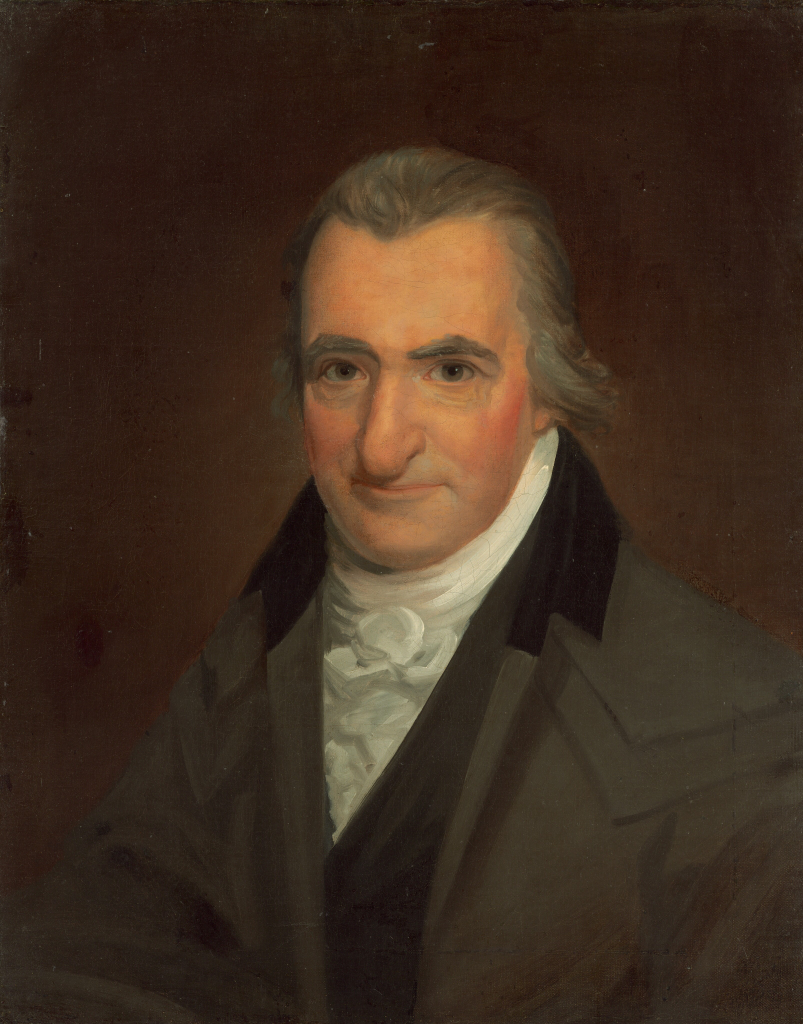
Referring to the scheme for interesting the school children of America in keeping alive the memory of Paine’s dear friend, Lafayette, Mr. Heap said: “This is all right so far as it goes, but I am free to confess that it does not go far enough. January 29th should be held in America of far more importance, since it gave to the country and the world one who, if only we were bold enough, would be nationally honored in each succeeding birthday. Of course, it was impossible to say what would have taken place if something else had failed, but all his (the speaker’s) reading had led him to the conviction that but for Paine’s timely appearance on the scene, American independence would have been indefinitely postponed, if not abandoned altogether.” Indeed, some writers go so far as to claim that he originated the conception of separation from the mother country, and certain it is that Paine first wrote the phrase, “free and independent states of America.”
The scene which took place in the city of William Penn in 1776 was vividly recalled, showing John Adams, Benjamin Rush, Franklin and Washington listening to the burning words of Thomas Paine, who turned their irresolution into a steadfast new purpose, as he begins to speak of the independence of America—her glorious future, her people, who shall swell with countless millions; her navy, that shall whiten the uttermost sea, that shall stride over the wrecks of thrones, to the universal empire of the western continent. Speaking of “Common Sense,” the speaker said:
“Written by an Englishman in ridicule of the British monarchy, no American printer would touch it. Written by an Englishman, it remained for a Scotchman to print it, and on the 1st of January, 1776, ‘Common Sense’ burst on the people of the New World like a prophecy.”
Referring to Paine’s lifelong efforts in the cause of freedom, it was pointed out how Paine improved upon Franklin by adopting as his motto, “Where liberty is not, there is my country.” A resume of Paine’s great work, “The Rights of Man,” followed, and the lecturer closed with a glowing peroration, proving that Paine was no atheist nor infidel. Sure, he emphatically asserted, that he believed in one God, and no more.
“We yet may hope,” said the lecturer, “that honest orthodoxy will cease to vilify his name, consequent upon his purely creedal unbelief, to the end that differences may be minimized and agreements amplified, that mutual love and sympathy may become universal, the fatherhood of God and the brotherhood of man alone our bond of union, our only prayer, which Foote described so happily as ‘the magnificent liturgy of the human race.'”