
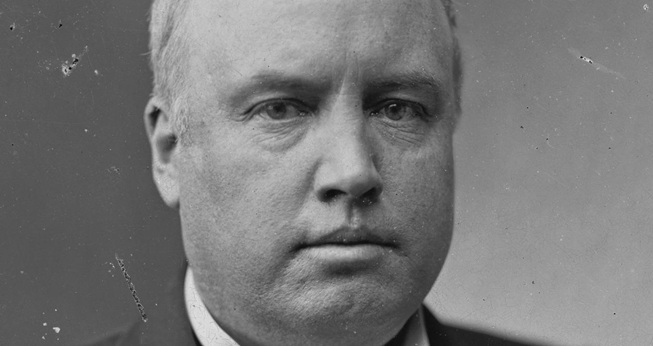
Chicago daily tribune (Chicago, Ill.), November 12, 1877
TOM PAINE’S DEFENSE
COL. INGERSOLL’S REPLY TO THE NEW YORK OBSERVER—THAT PAPER NOW ADMITS THAT PAINE DID NOT RECANT OR DIE FULL OF REMORSE—INGERSOLL’S EARLY TRAINING—THE STORY ABOUT HIS FATHER’S SEVERITY DENIED.
Col. Robert G. Ingersoll returns to the charge in his controversy with the editor of the New York Observer, in a letter which is shorter and more pointed than the former letter. Ingersoll writes to the editor of the Observer:
You ought to have honesty enough to admit that you did, in your paper of July 19, offer to prove that the absurd story that Thomas Paine died in terror and agony on account of the religious opinions he had expressed was true. You ought to have fairness enough to admit that you called upon me to deposit $1,000 with an honest man, that you might, by proving that Thomas Paine did die in terror, obtain that money.
You ought to have honor enough to admit that you challenged me and that you commenced the controversy concerning Thomas Paine.
You ought to have goodness enough to admit that you were mistaken in the charges you made.
You ought to have manliness enough to do what you falsely asserted that Thomas Paine did—you ought to recant. You ought to admit publicly that you slandered the dead; that you falsified history; that you defamed the defenseless; that you deliberately denied what you had published in your own paper. There is an old saying to the effect that open confession is good for the soul. To you is presented a splendid opportunity of testing the truth of this saying.
Nothing has astonished me more than your lack of common honesty exhibited in this controversy. In your last, you quote from Dr. J. W. Francis. Why did you leave out that portion in which Dr. Francis says that Cheetham, with settled malignity, wrote the life of Paine? Why did you leave out that part in which Dr. Francis says that Cheetham in the same way slandered Alexander Hamilton and De Witt Clinton? Is it your business to suppress the truth? Why did you not publish the entire letter of Bishop Fenwick? Was it because it proved beyond all cavil that Thomas Paine did not recant? Was it because in the light of that letter Mary Roscoe, Mary Hinsdale, and Grant Thorburn appeared unworthy of belief? Dr. J. W. Francis says in the same article from which you quoted: “Paine clung to his infidelity until the last moment of his life.” Why did you not publish that? It was the first line immediately above what you did quote. You must have seen it. Why did you suppress it? A lawyer doing a thing of this character is denominated a shyster. I do not know the appropriate word to designate a theologian guilty of such an act.
You brought forward three witnesses pretending to have personal knowledge about the life and death of Thomas Paine: Grant Thorburn, Mary Roscoe, and Mary Hinsdale. In my reply I took the ground that Mary Roscoe and Mary Hinsdale must have been the same person. I thought it impossible that Paine should have had one conversation with Mary Roscoe, and then one precisely like it with Mary Hinsdale. Acting upon this conviction I proceeded to show that the conversation never could have happened. That it was absurdly false to say that Paine asked the opinion of a girl as to his works, who had never read but little of them. I then showed by the testimony of William Cobbett that he visited Mary Hinsdale in 1819, taking with him a statement concerning the recantation of Mr. Paine, given him by Mr. Collins, and that upon being shown this statement she said that “it was so long ago that she could not speak positively to any part of the matter—that she would not say any part of the paper was true.”
At that time she knew nothing and remembered nothing. I also showed that she was kind of standing witness to prove that others recanted. Willet Hicks denounced her as unworthy of belief. To-day the following from the New York World was received, showing that I was right in my conjecture:
TOM PAINE’S DEATH-BED.
To the Editor of the New York World:—Sir: I see by your paper that Bob Ingersoll discredits Mary Hinsdale’s story of the scenes which occurred at the death-bed of Thomas Paine. No one who knew that good lady would for a moment doubt her veracity or question her testimony. Both she and her husband were Quaker preachers, and well-known and respected inhabitants of New York City. Ingersoll is right in his conjecture that Mary Roscoe and Mary Hinsdale was the same person. Her maiden name was Roscoe, and she married Henry Hinsdale. My mother was Roscoe, niece of Mary Roscoe, and I lived with her for some time. I have heard her relate the story of Tom Paine’s dying remorse, as told by her aunt, who was witness to it. She says (in a letter I have just received from her) he [Tom Paine] “suffered fearfully from remorse, and renounced his infidel principles, calling on God to forgive him, and wishing his pamphlets and books to be burned, saying that he could not die in peace until it was done.”
(Rev.) A. W. Lockwood,
Harpersville, N. Y.
You will notice that the testimony of Mary Hinsdale has been drawing interest since 1809, and has materially increased. If Paine “suffered fearfully from remorse, renounced his infidel opinions, and called on God to forgive him,” it is hardly generous for the Christian world to fasten the fangs of malice to the flesh of his reputation. So Mary Roscoe was Mary Hinsdale, and as Mary Hinsdale has been shown, by her own admission to Mr. Cobbett, to have known nothing of the matter; and as Mary Hinsdale was not, according to Willet Hicks, worthy of belief,—as she told falsehoods of the same kind about Mary Lockwood, and was, according to Mr. Collins, addicted to the use of opium,—this disposes of her and her testimony.
There remains upon the stand Grant Thorburn. Concerning this witness, I received yesterday from the eminent biographer and essayist, James Parton, the following epistle:
Newburyport, Mass., Nov. 1.
Col. R. G. Ingersoll:
Touching Grant Thorburn: I personally knew him to be a dishonest man. At the age of 89 he copied, with trembling hand, a piece from a newspaper and brought it to the office of the Home Journal as his own. It was I who received it and detected the deliberate forgery. If you are ever going to continue this subject I will give you the exact facts.
Fervently yours,
James Parton.
After this you are welcome to what remains of Grant Thorburn.
There is one thing that I have noticed during this controversy regarding Thomas Paine. In no instance that I now call to mind has any Christian writer spoken respectfully of Mr. Paine. All have taken particular pains to call him “Tom” Paine. Is it not a little strange that religion should make men so coarse and ill-mannered? I have often wondered what these same gentlemen would say if I should speak of the men eminent in the annals of Christianity in the same way. What would they say if I should write about “Tim” Dwight, old “Dan” Clark, “Tom” Scott, “Jim” McKnight, “Bill” Hamilton, “Dick” Whately, “Bill” Paley, and “Jack” Calvin? They would say of me just what I think of them now. Even if we have religion, do not let us try to get along without good manners. Rudeness is exceedingly unbecoming, even to a saint. Persons who forgive their enemies ought, to say the least, to treat with politeness those who never injured them.
It is exceedingly gratifying to me that I have compelled you to say that “Paine died blaspheming infidel.” Hereafter it is to be hoped nothing will be heard about his having recanted. As an answer to such slander his friends can confidently quote the following from the New York Observer of Nov. 1, 1877:
“We have never stated in any form, nor have we ever supposed that Paine actually renounced his infidelity. The accounts were insisting that he died blaspheming infidel.”
This for all coming time will refute the slanders of the churches yet to be. Right here allow me to ask, if you never supposed that Paine renounced his infidelity, why did you try to prove by Mary Hinsdale that which you believed to be untrue?
From the bottom of my heart I thank you for having compelled you to admit that Thomas Paine did not recant.
For the purpose of verifying your own admission concerning the death of Mr. Paine, permit me to call your attention to the following affidavit:
Warren, Ind., Oct. 27.—Col. R. G. Ingersoll:
Dear Sir: The following statement of facts is at your disposal. In the year 1833 Willet Hicks made a visit to Indiana and stayed over night at my father’s house, four miles east of Richmond. In the morning at breakfast my mother asked Willet Hicks the following questions:
“Was thee with Thomas Paine during his last sickness?”
Mr. Hicks said: “I was with him every day during the latter part of his last sickness.”
“Did he ever express any regret in regard to writing the Age of Reason, as the published statements say he did,—those accounts that have the credit of emanating from his Catholic housekeeper?”
Mr. Hicks replied: “He did not in any way by word or action.”
“Did he call on God or Jesus Christ, asking either of them to forgive his sins, or did he curse them or either of them?”
Mr. Hicks answered: “He did not. He died as easy as any one ever saw die, and I have seen many die in my time.”
William R. Hiatt.
Subscribed and sworn before me Oct. 27, 1877.
Warren Bigler, Notary Public.
You say in your last that “Thomas Paine was abandoned of God.” So far as this controversy is concerned, it seems to me that in that sentence you have most graphically described your own condition.
Wishing you success in all honest undertakings, I remain yours truly,
Robert G. Ingersoll.
INGERSOLL’S EARLY TRAINING.
Letter to the Utica Herald.
The claim of Oneida County to being the birthplace of Col. Robert G. Ingersoll must be surrendered, by authority of the person immediately concerned. Col. Ingersoll says he was born in Yates County, this State, and that must be held to settle this matter. He accounts in his own way for the little severity his father may have exercised, and, as will be seen, speaks of him with filial affection:
Peoria, Ill., Oct. 30, 1877.—Mr. Dear Sir: I was born at Dresden, Yates County, N. Y., on the 11th of August, 1833. I know nothing about the “incident” mentioned as having happened at Marshall, as that was before I was born.
My father was a man of great natural tenderness, and loved his children almost to insanity. The little severity he had was produced by his religion. Like most men of his time, he thought Solomon knew something about raising children. For my part, I think he should have known better than to place the least confidence in the advice of a man so utterly foolish as to imagine he could be happy with 700 wives.
When I think of the kind of God my father adored, and the awful consequences which he supposed would follow each infraction of the “divine law,” I am amazed that he was as kind, loving, and lenient as he really was.
Thanking you for the touching compliment you pay the memory of my mother, I remain, yours truly,
R. G. Ingersoll.