
The Beacon #1 September 1, 2021
By Gary Berton
The Thomas Paine National Historical Association was founded in 1884 by political activists and freethinkers. It united the leaders of progressive political groups of the time into one body – socialists, anarchists, ex-abolitionists, activists for women’s voting, health and reproductive rights, labor unionists, free speech advocates against the Comstock Act, and advocates for human rights of all kinds. All of them freethinkers. Our Association continued this activism with people like Leonard Abbott, a leader of the Socialist Party, T.B. Foote and E.B. Wakeman, who ran for office with the People’s Party, several Board members had ties to Emma Goldman, and James Morgan, organizer of NAACP and friend of W.E.B. DuBois. The founders of our Association saw Paine as the symbol of the fights of their day, which remain the fights of today.
The mission of the Association was to correct the false propaganda that historians used to marginalize, dismiss and mis-characterize Paine’s life, works, and legacy, which persists to this day, as lazy historians just pass on the tropes as established fact. Our Association is embarking on the ultimate realization of our mission to educate the world about Paine this Fall, when we will begin the official collected works of Thomas Paine, with an editorial board of the leading Paine scholars in the world led by our Association. This Building will be the center of that work, here in New Rochelle.
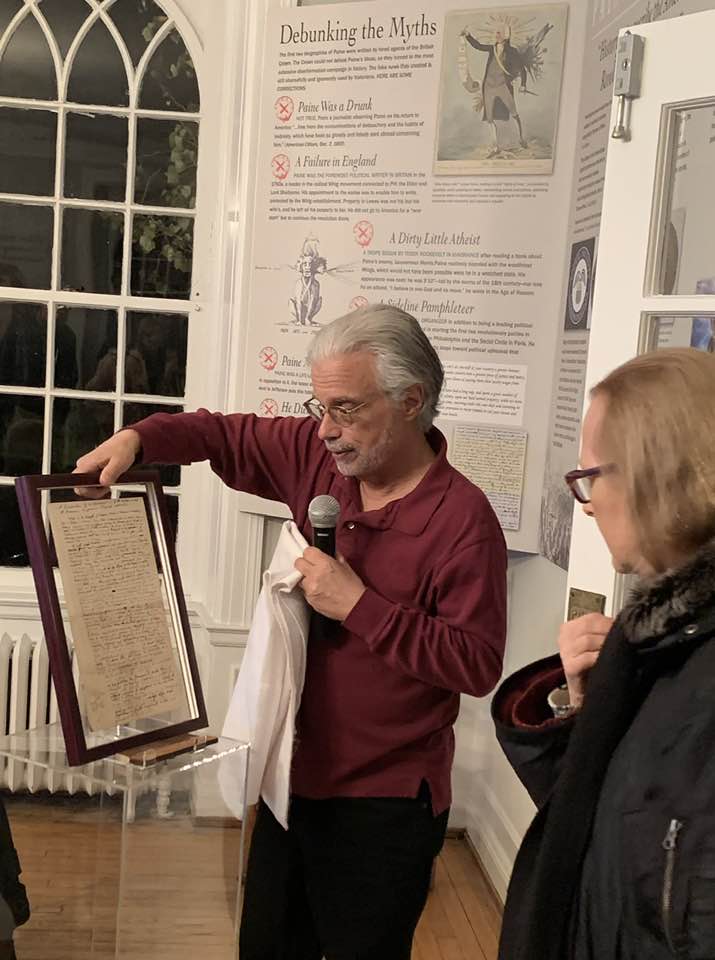
The importance of Thomas Paine to New Rochelle, the country, and the world can be seen in his final writing as he lay dying in Greenwich Village – it was a letter to President Jefferson and he wrote it under the guise of being A Slave , in order to disguise his authorship from Jefferson (who would have known from his interactions with Paine anyway), but mainly to provide a greater emotional impact. Paine and Jefferson were friends since they sat down together in Philadelphia to create the Declaration of Independence.* This letter written by Paine to Jefferson unleashed the decades of fury Paine harbored against slavery and Jefferson’s hypocrisy. Paine only wrote and organized against it anonymously. No one had been able to identify the author of the letter, until now. It is appropriate that we announce the author here on the celebration of Juneteenth. It was the first call for reparations to slaves as part of the demand for completely annihilating the barbarous practice of slavery and make amends to some degree.
A challenge was presented by a benefactor of history, Mr. Lapidus, to discover who the author was, and the Institute for Thomas Paine Studies (ITPS) at Iona College took up the challenge after other historians failed to do so. I was part of that team. The letter was written on Nov 30, 1808, and the original can be found in the Jefferson Papers online at the Library of Congress by just entering that date. Why Paine chose that date is unknown, other than he landed in America on Nov. 30 (but in 1774), and late 1781 was the approximate time Jefferson’s “Notes on Virginia” and the peace agreement to end the Revolutionary War occurred.
When Michael Crowder and I, both of us from ITPS, first read it, we both had the same reaction – this sounds like Paine. It was a strong, perhaps the strongest, denunciation of slavery ever written, culminating in a demand for reparations for all slaves immediately freed going back to 1781, 27 years, and anyone continuing the practice of slavery are “a set of inhuman scoundrels, and ought to be tar’d and feather’d and tyed to the tale end of a dung cart, and horse-whipt throughout the country, from state to state, and forever after banished from human society.” (from the Letter)
An article for a book from Cornell U Press has been completed and it will be published later this year presenting the proof of authorship. The content points to Paine: he addresses William Duane, editor of the Aurora newspaper and close ally of the Jefferson presidency, and to Jefferson. The letter takes to task Duane’s hollow praise of America while he ignored slavery, and Jefferson’s complacency by ignoring the utter corruption and inhumanity of creating the wealth of America through torture and brutality. The author had intimate knowledge as well as a history with both men. The context of the letter is that the author was disguised, it is not in Paine’s handwriting, and it was sent anonymously pretending to be a slave. The handwriting was that of Paine’s caretaker Mde. Bonneville, whose first language was French, so she misspelled many basic words as you will see.
The computer text analysis of the letter, developed over 10 years at ITPS, overwhelmingly points to Paine when compared to all the abolitionist writers of the day. This methodology has far outpaced other author attribution software, by increasing accuracy to 90% plus, compared to the standard of 65%.
Let me read one paragraph from the 24 page letter: Paine is speaking to Jefferson as a slave, the first part refers to the Slavery Clause taken out of the Declaration by Congress without any objection from Jefferson, and knowledge of that Clause was not publicly known, only someone close to the Committee who produced it:
“What your reasons can be for keeping open that execrable market where MAN shall be bought and sold, which you wrote so warmly against in the year ’76, and condemn’d as a mark of disgrace, of the deepist dye in the Christian king of G. Britain, I cannot conceive. Is a crime of this execrable nature any more criminal in the Christian Crown of Britain, than in the Christian Executive of America? If not, what are your reasons, sir, for suffering us since 30th. Nov. ’81 to be troden under foot & abused in such an inhuman & bruital manner? Are not Our rites as well secured to us by every law of natures God as any man’s in the universe? we think so; therefore, sir, we consider ourselves, intitled to our yearly wages from that very hour, and no man in the government (except a tyrant) can dispute our demand a single moment. And you may depend on this sir, that we shall never be recconciled to this government till we git it, & our freedom with it.—I think sir, you can’t do yourself & your country a greater honour, nor your unfortunate country men a greater piece of justice and mercy, then by freeing your slaves & paying them their yearly wages from ’81 to this day. And then, if any slave-holder in America shall here after refuse or neglect so to do, let him or them be made an example of, and their heads be hung in gibbets for an everlasting monument; & a terror to tyrants & evil doers. O! Thomas, you have had a long nap, and spent a great number of years in ease & plenty, upon our hard earned property, while we have been in the mean time, smarting under the cow-hide and sweating in the fields to raise provision to nurse tyrants to cut our throat and perpetuate our own bonds.”
Thomas Paine is the benchmark, the inspiration, the guide, the inspirer of the secular democratic trend in world history. His legacy is all around us: in Black Lives Matter, in separation of church and state, in the sanctity of government for, of and by the people, in civil and human rights.
The bible of these first principles is in the writings and political struggles of Thomas Paine.
And New Rochelle is the center of this legacy:
- it is here that the recognition of his services to the Revolution was awarded,
- here that the first monument to an American Founder was erected,
- here that the only structure where Paine lived and wrote in America is still standing,
- here that the headquarters of the Association that corrected the important legacy of Paine sits,
- here that the resulting Institute for academic work should raise Paine to the level of vast importance,
- and here that the official Collected Works of Thomas Paine will be produced for the first time.
It is not arcane historical curiosity that we look to Paine, but the inherent values unseen in the world before Paine, that remain today as the values we fight to establish still. His imprint on the movement for real democracy, not democracy in name only, is indelible and foundational, as is his blueprint for a rational society free of superstition.
* The creation of Paine’s position of authority in the Committee of Five to draft the Declaration is proved by the discovery in 2012 of an early draft with a note from Adams testifying that Paine gave “permission” to have that copy made. See www.thomaspaine.org main page for a link to the article.