
By Gary Berton
The Thomas Paine Historical Association will be designating the Paine Monument as the Thomas Paine Monument and Grave. We cannot officially change the name, as the City of New Rochelle has jurisdiction over it ever since TPNHA handed the maintenance of the site in 1905 to it. The rationale for our change in reference is the following.
As most of you know, the body of Paine was dug up and relocated to England in 1819, ten years after his death, by William Cobbett – a one-time opponent of Paine until he read Paine, and sniffed the winds of the politics brewing around him in favor of Paine’s politics, and became a supporter. He dug up the bones and left an empty grave, taking them back to England.
Twenty years later, in 1839, after years of raising money and securing the talents John Frazee, the sculptor, Gilbert Vale placed the monument near the original spot of Paine’s grave. It was placed 30 feet due north of the grave site. It is the oldest such monument to a Founder that we know of. More on Gilbert Vale below, but his biography of Paine (on our website) is one of the best, and as accurate as could be at the time.
In 1905, North Avenue (then North street) was being widened, and the Monument needed to be moved back, which it was, 15 feet straight back from North Avenue. (See article of the time below). In the process of relocating the Monument in 1905, the relic of Paine’s body, obtained by Moncure Conway in England, the brain of Paine, was placed beneath the Monument. This is the only surviving piece of Paine’s body to be interred. That makes it his grave. And a more fitting marker cannot be found, despite Paine’s request for a gravesite, that at this time, cannot be successfully established. He called for a 12’ X 12’ plot with trees planted around it. That was established before Cobbett made his heist, but for now it will have to wait to be recreated.
From the Truth Seeker, January 21, 1905 issue:
“Again the rumor is going around that the Paine monument in New Rochelle, N.Y., is to be removed! The facts are that the city of New Rochelle has taken charge of the monument, and will move it only about fifteen feet. It now stands at the junction of North street and the lane which leads from North street to the old house where Paine lived. North street has been widened to seventy-five feet, and takes in the ground where the monument stands. The lane, which runs at right angle to North street, has been widened to sixty-six feet, and named Paine avenue. The monument is to stand in the center of Paine avenue, guarded by stone posts and chains, and a driveway is to be made on either side of it. The city of New Rochelle is doing the work , and of course paying for it. All of the councilmen of the city desire to preserve the historic landmark, as may be inferred from the naming of the lane through which Paine walked, Paine avenue. The old Paine house, some quarter of a mile from North street, is still standing, occupied by its owner, Mr. See, one of the old settlers. A trolley car runs through North street, and one can now ride to the monument from New Rochelle depot, or from New York by trolley, if that form of amusement is bearable. The monument is now permanently located, or will be when moved to the center of Paine avenue, and the city of New Rochelle will care for it. Our informant is Capt. George W. Loyd, who has lived in New Rochelle since 1853, is over eighty-six years old, was a Copperhead in the civil war, is a Populist now, and has more fire and vitality in his body at the present time than many young men. His wife is ninety- three, and they have both been Paineites so long that the memory of man runneth not to the contrary. When the work is completed we will print a picture of the monument and its surroundings.”
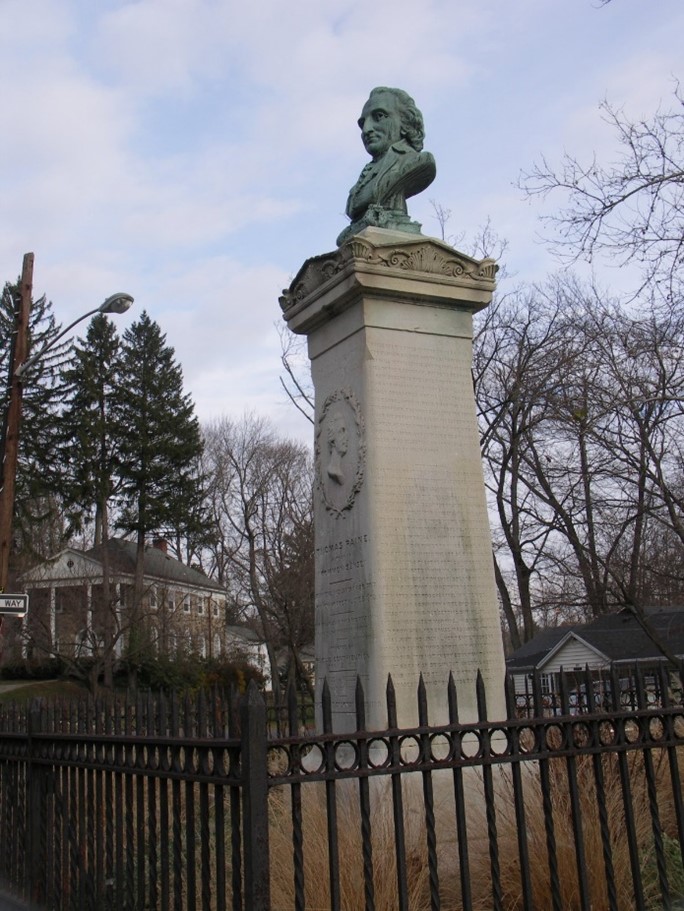
[Note: the bust on top of the Monument was placed there in 1899. It was created by a noted sculptor George MacDonald who was a Board member of TPNHA.]
Inscriptions on the Monument: Under the profile are the words:
THOMAS PAINE. Author of “Common Sense.”
Born in England, January 29, 1737; died in New York City, June 8, 1809.
The palaces of kings are built on the ruins of the bowers of paradise.
Erected by public contribution, November 12, 1839.
Repaired and rededicated May 30, 1881.
On the north side is inscribed:
I believe in one God and no more, and I hope for happiness beyond this life. I believe in the equality of man, and that our religious duties consist in doing justice, loving mercy, and endeavoring to make our fellow-creatures happy. – Age of Reason. It is necessary to the happiness of man that he be mentally faithful to himself. Infidelity does not consist in believing or in disbelieving; it consists in professing to believe what he does not believe. – (Age of Reason)
On the East side is inscribed:
It is only in the creation that all our ideas and conceptions of a word of God can unite. The creation speaketh an universal language, independently of human speech or human language, multiplied and various as they be. It is an ever-existing original which every man can read. It cannot be forged· it cannot be counterfeited; it cannot be lost; it cannot be altered; it cannot be suppressed. It does not depend upon the will of man whether it shall be published or not: it publishes itself from one end of the earth to the other. It preaches to all nations and to all worlds; and this world of God reveals to man all that is necessary for man to know of God.
Do we want to contemplate his power? We see it in the unchangeable order by which the incomprehensible whole is governed. Do we want to contemplate his munificence? We see it in the abundance with which he fills the earth. Do we want to contemplate his mercy? We see it in his not withholding that abundance even from the unthankful. In fine, do we want to know what God is? Search not the book called the scripture, which any human hand might make, but the scripture called the creation. – (Age of Reason)
On the South side is inscribed:
These are the times that try men’s souls. The summer soldier and the sunshine patriot will in this crisis shrink from the service of their country, but he that stands it now deserves the love and thanks of man and woman. Tyranny, like hell, is not easily conquered; yet we have the glorious consolation with us that the harder the conflict the more glorious the triumph. What we obtain too cheap we esteem too lightly. Heaven knows how to put a price upon its goods; and it would be strange indeed if so celestial an article as freedom should not be highly rated. – (Crisis No. I)
The times that tried men souls are over —and the greatest and compleatest revolution the world ever knew, gloriously and happily accomplished.
In the present case — the mighty magnitude of the object — the various uncertainties of fate it has undergone — the numerous and complicated dangers we have suffered or escaped — the eminence we now stand on, and the vast prospect before us, must all conspire to impress us with contemplation. To see it in our power to make a world happy — to teach mankind the art of being so — to exhibit, on the theatre of the universe a character hitherto unknown — and to have, as it were, a new creation intrusted to our hands, are honors that command reflection, and can neither be too highly estimated, nor too gratefully received.
Never, I say, had a country so many openings to happiness as this. Her setting out in life, like the rising of a fair morning, was unclouded and promising. Her cause was good. Her principles just and liberal. Her temper serene and firm. Her conduct regulated by the nicest steps, and everything about her wore the mark of honor. It is not every country (perhaps there is not another in the world) that can boast so fair an origin. Even the first settlement of America corresponds with the character of the revolution. Rome, once the proud mistress of the universe, was originally a band of ruffians. Plunder and rapine made her rich, and her oppression of millions made her great. But America need never be ashamed to tell her birth, nor relate the stages by which she rose to empire. – (Crisis XV)