
Paine’s First Principles Support the Structure of Democracy
By Gary Berton
Part Two of Two Parts – See part one here.
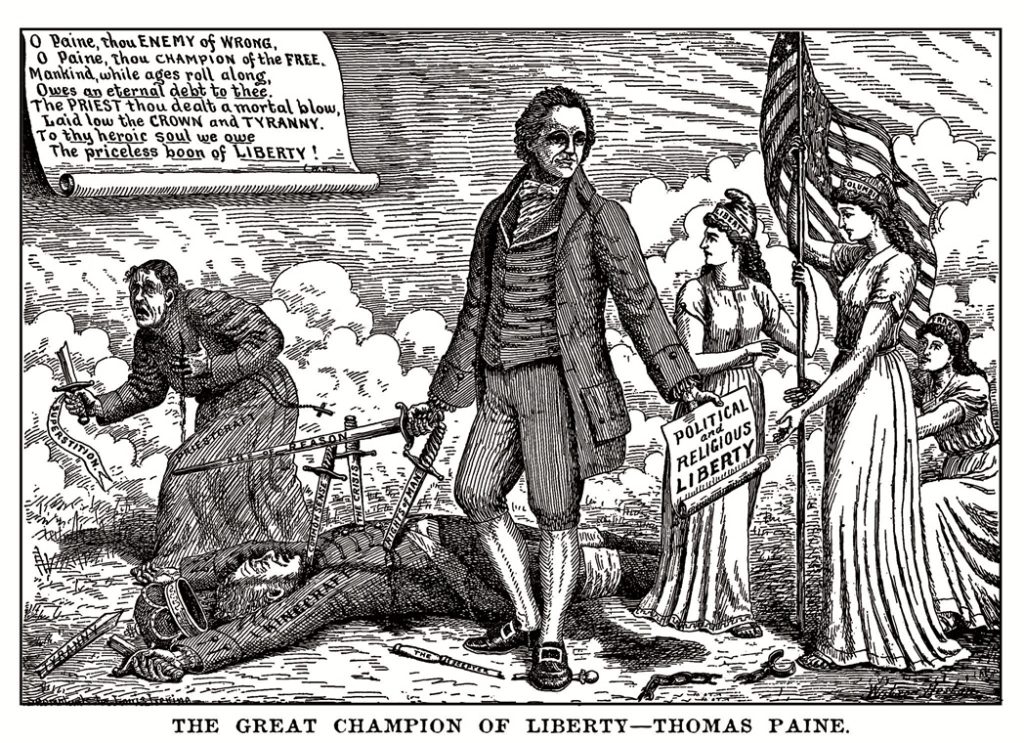
Thomas Paine’s first principles built the structure of democracy. The mechanisms central to Paine’s political theories are rooted in his ideology of first principles. The basic foundation of these principles is equality, and as a direct result, justice. If equality is practiced, then people share equal justice.
“Mankind being originally equals in the order of creation,” he wrote in Common Sense, “the equality could only be destroyed by some subsequent circumstance.”
“When a people agree to form themselves into a republic (for the word REPUBLIC means the PUBLIC GOOD, or the good of the whole, in contradistinction to the despotic form, which makes the good of the sovereign, or of one man, the only object of the government) when, I say, they agree to do this, it is to be understood, that they mutually resolve and pledge themselves to each other, rich and poor alike, to support and maintain this rule of equal justice among them. They therefore renounce not only the despotic form, but the despotic principle, as well of governing as of being governed by mere Will and Power, and substitute in its place a government of justice.” (Dissertations on Government, 1786)
The structure of his democratic theory is like a house: the foundation of that house is equality and justice; everything else rests upon it. If this principle is compromised and weakened, the whole structure is vulnerable to corruption and oppression.
Inherent in the equality/justice principle are rights. both natural and civil — civil rights arising from natural rights. Natural rights are inherent and received upon birth, without exception. Defending these rights is the object of democratic government.
Resting on this foundation of rights are four support pillars constructing the structure of democracy. (1) Rejection of precedent, (2) No one should live worse than in the state of nature. (3) Recognition of the natural sociability of humanity. (4) Enlightenment and reason solve problems. A few thoughts on each:
1. Rejection of precedent
Precedent got us into the problems of government. They represent the failures to ensure equality and justice. Precedent is the “originalist” interpretation of the Constitution; it’s the way things were always done, which is the excuse to maintain “tradition.” Precedent is the wall preventing people from building the democratic structures of a better world, Precedent reinforces structures that promote elitism, privilege, and injustice.
2 No one should live worse than in the state of nature.
If civilization has progressed, why are masses of the people worse off than if they lived in small groups in nature? That is not progress. The wellbeing of every person is what democracy insists upon. If many or most people live worse off than as small groups in nature, civilization is not progressing; it’s regressing. Why is another discussion for another day.
3. Recognize the natural sociability of humanity.
Humans evolved as social animals. The human mind, Paine wrote, is “unfitted for perpetual solitude.” That natural sociability is the basis of democracy. Building upon it is fundamental to democracy.
4. Enlightenment and reason solve problems
Knowing and using the real world around us must be the basis for knowledge, and applying that knowledge to solve problems. Anything else is invented to manipulate and confuse the people in their decision-making, which is anti-democratic.
Atop the pillars is a roof protecting the structure of government from outside elements. The roof consists of constitutions with democratic structures and laws.
Building the opposite structure is the bizarro world of Edmund Burke, whose political theory is oligarchy. His foundation is order, not equality. Burke’s pillars are “defending historical precedent,” following “tradition,” (not the Enlightenment ideals Paine advocated). Burke sought continuity, not change for the better. Burke saw humanity as a collection of “disconnected individuals.” His roof atop government is prescriptive for elite rule, not democratic order, government by the people.
Paine challenged and changed the entire philosophical structure of government, not just for the people in the 18th century, but for everyone in the world today.