

By Gary Berton
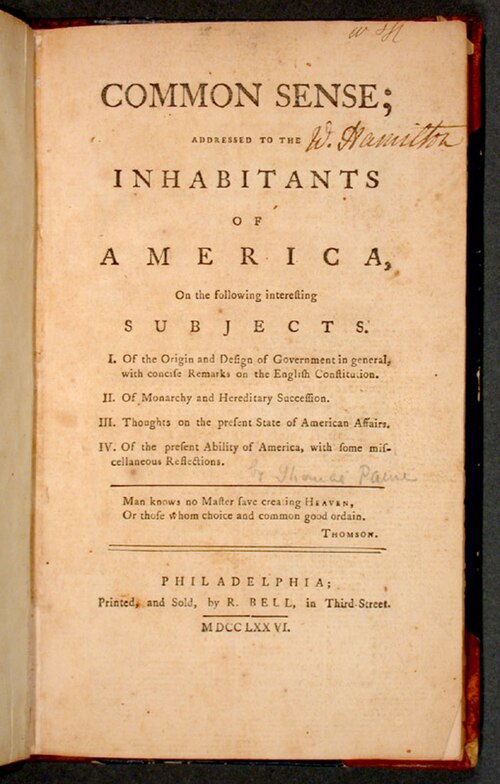
Thomas Paine’s Common Sense begins with a discussion on government; in fact, the content of it in general is about a new form of government. It is a manifesto for a new era, arising from the political economy that is emerging, hampered by feudalism. The Enlightenment has substantially weakened that feudal system, and it was time for someone, like a Thomas Paine, to help push it over. Paine was the last Enlightenment figure, and he built a bridge into the era of the democratic movement that we still live in.
No other progressive figure, no writer on rights, no author of treatises on humane existence, no philosopher like a Price, a Voltaire, a Burke, or a Rousseau did what Paine did: he drew a line in the sand and said no monarchy, ever, and instead it must be a democratic representative system, free from ruling classes. Utopian at first sight, but enduring.
So why would he begin his treatise with this: “Society in every state is a blessing, but government even in its best state is but a necessary evil; in its worst state an intolerable one; for when we suffer, or are exposed to the same miseries by a government, which we might expect in a country without government, our calamity is heightened by reflecting that we furnish the means by which we suffer. Government, like dress, is the badge of lost innocence; the palaces of kings are built on the ruins of the bowers of paradise.”
That first sentence above in the quote is cited by every anarchist and libertarian writer. It is even quoted by good historians, like Jack Fruchtman, as the essence of Paine on government. WRONG. (We saw him in Part 1 of “American Freethought” saying the “necessary evil” part.)
Paine knew his audience, and he started exactly where most people were at that time, that government is oppressive, but needed. But he then unfolds a thought experiment, where people inhabit unoccupied land, and set out to form an association to regulate themselves. Throughout the next six paragraphs, Paine reveals a new possibility, which turns government on its head.
In the beginning he stated that the purpose (end) of government is security: “Wherefore, security being the true design and end of government…” After he explains how representative government works for the people, he changes the definition of government by turning it over, and instead of security, it becomes “Here then is the origin and rise of government; namely, a mode rendered necessary by the inability of moral virtue to govern the world; here too is the design and end of government, viz. freedom and security. And however our eyes may be dazzled with show, or our ears deceived by sound; however prejudice may warp our wills, or interest darken our understanding, the simple voice of nature and of reason will say, it is right.”
He adds “Freedom” to “Security”. Why haven’t historians quoted this? It changes the whole point of his argument from a negative to a positive.
Freedom, rights, and equality can only be established through proper government, which is a government with a foundation of equality in rights and justice. The rest is propaganda and big lies.
To establish that type of government, it must be by, for, and of the people. (Lincoln, a Paine reader). When Dr. Fruchtman left that out, he leaves the whole point out, Paine’s point: government of the people as a whole, however we devise a system to do that (as Paine did leave it to us), is the only way to be free – it is not the absence of government, but the democratic form of government that can guarantee equal rights, opportunity, and yes, freedom. Without that governing structure, we fall prey to con men and women, big lies, autocracies, and constant upheaval.