
Proto-Drafts and the Early Formation of the Declaration of Independence
The drafting of the Declaration of Independence is most often narrated as a linear sequence of events: the Continental Congress appointed a Committee of Five; an initial draft was prepared; the committee reviewed it; and Congress debated and revised the text before adoption in early July 1776. This account, drawn largely from Jefferson’s later recollections and supported by surviving drafts, describes the formal phase of composition. Yet this narrative has also come to function as an origin story.
By treating the appointment of the Committee of Five as the beginning of the Declaration’s creation, historiography has tended to conflate the onset of formal drafting with the emergence of textual formation itself. This assumption leaves a significant stage unexplored: the period preceding committee appointment in which ideas, language, and possibly written formulations circulated informally and helped shape the framework that Congress ultimately authorized for drafting.
Rather than challenging the established historical record, this study proposes that it is incomplete. The later recollections of John Adams and Thomas Jefferson describe what may be understood as Phase II of the process: the moment when Congress formally assumed responsibility for producing a Declaration and delegated the task to a committee. The central question addressed here is whether a Phase I existed: an earlier, informal stage of development that preceded congressional delegation, and what material traces of that stage may still be discerned. In this article, the term “proto-draft” refers to provisional writings, such as memoranda, frameworks, or draft statements, circulated for evaluation or adaptation prior to formal committee drafting, rather than to a complete or authoritative declaration text.
Revolutionary Print Culture & Informal Drafting Practices
By 1776, political argument in British North America was deeply embedded in print culture. Pamphlets, broadsides, newspaper essays, and open letters functioned not only as vehicles of persuasion but also as sites of experimentation. Political ideas were frequently articulated in provisional textual forms that were intended to be revised, adapted, or absorbed into other documents.
Eighteenth-century legislative and committee practice likewise relied heavily on informal written submissions. Draft resolutions, memoranda, and proposed statements of principle often circulated privately before being formalized. Such texts were not typically preserved once their immediate utility had passed. The absence of surviving early drafts, therefore, does not imply their nonexistence; rather, it reflects the disposability of working documents in a period before systematic archival preservation, a feature common to eighteenth century legislative and political practice.
The Problem of the “First Draft”
Standard narratives tend to treat Jefferson’s “Rough Draft” as the beginning of the Declaration’s textual history. Yet even within the established documentary record, this assumption is unstable. Editorial commentary in The Papers of Thomas Jefferson acknowledges that portions of the Rough Draft were copied from earlier texts, including material previously written in other contexts. As Julian P. Boyd demonstrated in his reconstruction of the Declaration’s textual evolution, the surviving Rough Draft itself presupposes an earlier compositional layer, fragments of which survive only partially, confirming that the extant manuscript tradition does not capture the document’s full drafting history.
What remains unclear is whether earlier texts existed that were not authored by Committee of Five members and that circulated beyond Congress’s private papers. The possibility of such texts has received little sustained attention, largely because the evidentiary record is fragmentary. Nevertheless, fragmentary evidence is precisely what survives from informal drafting processes.
The Sherman Copy’s Verso Inscription
The most significant material trace bearing on this question appears on a working draft copy associated with Roger Sherman. On the verso of this document is a contemporaneous inscription describing the text as “a beginning perhaps,” noting that it was “Copied from Original,” and recording that the copying occurred “with T.P.’s permission.”
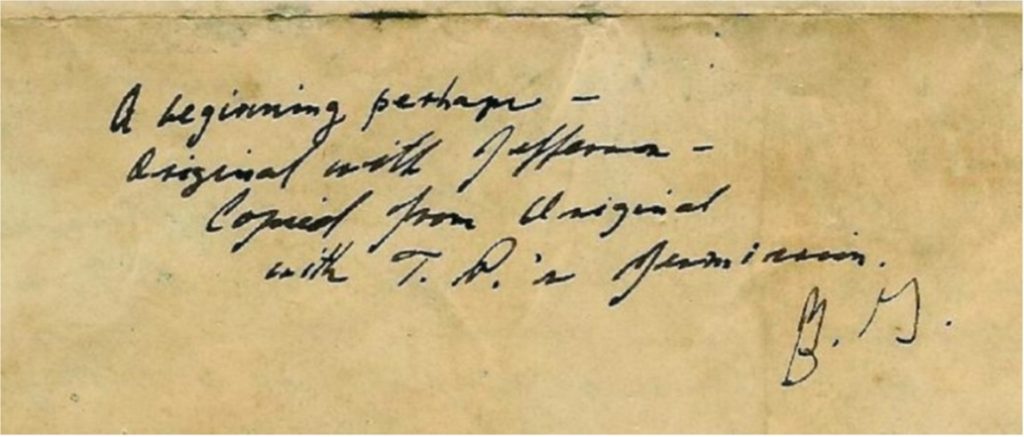
Several features of this inscription merit careful attention. The phrase “a beginning perhaps” signals provisionality. It does not describe a final draft, but a starting point; precisely the language one would expect for a proto-draft. The explicit distinction between the copy and an “Original” indicates textual derivation rather than composition, implying the existence of a prior written text no longer extant. The reference to permission suggests that the “Original” was associated with an identifiable individual who exercised control over its use. Importantly, the inscription makes no claim about authorship of the Declaration itself. Its evidentiary value lies in documenting a procedural act: the copying of a prior text for consideration or use in drafting.
The Early Working Title & National Framing
The Sherman copy bears the heading: “A Declaration by the Representatives of the United States of America in General Congress Assembled.” This same formulation appears in other early drafts, including John Adams’s fair copy and Jefferson’s Rough Draft. The presence of this fully articulated national designation at such an early stage is noteworthy, presupposing a unified political identity, representative legitimacy, and a national, rather than colonial, subject. That this framing appears consistently across the earliest surviving drafts suggests that it was not improvised during committee revision but inherited from an earlier conceptual layer.
The Plausibility of Thomas Paine as “T.P.”
The initials “T.P.” on the Sherman inscription cannot be identified with certainty. With this in mind, Paine emerges as the most historically plausible candidate when contextual factors are considered. By early 1776, Paine was one of the most influential political writers in the colonies, actively engaged in arguing for independence at a national scale, closely connected to figures operating in and around Congress, and known for producing texts intended to catalyze action rather than to establish personal authorship.
This article does not claim that Paine authored the Declaration. Rather, it argues that Paine is a historically plausible figure to associate with a lost proto-draft that circulated informally prior to committee drafting.
Toward a Proto-Draft Selection Model
Taken together, the evidence supports a restrained but consequential inference: there is material evidence of a pre-committee textual layer; that layer already contained mature national framing; the Sherman inscription records a copying act from a prior “Original”; and the initials “T.P.” plausibly correspond to a known political writer engaged in national-level argumentation. The convergence of these facts is consistent with a drafting process in which multiple provisional texts circulated informally and for further development.
Comparable proto-textual stages are well documented in the drafting of several revolutionary-era state constitutions, where multiple provisional drafts, sometimes originating outside formal drafting bodies, circulated prior to adoption, though only the final texts were preserved in the official record. Such practices were consistent with broader legislative norms, in which informal draft texts and memoranda routinely preceded formal committee action and were rarely preserved once superseded. The possibility that a provisional declaration framework originated outside the formal drafting committee appears ordinary rather than exceptional within eighteenth-century practice.
Conclusion
The absence of surviving proto-drafts of the Declaration ofIndependence should not foreclose inquiry into its earliest stages of formation. Informal drafting, textual circulation, and selective adaptation were standard features of eighteenth-century political practice, and their traces are often indirect. Historians have long recognized that key manuscript stages in the Declaration’s formation were likely discarded once superseded, reflecting standard eighteenth-century documentary practice rather than archival anomaly.
By attending to procedural evidence, such as the Sherman inscription and the early appearance of settled national framing, historians can begin to reconstruct a missing stage in the Declaration’s creation. This stage does not undermine established narratives but enriches them, offering a more realistic account of how foundational political texts come into being.
DID YOU KNOW?
THE DECLARATION WASN’T SIGNED ON JULY 4TH. Most delegates signed on August 2, 1776 — nearly a month after its adoption. July 4th was the date Congress approved the final text, not the signing ceremony.
CONGRESS AS A WHOLE MADE ABOUT 86 CHANGES. A quarter of the original text, including a passage condemning the slave trade, was cut before signing.
THE DECLARATION WAS NEARLY LOST. During the War of 1812, it was hastily rolled up in a linen sack and carried out of Washington by a State Department clerk just before British troops burned the capital.