
Paine’s May 8, 1776 Forester Letter
Edited with Commentary by Richard Briles Moriarty
Common Sense moved many towards declaring independence from Britain. But the Pennsylvania Assembly was controlled by those advocating continued dependence on Britain. To neutralize demands to restructure, through a Convention, how Pennsylvania was governed, the Assembly scheduled and created new seats to be chosen in a May 1, 1776 election. A sthe election approached, it was expected to result in a majority supporting independence. Surprising everyone, the “dependent faction” prevailed, threatening to doom the independence movement. Paine and other radicals sought to snatch victory from the jaws of defeat.
Through a May 8, 1776 “Forester” letter, Paine argued that the Assembly itself was illegitimate. Excoriating Quakers who supported reconciliation for travelling “to the summit of inconsistency” so rapidly “as to acquire autumnal ripeness by the first of May,” he warned that their “rotting time” approached. Broadening his assault to the entire “dependent faction,” Paine sought to expose “inconsistency, partiality, and injustice” of that faction, and “like an honest man, who courts no favor, to shew to them the dangerous ground they stand upon” as reflected in the “probable consequences of the late election.”
Paine declared all Assembly members must “take an oath of allegiance to serve the same King against whom this province, with themselves at the head thereof, are at war.” Hypocrisy, Paine roared, never rose “to such a pitch as this!”
By pretending moderation, “we are running into the most damnable sins. It is now the duty of every man from the pulpit and from the press, in his family and in the street to cry out against it. Good God! Have we no remembrance of duty left to the King of Heaven! No conscientious awe to restrain this sacrifice of sacred things? Is this our chartered privilege? This our boasted constitution, that we can sin and feel it not?” Yet that “sin lies not” with the “people” but with “the fountain head” and the delusions it has imposed on others.” The “guilt centers in a few, and flows from the same source, ”that failed to protect Pennsylvania in recent frontier conflicts.
While those favoring independence “had to sustain the loss of those good citizens who are ”fighting in Canada, theTories“ by never stirring out, remain at home to take the advantage of elections” and “Germans, of property, zealots in the cause of freedom, were likewise excluded for nonallegiance.” Yet “the tory non-conformists, that is, those who are advertised as enemies to their country, were admitted to vote on the other side” which is a “strange contradiction indeed!” Adding in Quakers who were “duped by the meanest of all passions, religious spleen,” the “combined impact allowed the” proprietary dependants to support the British and Proprietary power against the public. Despite “having many of our votes rejected, others disqualified for non-allegiance, with the great loss sustained by absentees, the maneuver of shutting up the doors between seven and eight o’clock, and circulating the report of adjourning and finishing the next morning, by which, several were deceived,” the candidates favoring independence did surprisingly well.
Those favoring independence “have stood the experiment of the election, for the sake of knowing the men who were against us. “Alas, what are they!”
What Were the Forester Letters?
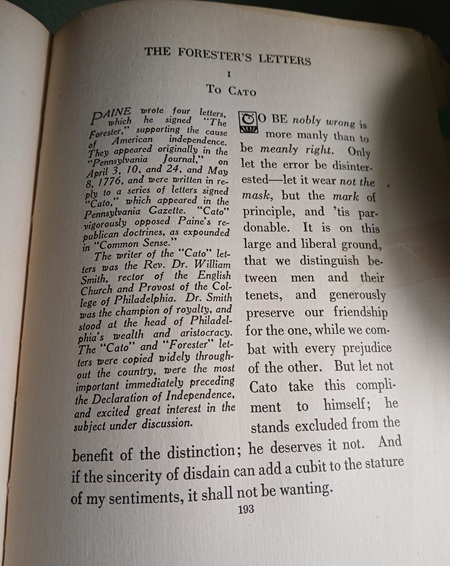
In February 1776, a month after Common Sense was published, Congress deep-sixed a draft Committee Report that emphasized how deeply Congress desired reconciliation with Britain because that draft contains hints that independence was an alternate option. While some colonial legislatures cautiously loosened their instructions to Congressional delegates to allow them to consider independence options, Pennsylvania, New York and other colonies persisted in instructing their delegates to actively resist any such efforts. With William Smith, writing as “Cato” in Pennsylvania newspapers, arguing forcefully for reconciliation, the fervor created by Common Sense was insufficient. Paine remained silent as Smith’s published letters piled up. He finally let loose, from March 28, 1776 on, with his Forester letters. Before the May 1 election, Paine focused on refuting arguments made by Smith. After that disastrous election, he did not just shift gears. Paine drove a new vehicle aimed at eliminating the Assembly and transforming Pennsylvania’s government into one controlled by radicals and strongly supporting independence. Without the efforts of Paine and other radicals, July 4 would likely now be just another date on the calendar.