
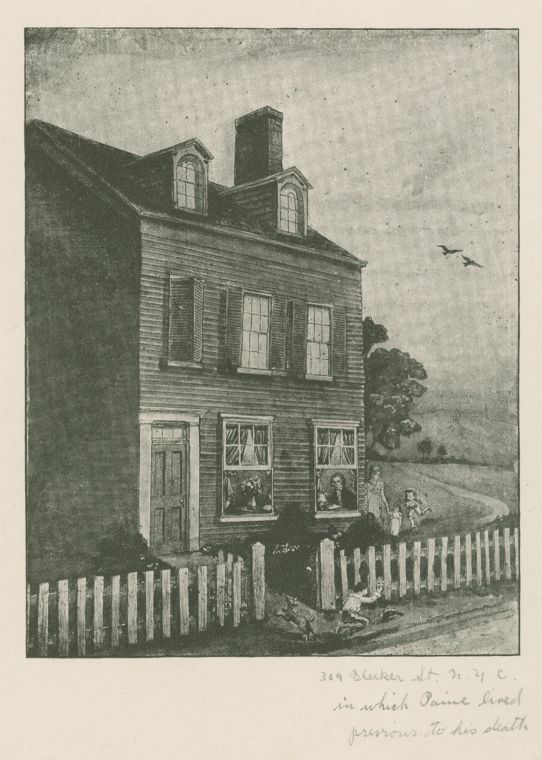
In April 1797, as Napoleon Bonaparte continued his meteoric rise, Thomas Paine made his way to 4 Rue du Théatre Français. With his knock on the door, life changed for Nicolas and Marguerite Bonneville and their very young children. Paine had grown close to the couple during the early days of the French Revolution. Now, stateless and homeless in the wake of the Committee of Public Safety’s Terror, an 11-month incarceration that almost killed him, and his long recuperation at the home of American Minister to France, James Monroe, Paine had been invited to take refuge at the Bonneville home. Madame Bonneville expected the great man to stay for a fortnight. Instead, he stayed for six years.
Surrounded by the Bonneville’s circle of writers and intellectuals—headstrong, passionate, and yet still optimistic even in the wake of so much death—Paine new companions rekindled his revolutionary spirit. The Bonnevilles were great admirers of Paine. They even named their fourthborn son, Thomas Paine Bonneville, in the great man’s honor the year after Paine arrived at their home, and asked him to serve as godfather. As Paine’s fortnight turned into months and then years, his presence as a doting, albeit eccentric, “grandfather” became the norm, while the family’s hospitality towards him—between 1797 and 1802—became the foundation of an abiding friendship.
In 1802, Nicolas Bonneville was arrested by Napoleon and his printing presses were seized just as Paine was finally preparing to return to the United States. Paine saw a way to pay the struggling Bonnevilles back for their generosity, so Madame Bonneville and three of her four boys—12-year old Louis, 5-year-old Benjamin and 4-year-old Thomas, sailed to America shortly after Paine’s return, planning to stay until Nicolas could get back onto a solid financial footing. Instead, for the next seven years in New York, this “odd couple” became a part of Paine’s sometimes eccentric orbit. Little Nicolas was too frail to travel and remained in France, while Louis, the oldest, was unhappy in New York, so arrangements were made for him to return to France and to the care of a family friend until he could be reunited with his father.
By 1808, prone to a growing litany of frailties, Paine was not the easiest person to be around. The small town of New Rochelle, 22 miles from New York, was no panacea for a happy life. There was an ill-executed attempt on Paine’s life by a disgruntled workman, and the town had infuriatingly refused to let him vote in an election, alleging that he was not an American citizen. As a result, the Paine-Bonneville “family” began spending more time in what is now Greenwich Village. Paine began facing physical struggles. A bad fall and episodes of transient ischemia made it difficult for him to hold a pen. But he was still busy trying to make the world a better place.
As Paine shuttled between a series of rooming houses, Madame Bonneville became his occasional secretary: “I …went regularly to see him twice a week; but, he said to me one day: “I am here alone, for all these people are nothing to me, day after day, week after week, month after month, and you don’t come to see me.” An aging, ailing man, who thrived on arguments in the service of great ideas, now roiled against the infirmities of old age and his confinement in lonely, shabby rooms. At the same time, the futures of the Bonneville boys weighed heavily upon Madame Bonneville. It was the central bond between Paine and her.
On June 8, 1809, Thomas Paine—physically diminished but with his mind still clear—died peacefully. With the reading of Paine’s will, the responsibilities for his burial and the execution of his estate lay on Madame Bonneville’s shoulders.
Whatever scholars may make of Paine’s feelings about Madame Bonneville, and hers about him, there can be no disputing her position as the principal beneficiary in Paine’s will. His bequest included “shares, movables, and money… for her own sole and separate use, and at her disposal, notwithstanding her coverture.” Small amounts were dispensed to old friends, including Nicolas, but the most significant chunk, including 100 acres in New Rochelle, went to Madame Bonneville: “…in trust for her children …their education and maintenance, until they come to the age of twenty-one years, in order that she may bring them well up, give them good and useful learning, and instruct them in their duty to God.”
Madame Bonneville wrote, “Paine, doubtless, considered me and my children as strangers in America. His affection for us was…great and sincere.” His generous bequest to the boys in his will proves that.
In March of 1810, Marguerite Bonneville, with Paine’s dear friend Walter Morton by her side, took a stage coach to Albany, and, associated with Paine’s estate, posted a bond of $14,000—an amount that would today be the equivalent in purchasing power of about $359,973. Paine had indeed provided for his “boys”. Thomas Paine—physically diminished but with his mind still clear—died peacefully. With the reading of Paine’s will, the responsibilities for his burial and the execution of his estate lay on Madame Bonneville’s shoulders.

What of Paine’s “Dear Boys”?
Benjamin Bonneville
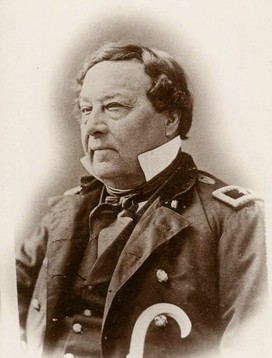
Paine loved the youngest Bonneville boys. After his death, Madame Bonneville, with a boost from Lafayette, petitioned Thomas Jefferson for a place for Benjamin at West Point. He rose to Brigadier General in the U.S. Army as well as gaining fame as an explorer of the American northwest. The Bonneville Salt Flats and the Pontiac Bonneville are named for him.
Thomas Paine Bonneville
Thomas Paine Bonneville did not fare as well. On January 1, 1812, now dropping the “Paine,” the adolescent Thomas became a midshipman in the U.S. Navy. He was awarded a sword of valor for his service during a fierce battle, but Thomas was a discipline problem. Heroism and discipline did not go hand in hand. Thomas resigned from the Navy in 1816. In November 1820, he enlisted as an Army private for a five-year tour, took a 2-month leave for illness, left on March 26, 1821, and vanished from history’s gaze.