
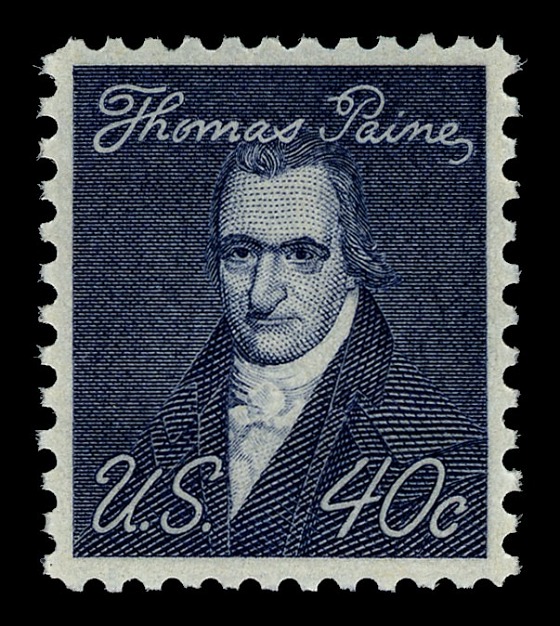
By Edmund Smith
A curious teenager sifting through my fathers small library, I opened up a cardboard-boxed book by Joseph Lewis, Inspiration and Wisdom from the Writings of Thomas Paine, signed by the author. Contained within were numerous short and longer quotes of Paine’s writings, filled with such clarity, power and sense! I felt drawn back to that book numerous times.
I came to Paine not as an academic, but as a “common man.” My life’s bent was as a naturalist, eventually a science teacher. History was a hobby for light dabbling. Always pulled toward Paine, I once asked a high school social studies department chair what he thought of Paine. He grimaced and said he despised Paine for having sought the execution of King Louis XVI, who had supported the colonies against England. I believed him and assumed I had misread Paine. Soon after, I read the truth about him in France. I was shaken that a respected history teacher could err so badly.
In time, I learned that much of Paine’s “history” is false — he was a drunk, a filthy little atheist. “He had lived long, did some good and much harm.” The true history of Paine’s treatment was worse — spat on when he returned to America, denied service, denounced in newspapers and physically accosted in the streets. Even the Quakers refused him burial privileges.
Why then did young Lincoln have a copy of Age of Reason and quote from it, causing his concerned friends to hide this fact from public view? Why was Jose Gervasio Artigas so inspired by Paine that he led the revolution that founded Uruguay? How could Robert Ingersoll and Thomas Edison come to write defenses of Paine with passion, eloquence and glowing praise?
I joined the TPNHA hoping to learn more of Paine, to discover if he wasn’t, in fact, optimis hominus. Here I learned of Paine’s anti-slave letter to Jefferson. I wondered, would there have been a Civil War if the founders listened? Would we have a prouder American history? No race massacres? No razing of Black Wall Streets? No Green Book? No impugned Black welfare mothers? No necessity for Black Lives Matter?
Here in the TPNHA, I learned that wherever Paine went, he profoundly moved the needle of progressive history. His pamphlets and books helped form modern America, England and France, earning immediate translations into other languages. That’s known. Few know about his several weeks’ sojourn in Mystic, Connecticut, with Madame Bonneville’s family. Few know he dove into the creation of the Connecticut state constitution. For me, there is no greater catalytic enzyme to accelerate progressive movements everywhere he journeyed.
I ponder what were Paine’s other achievements that we know nothing about, partly from many of his papers being lost in a fire, mostly from public rejection of him since Age of Reason was published in America.
When he wrote, “We have it in our power to begin the world over again,” what if the world had listened to his views regarding religion? Would Europe’s Christians have engaged so deeply in the Jewish Holocaust?
Would there have been the Irish “Troubles?” Would Christians, Muslims and Jews still be squabbling over shared holy acres, scattered throughout the Mideast? Would there be war in Gaza and Israel today?
Why did the world miss its chance for the equitable, sustainable and happier world that Paine envisioned? Why did our ancestors not pay heed?
Carl Sagan, a Paine admirer, wrote:
What an astonishing thing a book is. Across the millennia, an author is speaking clearly and silently inside your head, directly to you. Thus I hear Thomas Paine speaking to me. He still lives. He still wants the world to listen.
To achieve the civilization we can still have, if only we listen and take action, have we fairly named ourselves homo sapiens, wise humans? Would a better fit be homo insipiens, senseless, or homo acedians, peevish?
I joined the TPNHA because Paine still lives among us, on bookshelves, yes, but moreso here in The Beacon. There are still statues to be cast, a national monument to be built, national school curriculums to be written, and biographical movies to be made with enough drama without the slightest exaggeration.
“We — even we here — hold the power and bear the responsibility,” said Lincoln, channeling Paine when trying to save our nation. Do not both speak directly to us at this moment, as our modern American democratic government again teeters?