
The Beacon #5 May 1, 2022
By Gary Berton
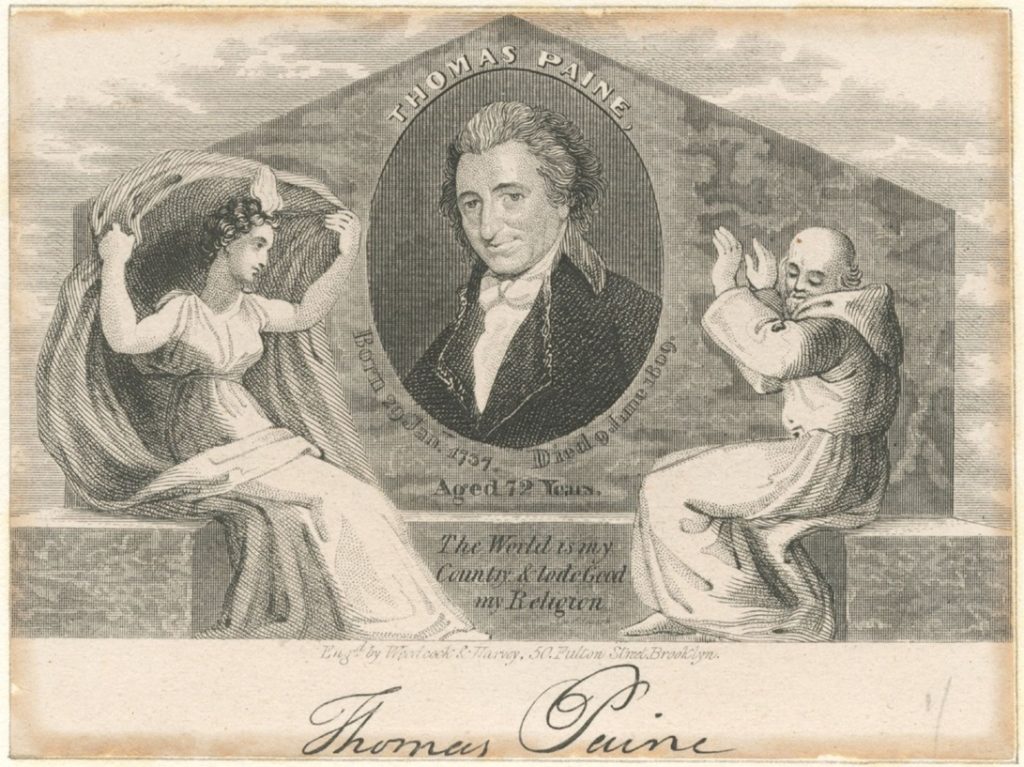
Gilbert Vale was an early supporter of Thomas Paine, first in England, then in America in the early 19th century. He was a freethought publisher and writer, and through his work he reached the freethought and progressive segments of the American people, and was able to rally them to raise the money to construct the Paine Monument. He chose to place it near the gravesite of Paine to mark his presence there, and accommodate Paine’s wish.
Vale was born in London, England, in 1788, died in Brooklyn, New York, August 17, 1866. He was educated to join the clergy, but he abandoned preparation for that profession, got involved in rebellions in England, and came to the United States in 1829, and engaged in teaching, making a specialty of navigation, and in lecturing, publishing, and literary pursuits in New York city and Brooklyn. For several years he edited the Citizen of the World and subsequently The Beacon, a literary and scientific journal, for which this Newsletter honors him. He also was an inventor, and patented a combined terrestrial globe and celestial sphere to facilitate the teaching of astronomy. Vale was a free-thinker, and wrote accordingly. He published Fanaticism, its Source and Influence (New York, 1835), and the Life of Thomas Paine, including his letters to General Washington, which were suppressed in other biographies of Paine back then (1841).
From The Truth Seeker NEW YORK, SATURDAY, JUNE 4, 1881 article “Rededication of Paine’s Monument” excerpts:
“On Monday last, Decoration day, a goodly number of the admirers of Thomas Paine, amounting to several hundreds, assembled at the monument erected to his memory near New Rochelle in 1839. The day was lovely and the meeting was in every way most pleasant. The major portion of those who went out from the city took the 10 A.M. train at the New Haven depot, and a pleasant ride of forty minutes brought us to village of New Rochelle, Westchester county. Quite a party were in waiting at the depot with numerous omnibuses and other carriages. These were soon filled, and a procession was formed which turned its face toward the monument, nearly two miles north of the station. Capt. Geo. W. Loyd, mounted on a white horse named Button [the same as one once owned by Thomas Paine], acted as marshal and escorted us to the monument.
The lot in the center of which the monument stands is some twenty feet square, surrounded by a wall laid in cement and some three or four feet high, with a tree in each corner affording an agreeable shade. The monument is of Westchester marble, of a light color, and is a straight shaft some twelve in hight, including the base and capstone and cornice of Ionic order. It is about three feet square at the base, and tapers to thirty inches or thereabouts next the cap. The whole is profusely lettered on the four sides.
Several speakers and notables were present, including future leaders of TPNHA like Thaddeus Wakeman, Samuel Putnam, D.M. Bennett, and many others. Mrs. H. Allen gave a brilliant paean:
“It will be seen by the life and writings of Thomas Paine that he was a correct thinker, a ready writer, with a heart free from guile but overflowing with benevolence; firm in purpose and untiring in pursuits, he warmly espoused the cause of liberty and human rights, and he defended his cause with such force of argument and eloquence that he bore down all opposition. With a mind as capacious as the universe, and a perception as quick as thought, he could grasp the most extensive subjects, and discover their most abstruse bearings; he could discover truth, and always espoused her cause, which was one reason why, in debate, he always put his adversary to flight. He erected a monument that will be more durable than brass, and more precious than rubies. When conquering heroes shall be forgotten; when the rich and noble of the earth shall be laid low in the dust; when the proud obelisk and triumphal arch shall molder and decay, there shall live with grateful remembrance in the hearts of his countrymen the name of Thomas Paine.”