
By Barbara Crane
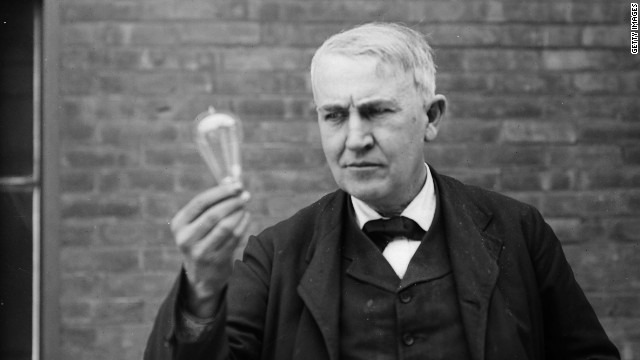
Thomas Edison, among the most famous men of the early 20th century, played a vital role in restoring the public reputation of Thomas Paine. A great admirer of Paine since his youth, Edison attended the 1925 groundbreaking ceremony for the Thomas Paine Memorial Building in New Rochelle.
Pulitzer Prize winning political biographer Edmund Morris, in his 2019 Edison, tells how Edison found Paine as a child in Michigan before the Civil War. Edison’s father, a “radical, randy, secessionist,” Morris writes, “had ‘larned’ him the complete works of Thomas Paine when he was still a newsboy on the Grand Trunk Railroad.”
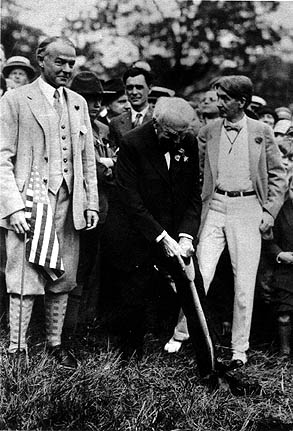
Edison’s affinity for Paine led him to befriend William van der Weyde at the Thomas Paine National Historical Association. To introduce van der Weyde’s 1925 biography, The Life and Works of Thomas Paine, he wrote:
“I have always been interested in this man. My father had a set of Tom Paine’s books on the shelf at home. I must have opened the covers about the time I was thirteen. And I can still remember the flash of enlightenment which showed from his pages. It was a revelation, indeed, to encounter his views on political and religious matters, so different from the views of many people around us….
“Many a person who could not understand Rousseau, and would be puzzled by Montesquieu, could understand Paine as an open book. He wrote with a clarity, a sharpness of outline and exactness of speech that even a schoolboy should be able to grasp….
“He has been called an atheist, but atheist he was not. Paine believed in a supreme intelligence, as representing the idea by which other men often express the name of deity….
“He conceived and designed the iron bridge and the hollow candle, the principle of the modern central draught burner. The man had a sort of universal genius. He was interested in the diversity of things.”